Wood dust and treated lumber: what you breathe and eat
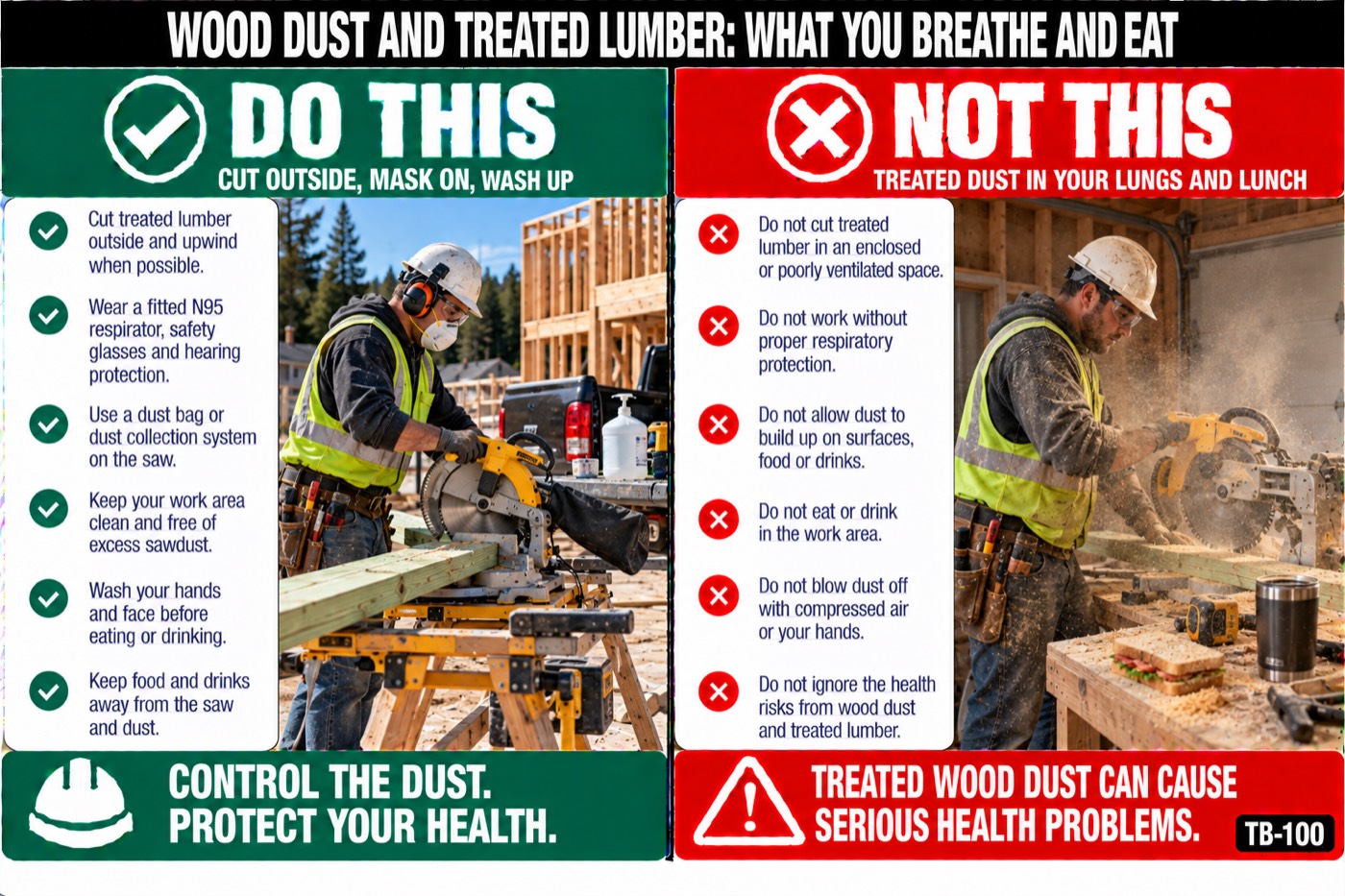
The fine dust off the saw that you cannot see is the part that reaches the bottom of your lungs and stays. Wood dust is a known cause of nasal cancer, and the dust off treated lumber has the treatment in it.
The points
- Years of sawdust in a closed garage or under a tarp gives you the cough that does not go away, the asthma from cedar, and in the worst case a cancer of the nose and sinuses. Treated lumber dust and smoke put the preservative into you.
- The rule sets a limit on dust in the air, 15 milligrams per cubic meter of total dust over a shift for dust with no rule of its own, and says engineering controls come first: cut outside, cut with the wind at your back, cut with a bag or a vac on the saw.
- Cutting treated lumber: outside, upwind, with a dust mask. An N95 that seals to your face stops the dust; a bandanna does not. Eye protection stops the chips, which come off a table saw at 100 miles an hour.
- Wash your hands and face before you eat, drink or smoke, and knock the sawdust off before you get in the truck. The treatment in the dust on your hands is not something you want in a sandwich.
- Never burn treated lumber: not in a burn pile, not in the shop stove, not in the barrel on a cold morning. The smoke carries the copper and, on older wood, the arsenic, and the ash is worse than the smoke.
Why it goes wrong
Wood dust is listed by the international cancer agency as a known human carcinogen for cancer of the nose and sinuses, mostly from hardwoods, and any wood dust irritates the lungs. Western red cedar causes asthma in people who never had it, and once you have it, you have it. Respirable dust is under 10 microns, it hangs in still air for hours, and the miter saw and the table saw make the most of it.
The limit in the 1926.55 table for particulates not otherwise regulated is 15 milligrams per cubic meter of total dust, averaged over 8 hours. The 5 milligram respirable limit is the general industry number, not the construction one. Paragraph (b) says engineering and administrative controls first, and respirators only when those cannot get there. A cut station outside with a vac on the saw is the control; a mask is what you add on top of it, and the company respirator rules apply the day you put one on.
Treated lumber sold for decks and framing since 2004 is copper based: ACQ, copper azole or micronized copper. The old green CCA lumber had arsenic and chromium in it, and it is still in the decks, fences and posts you are tearing out, and still sold for posts and marine use. Arsenic has its own standard in 1926.1118. Either way the route in is dust in the nose and dust on the hands that goes to the mouth.
Burning is the worst thing you can do with it. The arsenic in CCA goes up in the smoke and concentrates in the ash; researchers who tested ash from burned CCA wood reported that a single tablespoon can hold enough arsenic to kill someone. Copper-treated lumber smoke is bad for you too, and EPA and the treated-wood labels both say never burn it. Offcuts go in the dumpster.
Practice on this crew: the cut station is outside and upwind of the work, not under a tarp on a still day. The miter saw has a bag or a vac. Blowing sawdust off your shirt with the air hose puts it right back in the air, and the rule in 1926.302 bans compressed air for cleaning over 30 PSI anyway. Gloves for handling treated lumber; a splinter of it gets infected fast, and the rash on your forearms is the treatment.
Questions for the crew
- Where is the cut station today, and which way is the wind?
- Who is cutting treated lumber today, and what is on their face?
- Where do the treated offcuts go at the end of the day?
To close
Today the cut station goes outside and upwind, treated offcuts go in the dumpster and never in a fire, and everybody washes before lunch.
To hold this talk with your crew
1
Read it aloud. Five minutes, before the work starts.
2
Ask the questions. A crew that talks is a crew that remembers.
3
Have them sign on their own phones, and the record is sealed.