The stairwell opening: a 2x4 on two nails is not a rail
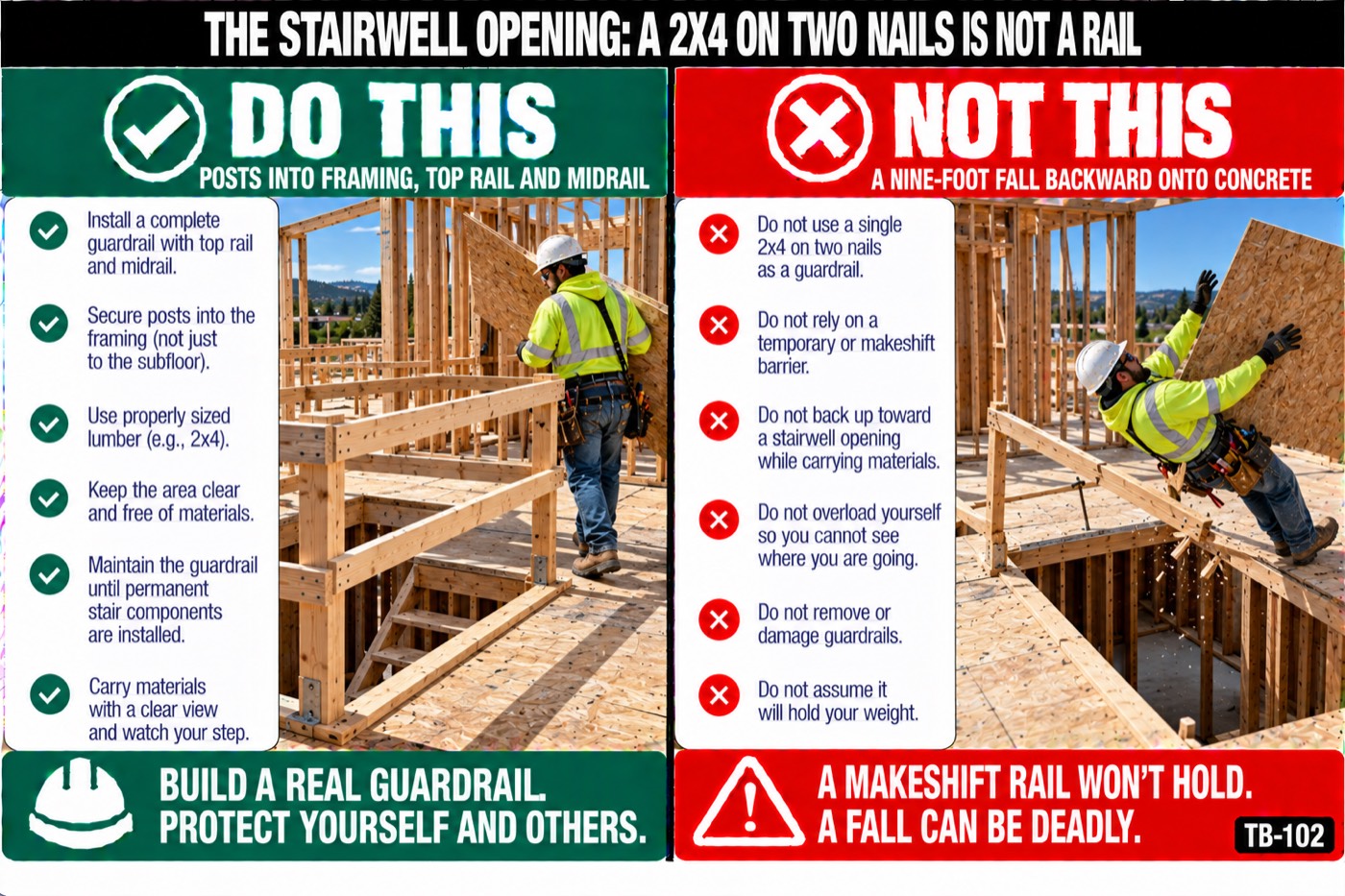
A guardrail has to take 200 pounds pushed against the top rail without giving. A 2x4 on two nails gives at about the weight of a person leaning on it, and the stairwell it is guarding is a 9-foot drop onto the basement slab.
The points
- The stairwell is the biggest hole in the house and the one everyone walks past all day carrying something. The fall is 8 to 10 feet onto concrete, backward, with a sheet in your hands.
- From the day the floor goes down to the day the finished rail goes in, the opening has a guardrail: top rail at 42 inches, give or take 3, a midrail halfway, a top rail built to take a 200-pound push without breaking or dropping below 39 inches, and a midrail built to take 150.
- That means posts nailed into framing with at least three 16d nails, or bolted, and a rail fastened to every post. A 2x4 on two nails, a strip of caution tape or a sawhorse across the opening is not a guardrail.
- The temporary stairs get their rail the day they go in, not when the drywall is done. Any stairs with four or more risers have a stairrail, and the open side of every landing has a guardrail.
- The rail that comes off for the tub or the cabinets goes back on the same hour, by the person who took it off. A rail off for five minutes is someone's job, and someone stands at the opening while it is off.
Why it goes wrong
The criteria are in 1926.502(b): top rail 42 inches plus or minus 3 above the walking surface, a midrail between the top rail and the floor when there is no wall at least 21 inches high, and a top rail that takes a 200-pound force applied within 2 inches of the top edge without failing, and without deflecting below 39 inches. The duty to have it comes from 1926.501: holes at 6 feet and residential construction at 6 feet. Stairs with four or more risers get a stairrail under 1926.1052.
Here is why the 2x4 on two nails fails. A 16d nail in spruce pulls out at somewhere around 30 to 50 pounds in withdrawal and carries about 100 pounds in shear before the wood crushes and it bends. A person stumbling into a rail at walking speed puts several hundred pounds on it for a moment. Two nails, one at each end, and the rail rotates on them and drops.
Build it like it matters: 2x4 posts to the rim or a joist with three 16d nails in shear or a pair of lag screws, posts no more than 8 feet apart, and the rail on the inside face of the posts so a push drives it into the post instead of off the nails. Nail the midrail the same way. Where people will work below, add a toeboard; a hammer off the edge lands on the head of whoever is on the basement stairs.
The timing is the whole point. Floor sheathed and the opening framed: rail the same day. Temporary stairs set: stairrail the same day, on the open side, with the landing railed. The finish rail may be three weeks out, and in those three weeks the plumbers, the electricians and the drywall crew all walk past that hole. Whoever controls the site owns that gap, whichever company's people are on the floor.
The rail comes off to hoist drywall, the tub and the cabinets through the opening, and that is when the falls happen. The person who takes it off puts it back before they leave the opening, and while it is off, a person stands there and nobody backs toward it. A cover over the stairwell is the alternative, secured and marked, but a cover gets pulled to bring things up, and a rail does not.
Questions for the crew
- What is around the stairwell opening right now, and would it take 200 pounds?
- Who takes the rail off to bring material up today, and who puts it back?
- Do the temporary stairs have a rail, and on which side?
To close
By the end of today the stairwell has a rail with posts into framing and a midrail, and it does not come off without someone standing there.
To hold this talk with your crew
1
Read it aloud. Five minutes, before the work starts.
2
Ask the questions. A crew that talks is a crew that remembers.
3
Have them sign on their own phones, and the record is sealed.