Nails in scrap and the cord across the subfloor
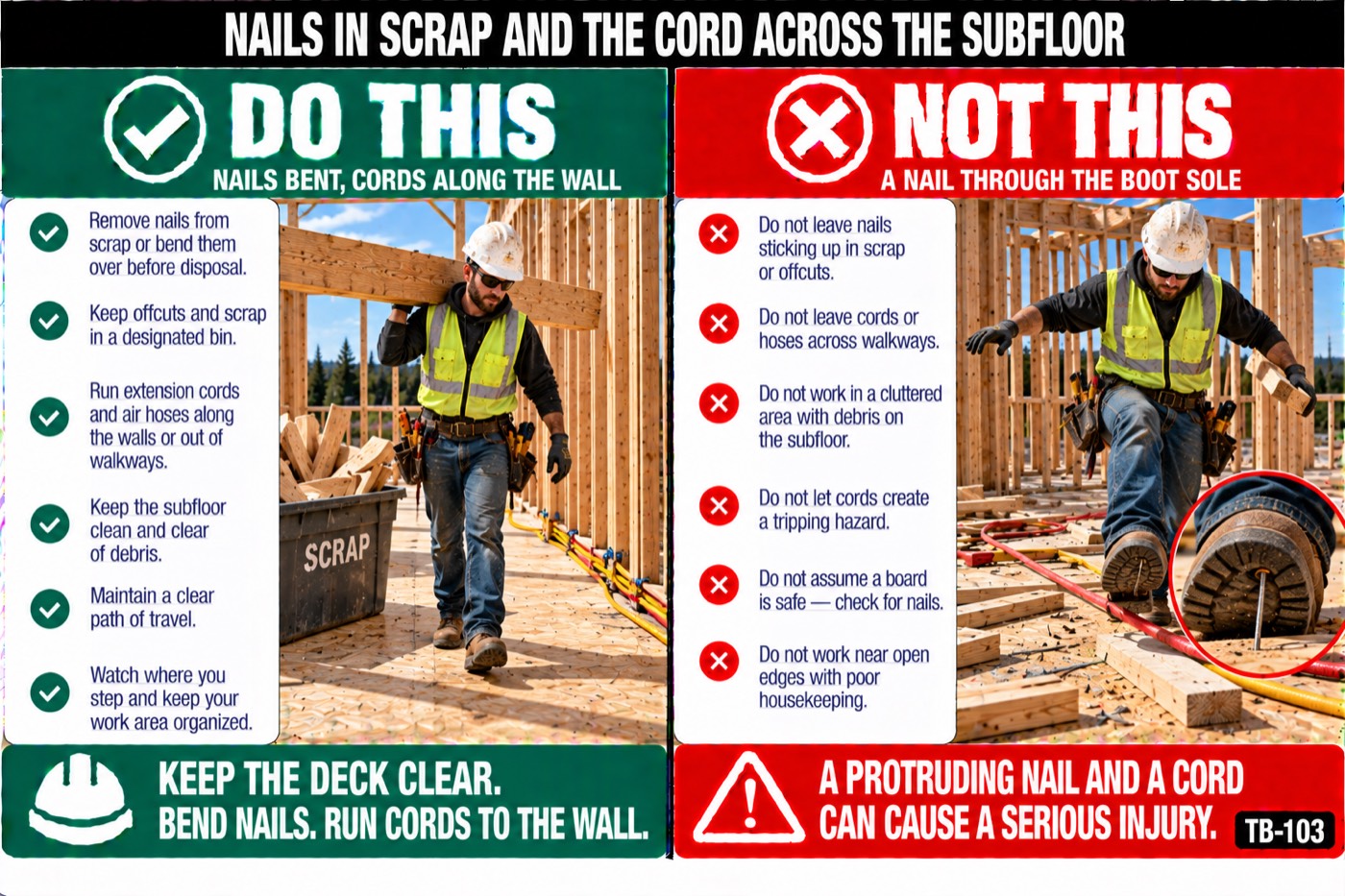
A 16d nail sticking out of a block goes through a boot sole and an inch into the foot. It has been the same injury since the rule was written, which is why the rule names it: scrap lumber with protruding nails gets cleared.
The points
- A framing site hurts people from the ground up: a nail through the foot from a block, a fall over a cord or an offcut rolling underfoot at the edge, a stack that shifts and takes an ankle. None of them is a fall from height, and every one costs a week or more.
- The rule: scrap and form lumber with nails sticking out, and all other debris, is kept cleared from work areas, walkways and stairs. Not at the end of the day. During the work.
- Blocks and offcuts go in the scrap pile or the dumpster as they are made, not kicked to the side. Bend or pull the nails in anything you drop, and never leave a block nail-up on the deck.
- Cords and hoses run along the walls, not across the paths, and never across the leading edge or down the stairs. A cord across the subfloor is the trip that takes you off the edge or into the saw.
- Stacks of lumber and sheathing sit flat on dunnage, banded or low, over joists that can carry them and never against a braced wall. A stack you have to climb over is a stack in the wrong place.
Why it goes wrong
The nail through the sole goes into the arch, carrying rust, dirt and whatever was in the boot. That is a tetanus shot, a deep infection that can reach the bone, and a week or two off at the least. It is the block that was dropped nail-up and then covered by sawdust. The rule in 1926.25(a) names it exactly: form and scrap lumber with protruding nails, and all other debris, kept cleared from work areas, passageways and stairs. Puncture-resistant insoles help; a clean deck helps more.
Offcuts roll. A piece of 2x4 on a sheathed deck rolls under a boot like a log, and at the leading edge that puts you over. You cannot see your feet with a sheet in your hands. Sawdust on a pitched roof deck is the same as ice. The cord in the path is the one you back over stepping away from the saw with a board in your hands.
Twenty sheets of 3/4 subfloor is about 1,400 pounds on a few square feet. Put a stack across the joists near a bearing wall, not mid-span, and not on the cantilever. A lumber pile leaned against a braced wall is a load the braces were never sized for. Pull from the top of a stack, not the middle, and keep the bands on until you need the material.
The fire side of the rule, 1926.25(b), says combustible scrap is removed at regular intervals. Sawdust and offcuts next to a torch, a heater or the cut station is a fire that starts in the afternoon and is found in the morning. The scrap goes in a dumpster or trailer, not in a pile against the house.
Five minutes at every break: blocks off the deck, nails bent in anything going in the pile, cords back along the wall, the cut station swept. Put the dumpster where the throw is short, and only throw scrap over the edge into a marked zone with nobody below. The temporary stairs and the walkway across the foundation get the same treatment; a tread with an offcut on it is a fall on stairs.
Questions for the crew
- Where does scrap go on this site today, and how far is the throw?
- Where are the cords and hoses running right now, and which path do they cross?
- What is stacked on this deck, where, and what is it sitting on?
To close
Today every block gets its nails bent before it hits the deck, and the cords are back along the wall by the first break.
To hold this talk with your crew
1
Read it aloud. Five minutes, before the work starts.
2
Ask the questions. A crew that talks is a crew that remembers.
3
Have them sign on their own phones, and the record is sealed.