Carrying modules: a glass sail on a pitched roof
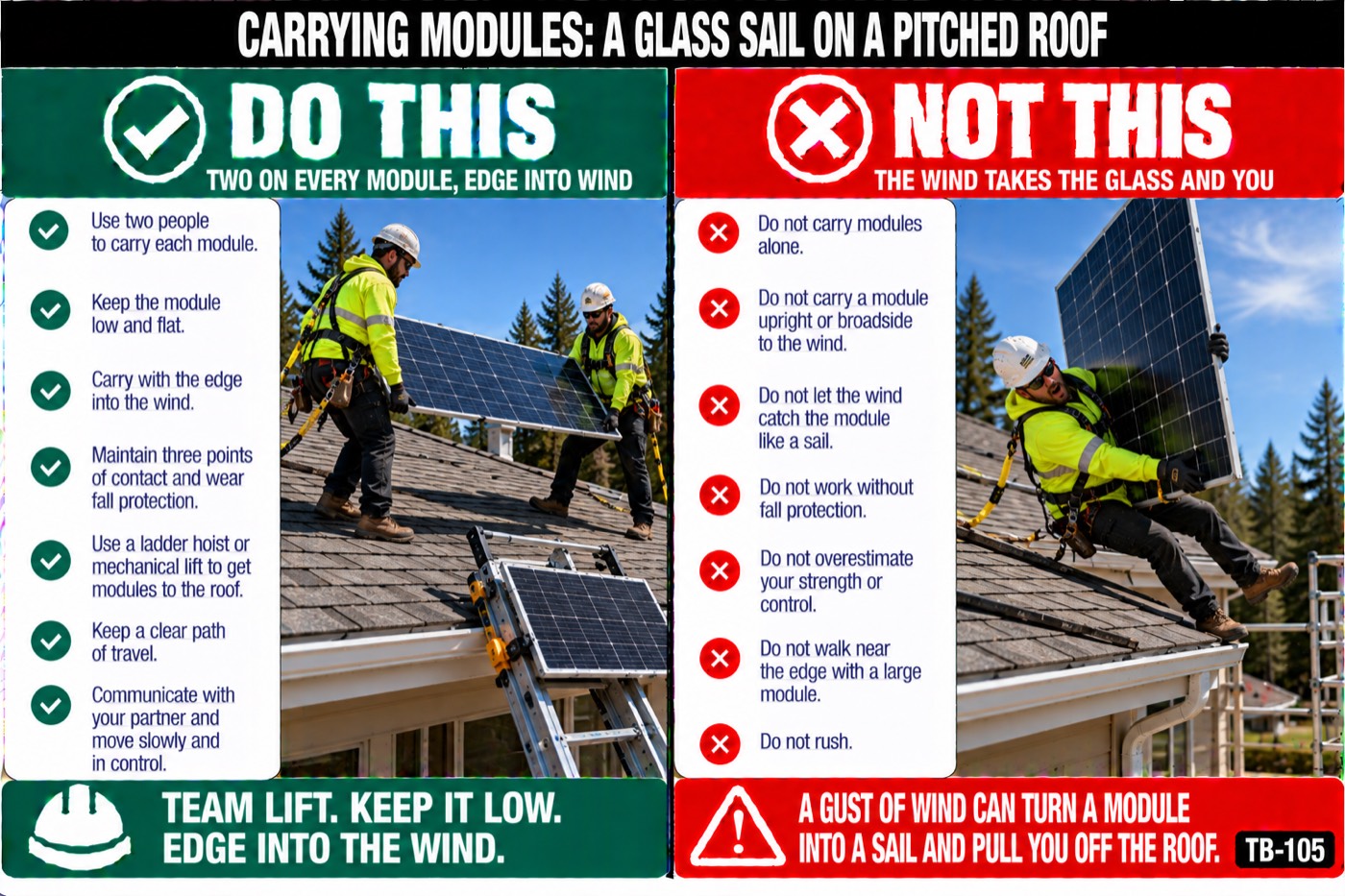
A module is a sheet of glass about three and a half feet by seven, and the big ones weigh 70 to 90 pounds. In a 25 mph gust the wind pushes on it with about 40 pounds. That is a sail, and you are the mast.
The points
- A worker who lets go of a module in wind on a 6:12 pitch either follows it off the eave or gets cut by it when it breaks. Both have happened on ordinary residential jobs.
- Two people carry every module on the roof. Nobody carries one up a ladder, ever; the rule says you carry nothing that could make you lose your balance, and a module always can.
- Modules go up on a ladder hoist, a lift, or a conveyor, and they come off the hoist to two sets of hands standing on something solid.
- Sustained wind over 20 mph or gusts you cannot predict stop module carrying. Racking and wiring can go on; the glass stays stacked and strapped.
- Carry it flat to the roof and low, edge into the wind, and set it on the rails before anyone lets go. Never turn it broadside to a gust.
Why it goes wrong
Wind load on a flat surface runs about 1 pound per square foot at 20 mph, 1.6 at 25, and 2.3 at 30. A module has 20 to 30 square feet of face. So a 25 mph gust broadside puts 40 to 50 pounds of sideways push on a person already holding 70 pounds of glass on a slope. You cannot hold that and stay on your feet.
Tempered module glass does not chip; it shatters into thousands of pieces the size of a fingernail. A module that hits a rail corner or a roof jack breaks in your hands, the aluminum frame is now a loose bar, and the glass goes down the roof and off the eave onto whoever is below.
A ladder is for a person and a tool belt. One hand for the ladder at all times, and no load that can pull you off balance. A 45 pound residential module carried up a ladder in any breeze fails both tests. Rent the ladder hoist or hand the modules up from a lift; the hoist costs less for a day than the ambulance.
At the top of the hoist is where people get hurt. The person receiving is at the eave, reaching out, often bent over the edge. That person is tied off before the first module comes up, standing on a set foot, and takes the module from the carriage only after it has stopped.
The two person carry works when both people go the same direction at the same speed and agree who calls it. Long edge parallel to the slope, module low against the legs, the uphill person leading. Set it on the rails, both hands still on it, then say it is down. Only then does anyone let go.
Wind cut-off is a decision the foreman makes before the first module goes up, not after one gets away. Look at the forecast and at the trees. Afternoons on open sites get worse, so stage the module work for the morning and the connector and racking work for later.
Questions for the crew
- What is the wind doing right now and what is the forecast for this afternoon?
- How are modules getting up to this roof today, and who is receiving at the top?
- Where does a module end up if it gets away on this pitch, and who is standing there?
To close
Every module on this roof today goes up on the hoist and moves with two people on it, and if the gusts start we stop carrying glass.
To hold this talk with your crew
1
Read it aloud. Five minutes, before the work starts.
2
Ask the questions. A crew that talks is a crew that remembers.
3
Have them sign on their own phones, and the record is sealed.