DC connectors: the arc that does not stop
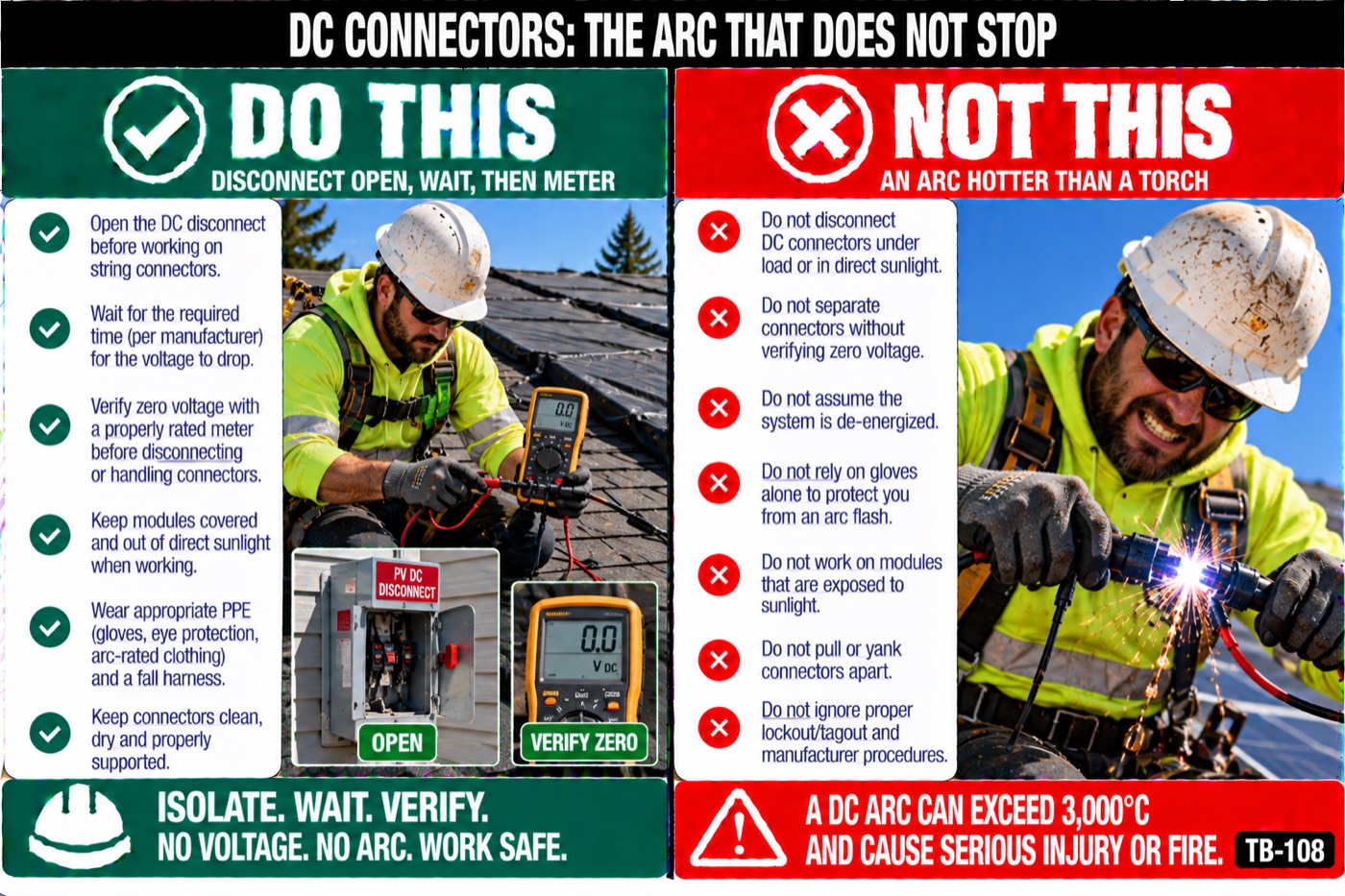
Pull an MC4 apart with 10 amps flowing at 600 volts and you draw an arc hotter than a cutting torch, and it stays lit. The connector is printed with do not disconnect under load for that reason.
The points
- A DC arc at string voltage burns at several thousand degrees, will not go out on its own, and puts molten copper and plastic into the hand that opened it. Burned connectors are also how array fires start months later.
- Never open a connector under load. Shut the inverter down, open the DC disconnect, wait for the rapid shutdown to bring the array conductors down, and then measure before you unplug.
- Mate only matching connectors from the same maker, pushed until they click, and give each one a pull. A half-mated connector is a high-resistance joint that heats every sunny afternoon.
- Crimps are made with the maker's crimp tool on the right gauge wire, and a crimp you can pull off with your hands goes in the trash. Pliers are not a crimp tool.
- Listed equipment gets installed the way the listing says. That is the rule, and on connectors it is also the difference between a joint that lasts 25 years and one that burns.
Why it goes wrong
Alternating current arcs get 120 chances a second to go out when the current crosses zero. Direct current gets none. Once a gap is ionized at 600 volts DC, current keeps flowing across it and the arc lengthens as the contacts separate, easily an inch or two, until something melts far enough apart. The person pulling the connector holds one end of that.
A rapid shutdown system, required on rooftop arrays since the 2014 NEC, in its current form since the 2017 NEC, and the code the inspector will check, brings conductors outside the array boundary to 30 volts or less within 30 seconds of shutdown, and conductors inside the array to 80 volts. It does not make the module leads dead. A module-level device can fail, and 80 volts DC across wet gloves is still a shock. Test after shutdown; do not assume.
MC4 is a shape, not a standard. Connectors from different makers look alike and will often push together, but the contact pressure, the seal and the plastic are different, and the listing does not cover the mix. Cross-mated connectors are one of the leading causes of rooftop PV fires. The module leads tell you the maker; buy the field connectors to match.
A proper crimp is a cold weld. The maker's tool sizes the barrel to the wire and closes it fully; the connector then clicks together and holds against a firm pull. Use pliers or the wrong die, and the joint has a fraction of the contact area, heats under 10 amps, oxidizes, heats more, and eventually arcs inside the housing. That is the burned connector found on a service call.
Wire management is part of connector safety. Cable resting on a shingle or a hot metal roof abrades, and cable hanging in a loop below the module catches ice and animals. Clip cables to the frame or rail, keep connectors up off the roof surface, and leave a drip loop so water runs off before it reaches the seal.
The common mistake is disconnecting a string at the roof because the inverter reads zero. The inverter reading zero means the inverter is off. The string is at full open circuit voltage and, if there is a fault to ground somewhere, is a live circuit through the racking. Open the disconnect, wait, measure at the string ends, then work.
Questions for the crew
- What connector brand is on these modules, and what is in the box of field connectors?
- Who has the crimp tool for this wire gauge, and who checked it?
- After shutdown, what voltage should we read at the string ends here, and who is reading it?
To close
Nobody unplugs a connector on this array today without the DC disconnect open, the wait, and a meter reading first.
To hold this talk with your crew
1
Read it aloud. Five minutes, before the work starts.
2
Ask the questions. A crew that talks is a crew that remembers.
3
Have them sign on their own phones, and the record is sealed.