Battery storage: a fire you cannot put out
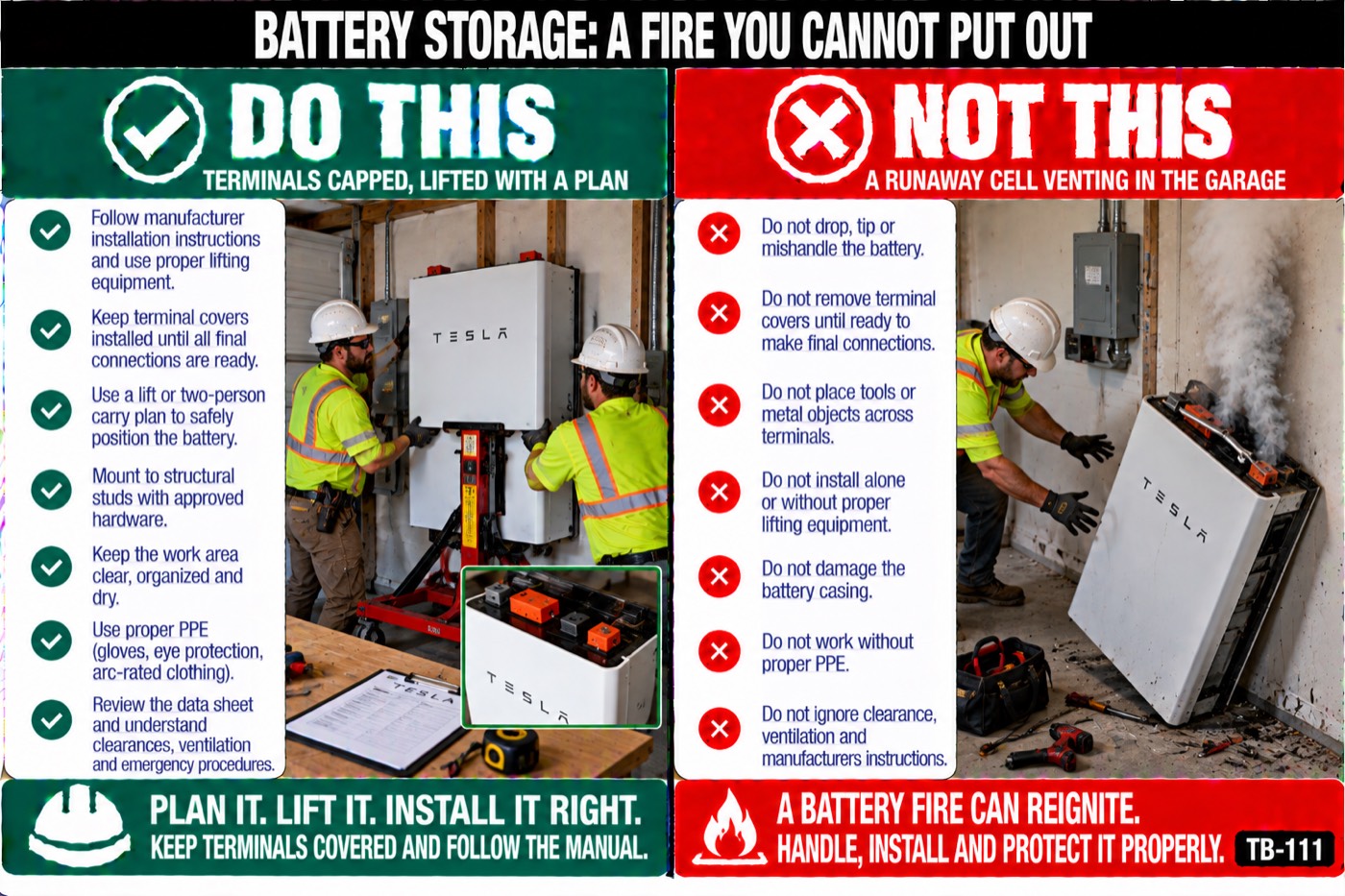
A lithium battery in thermal runaway makes its own oxygen. You cannot smother it, a garage extinguisher does nothing, and it can reignite hours after the fire department leaves.
The points
- A punctured or shorted lithium cell heats itself past about 300 °F, vents hydrogen, carbon monoxide and hydrogen fluoride, and spreads to the next cell. Breathing that gas in a closed garage is the injury that happens before the fire.
- A wall-mounted residential unit weighs 250 to 350 pounds. It goes up with a lift or the maker's mounting jig and enough people, and it is fastened to structure, never to drywall.
- Terminals stay capped until the last step. A 48 volt battery can push thousands of amps into a wrench across its posts; the wrench welds and the battery starts heating.
- The listing sets the clearances, the spacing between units and the rooms it can go in. If the drawing puts it somewhere the listing does not allow, stop and get the drawing changed.
- Read the safety data sheet before you unbox the first unit, and keep it in the truck. It tells you what comes out of the cell and what to do if it starts venting.
Why it goes wrong
Thermal runaway starts when a cell's internal temperature climbs past the point where the electrolyte and cathode begin to break down on their own, roughly 300 °F for common chemistries and higher for lithium iron phosphate, which is what most residential units now use. The reaction makes heat faster than the cell can lose it, and the cell vents flammable gas at high pressure. That gas is what ignites, and that is why a venting battery with no flame yet is still an evacuation.
The rule on batteries in construction is written for lead-acid: ventilation to prevent an explosive mixture, racks that hold the weight, protective equipment for handling, and eyewash within 25 feet. Lithium units are sealed and give off nothing in normal use, but the ventilation and weight points carry straight over, and hydrogen fluoride from a venting cell is a chemical burn to eyes and lungs. The safety data sheet is the document that covers the chemistry you actually have.
A cell damaged in shipping can go into runaway days later. A dented case, a unit that was dropped off the tailgate, or a battery that reads a different voltage from its label goes back to the supplier and does not get installed. Photograph it, leave it outdoors away from the house and vehicles, and do not put it back in the truck.
The residential code the inspector uses limits unit size and total capacity in a garage, keeps units 3 feet from each other unless the listing allows closer, keeps them out of sleeping rooms, and requires impact protection where a car can hit them. Nothing about these rules is about performance; they exist so a fire in one unit stays in one unit long enough for people to leave.
Weight is the routine injury. A 300 pound flat unit going onto a wall bracket 3 feet up wants four people or a lift, and the moment it hangs on the bracket is when hands are between it and the wall. Fasten the bracket into studs with the specified lag bolts, check it with a level and a pull, and only then bring the battery to it.
If a unit starts venting during installation, everyone leaves the room, the doors are opened from outside if that can be done without going back in, and 911 is called and told it is a lithium battery. Do not spray it with a handheld extinguisher, do not try to move it, and do not go back for tools. Firefighters cool these with hundreds of gallons of water, and they need to know what they are walking into.
Questions for the crew
- What chemistry is this battery, and where is the safety data sheet right now?
- How is this unit getting onto the wall, and how many hands does that take?
- If it starts to vent in that garage, which way does everyone go and who calls it in?
To close
Every unit on this job gets inspected for damage before it comes off the pallet, and nobody lifts one without the plan for the weight.
To hold this talk with your crew
1
Read it aloud. Five minutes, before the work starts.
2
Ask the questions. A crew that talks is a crew that remembers.
3
Have them sign on their own phones, and the record is sealed.