Black array: 150 °F glass and the sunburn
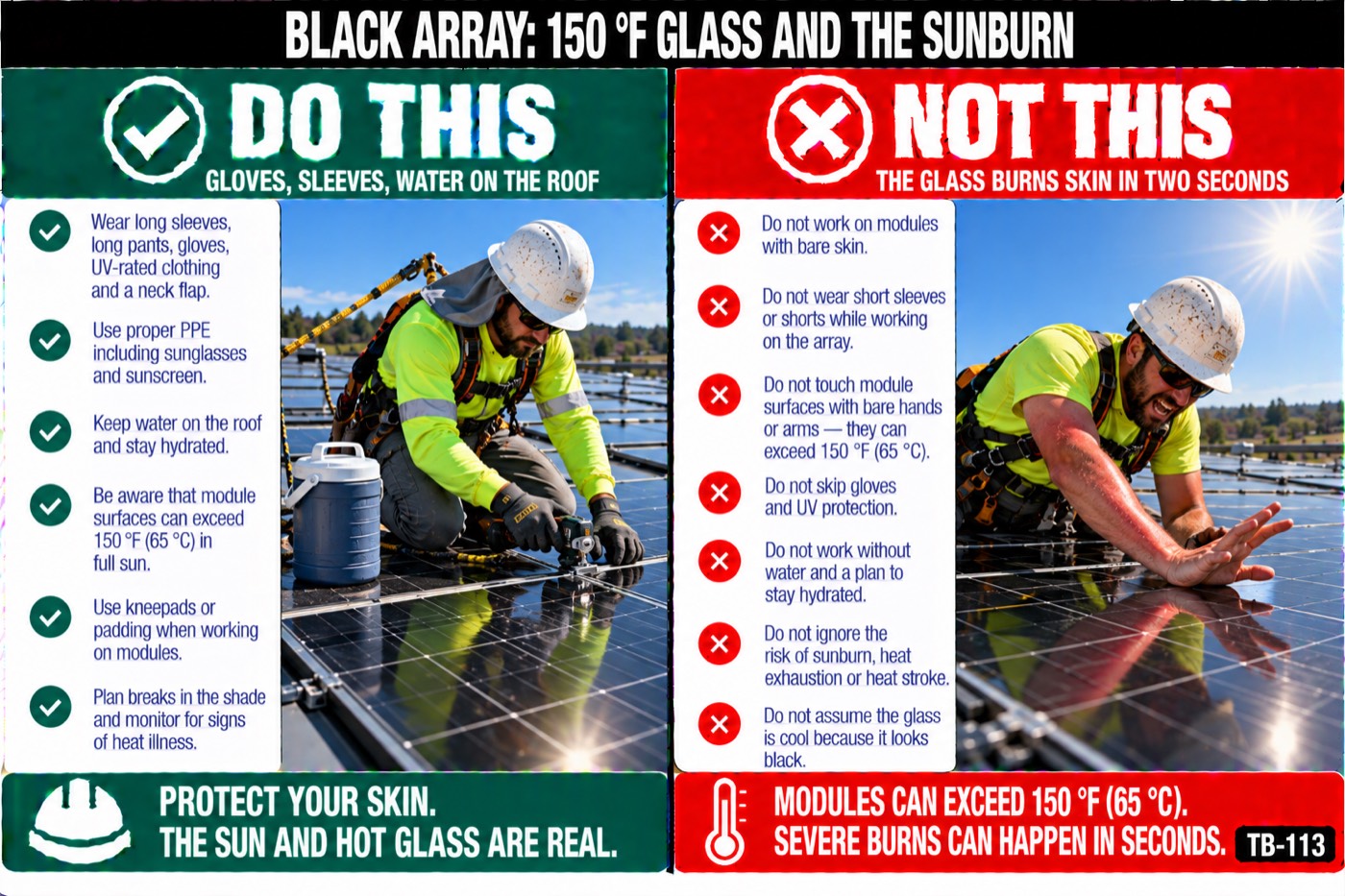
On a 95 °F day the glass on a module reads 150 to 170 °F. Skin burns in about two seconds at 150. You are kneeling on it, leaning on it, and setting your hands on it all day.
The points
- On a hot day module glass runs 140 to 180 °F, and glass that hot burns skin that stays on it: a knee, a forearm resting on the frame, a hand bracing on the panel. The black roof under the array heats the air you are breathing too.
- Gloves stay on when handling modules in sun, and long sleeves are for the glass as much as the sun. A wet rag on the module you are working on takes some of the heat out of the glass.
- The array reflects light up. Sunglasses rated for UV, a brim, and something covering the back of the neck. The burn on the neck and under the chin comes from below.
- A cup of water every 15 to 20 minutes, before you are thirsty, and the water is on the roof, not in the truck. Nobody goes an hour on the array without drinking.
- When the ambient tops 90 °F, module work rotates in and out of shade on a schedule the foreman sets, and anyone who stops sweating or gets confused comes down now.
Why it goes wrong
A module in full sun runs roughly 45 to 85 °F above the air because it is a dark glass sheet designed to absorb light, and only about a fifth of that energy leaves as electricity. It runs coolest on an open ground rack and hottest mounted close to a roof, with no airflow behind it. On a 95 °F day that puts the glass between about 140 and 180 °F. The hot-surface burn standard puts the line for glass at 133 °F for a minute of contact and 118 °F for ten minutes. Your knee on a module is in contact longer than that.
The rule makes the employer responsible for requiring the protective equipment appropriate to the exposure, and on an array in summer that means gloves, sleeves, UV eye protection and a neck cover, along with the hard hat brim. This is not comfort equipment. A crew that works bare-armed on hot modules has burns by the second week and skin cancer by middle age.
Glare from an array is a second sun from below. Module glass is anti-reflective, but at low sun angles it still throws a large fraction of the light up into your face, and the UV comes with it. The classic solar burn is under the chin, inside the nostrils, and on the back of the neck under the hard hat, all places a brim does nothing for. Sunscreen there, reapplied at lunch.
Dehydration is the real productivity problem on an array. Sweat loss on a hot roof runs a quart an hour or more, and thirst lags loss by about 2 percent of body weight, which is already enough to slow thinking and balance. Set a schedule: everyone drinks a cup every 15 to 20 minutes, and a jug goes up with the first module.
Heat illness runs from cramps to exhaustion to stroke, and the change from the second to the third is a person who stops sweating, gets confused, or stumbles. That is a call to 911 and cooling with water and shade immediately, not a break in the truck with the air conditioning. A body temperature over 104 °F is damaging organs while you wait.
The common mistake is scheduling the array work for midday because that is when the sun makes the strings easy to test. Test at midday if you must, but do the kneeling, carrying and clamping in the morning. A 6 a.m. start on a summer array finishes the module work before the glass reaches its worst.
Questions for the crew
- What is the forecast high today and what does that make the module surface?
- Where is the water on the roof, and who is watching the clock for the drink schedule?
- Who on this crew has had heat trouble before, and what does the rotation look like this afternoon?
To close
Gloves, sleeves and neck cover on the array today, water on the roof before the first module, and anyone who stops sweating comes down.
To hold this talk with your crew
1
Read it aloud. Five minutes, before the work starts.
2
Ask the questions. A crew that talks is a crew that remembers.
3
Have them sign on their own phones, and the record is sealed.