Rollers: the drum slides on a fresh mat
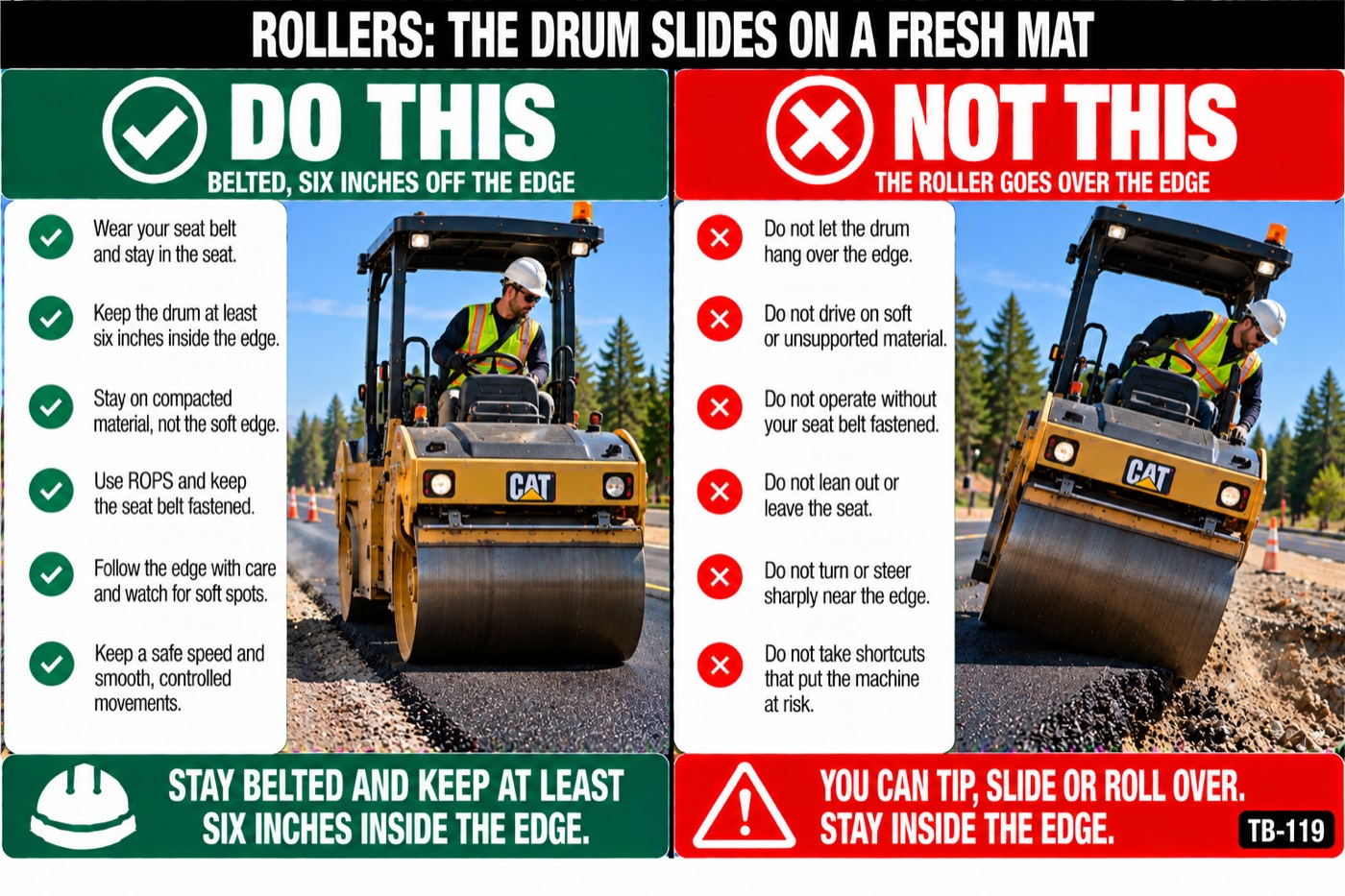
A roller has a high, heavy drum and a short wheelbase. Put it on a fresh mat at 280 °F next to an unsupported edge with a three-foot drop, and it is one of the easiest machines on the job to roll over, and one of the heaviest things that can land on you.
The points
- A roller that goes over the edge of a lift or down a shoulder lands on the operator if they are not belted in the seat, ROPS or no ROPS. A ROPS with an operator thrown out of the seat is a cage protecting nobody.
- Compactors built after July 15, 2019 are covered by the rollover protective structure rules in 1926.1000, and the machine's manual requires the seat belt with the ROPS. The belt is what keeps you inside the space the ROPS protects. Buckle it every time you sit down.
- The unsupported edge of a mat is soft, hot, and has nothing under it. On the first pass keep the drum 6 inches inside that edge, and only overhang the edge once the mat has taken a pass and stiffened.
- Cross-slopes and superelevations are where rollers slide. A steel drum on hot mix at a 4 percent cross-slope has less grip than you think, and a vibrating drum has less than a static one. Vibration off when you turn on a slope and near edges.
- Climb on and off with three points of contact, and park it on the level, drums on cooled mat or off the mat, brake set. A roller that rolls away on a grade does not stop for a cone.
Why it goes wrong
The hazard is geometry. A tandem roller carries most of its weight in two smooth drums with a narrow footprint and a center of gravity that sits higher than a truck's. When a drum drops off a lift edge or a shoulder, the machine tips around that drum and the operator's platform swings out over the drop. On a 3-foot embankment the roll takes about a second. Nobody jumps clear of that.
1926.1000 covers rollover protective structures for the listed equipment and, for compactors manufactured after July 15, 2019, it covers rollers. Older machines may or may not have a ROPS. If the roller has one, the belt is required with it. The ROPS is designed on the assumption the operator stays inside its envelope. Roller operators crushed under ROPS machines are usually found outside the seat.
Fresh mat is not ground. At 250 to 300 °F it is a plastic layer 2 to 4 inches thick on top of whatever is underneath. The outside edge has no confinement, so the first pass close to it pushes mix outward and down and the drum follows. The practice is to stay 6 inches inside on the first pass and to come back and roll the edge once the mat has cooled enough to hold it.
A hot mat on a slope is a slick surface. Water spray on the drums, needed to stop pickup, makes it slicker. On a superelevated curve or a steep crown the low-side drum can start to slide sideways under vibration, and the operator's first instinct, steering uphill, does nothing because the drum is not gripping. Static passes on slopes, slower, with the drum's leading edge pointed slightly uphill.
Rollers slide backward, too. On a grade, stop the machine and set the brake before turning around to look behind. A roller with the propulsion lever centered on a 6 percent grade will creep. The roller that killed a laborer at the bottom of a ramp was parked with the lever in neutral and the brake off.
Seat belts are also the rule for anyone who rides the machine, and on a roller that means the operator only. No riders on the platform, no passenger perched on the fender. The ROPS and belt protect the seat, and only the seat.
Questions for the crew
- Which rollers on this job have a ROPS and a working seat belt, and which do not?
- Where on today's pull is the unsupported edge, the drop, or the cross-slope that the roller operator needs to plan for?
- Where is the roller going to park when it is not on the mat, and is that spot level?
To close
Today the roller operator is belted every time the seat is occupied, and the first pass stays 6 inches inside every unsupported edge.
To hold this talk with your crew
1
Read it aloud. Five minutes, before the work starts.
2
Ask the questions. A crew that talks is a crew that remembers.
3
Have them sign on their own phones, and the record is sealed.