Haul trucks at the hopper: the raised bed and the wire
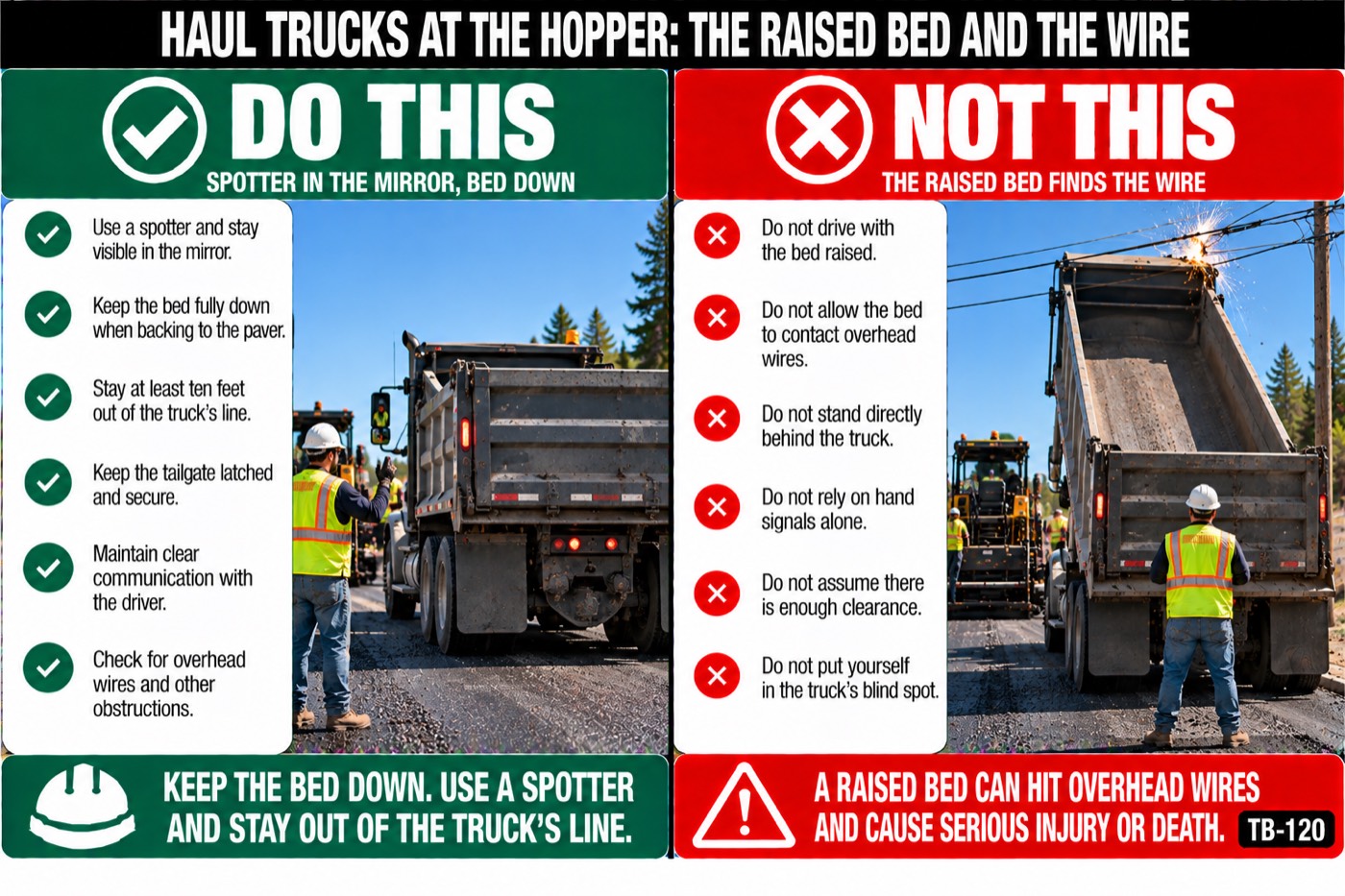
A loaded tandem dump carries about 40,000 pounds of mix and backs to the paver 30 or 40 times a shift with its mirrors full of hopper. The driver cannot see the person waving them in if that person is behind the tailgate.
The points
- The truck backs over the spotter, or the tailgate swings open on the spotter, or the raised bed pulls into a 12-kV line and the driver steps out of an energized truck. Each of those has killed paving hands, and each one happens at the hopper.
- 1926.601 says a vehicle with an obstructed view to the rear does not back up unless it has an audible reverse alarm or an observer signals it is safe. On a paving job the alarm is buried under the paver and the roller, so the observer is the control. That person stands to the side, never behind.
- The spotter stands on the driver's side, in the mirror, 10 feet off the truck's line, and gives the stop signal early. If the driver loses the spotter in the mirror, the driver stops. That is the deal, and every driver on this job hears it before their first load.
- Tailgate: latched until the truck is bumped up to the push rollers, and nobody stands in the swing of the gate while it is released. The bed goes up only when the driver has looked up. A bed at full lift is about 20 feet in the air and a line over a road can be 18.
- The bed comes down before the truck moves. Pulling away with the bed raised takes down the wire, tips the truck when the mix hangs in the front, or rips the hopper. Driver checks the bed indicator, then the mirror, then rolls.
Why it goes wrong
Backing is where haul trucks kill on a paving job. The driver has a mirror on each side and a bed behind them. The paver's push rollers are what the truck is aiming for, and the driver is judging that through a mirror while a person stands somewhere near the tailgate. If that person is directly behind the truck, they are invisible. The observer rule in 1926.601 only works if the observer is where the mirror can see.
The spotter is not there to help the truck line up. The spotter is there to stop it. Clear signal from the side, eye contact in the mirror, and a stop signal given 10 feet early rather than at the bumper. Nobody else gives the driver signals. Two people waving is how a driver hits the paver, or the second waver.
The tailgate on a dump carries a few hundred pounds of steel on two pivots and a latch, and when it is released with a load against it, it swings out hard. The person who trips the latch stands at the side of the truck, never behind the gate. On trucks with a chained gate, the chains get checked at the walk-around, because a gate that drops on the hopper wings takes the screed hand with it.
Overhead lines are the haul truck hazard that people forget because it is not at the hopper. A dump body at full lift reaches about 20 feet. Distribution lines along a residential street are often 18 to 25 feet up, and service drops to houses can be lower. The driver looks up before the bed goes up, and the crew has already walked the pull that morning and flagged every crossing. If the bed touches a wire, the driver stays in the cab and everyone stays back until the utility clears it.
Pulling away with the bed raised is the most common truck-and-paver damage there is and it is a rollover risk. Mix that sticks in the front of the bed on a cold morning leaves the load high, and a truck moving with a bed up and 10,000 pounds hung at the top is unstable on any cross-slope. Bed down, then move. Some crews put it on a hand signal from the spotter: bed down, thumbs up, then the truck rolls.
Trucks with dump bodies also need the body prop, permanently attached, in place any time someone is under a raised bed for cleaning or inspection. Hydraulic pressure alone is not a support. A bed that drifts down on a person cleaning the hinge is the same injury as a car falling off a jack.
Questions for the crew
- Who is the spotter at the hopper today, and where exactly are they standing when a truck backs in?
- Are there wires crossing today's pull, and how high, and who walked it this morning?
- Have all the haul drivers on this job heard the rule about losing the spotter in the mirror?
To close
Today one spotter on the driver's side stops every truck, and no bed goes up until the driver has looked up and no truck moves until the bed is down.
To hold this talk with your crew
1
Read it aloud. Five minutes, before the work starts.
2
Ask the questions. A crew that talks is a crew that remembers.
3
Have them sign on their own phones, and the record is sealed.