Milling machine: nobody near the drum while it turns
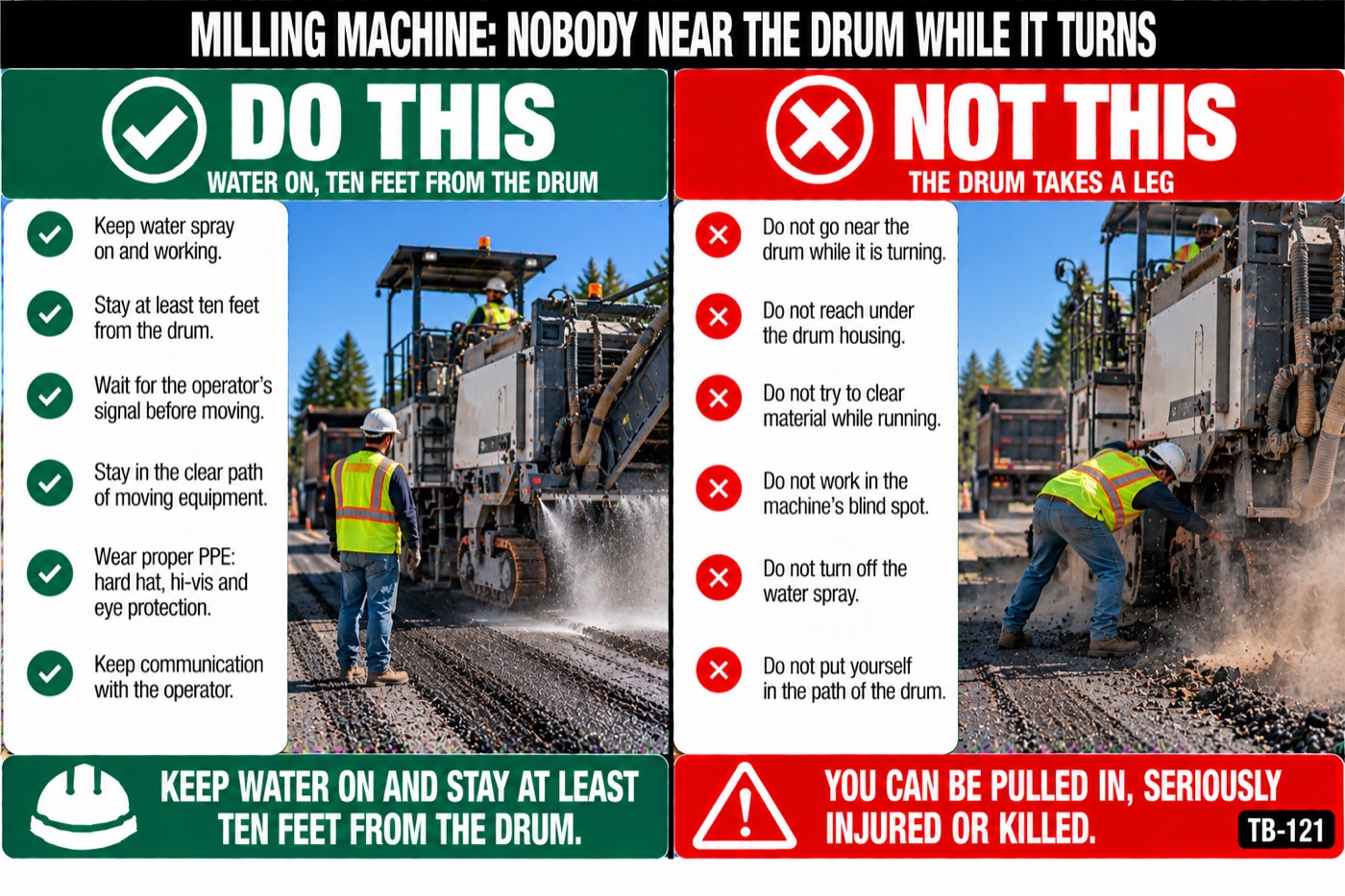
The cutting drum on a half-lane mill carries around 150 carbide teeth and turns at about 100 rpm while it chews 2 to 4 inches of pavement. The dust it throws is respirable silica, and OSHA's limit for that is 50 micrograms per cubic meter, which is less than a pinch of flour spread through a house.
The points
- The drum takes a leg off a ground hand who steps to the side of the machine to clear a chunk, and the conveyor takes a hand that reaches in to unstick a belt. Both are in the same 20 feet of machine and both are moving until the operator shuts them down.
- Respirable silica from milling is covered by 1926.1153. Table 1 says small mills use water spray with surfactant, and half-lane and larger mills use drum-enclosure exhaust plus water spray. With those working, no respirator is required. With the water off, you can go past the limit fast.
- Nobody is within 10 feet of the drum housing while the drum is turning, and nobody steps onto the machine's side or behind the moldboard from the ground. Ground hands stay ahead of the machine, at the operator's signal, or on the deck.
- The teeth change is the injury the operator does not expect. The drum is turned by hand or with the service turning device, machine off, key out, never by bumping the engine. Cracked teeth fly, a drum that turns under power with a hand on it takes the hand.
- Water on, and the crew checks it. If the spray bars clog or the tank runs dry, the mill stops until it is fixed. A milling pass with the water off is not a job that got done; it is a silica exposure that got recorded.
Why it goes wrong
A milling drum is a steel cylinder with rows of tool holders and carbide-tipped teeth that rotate up-cut into the pavement. The housing contains it but the sides are open at the ground for the side plates to ride on. A ground hand who steps in close to pull a chunk of curb or clear the moldboard is stepping next to a drum that will pull a boot in faster than the operator can react. The standing rule is that when the drum turns, the drum is alone.
The conveyor runs milled material up to the truck ahead at belt speed. Belts jam. The reflex is to reach in and free the jam with a hand or a shovel while it is running. The conveyor does not stop for the shovel. Stop the belt, lock it out, and clear it. The same goes for the primary conveyor under the drum housing, which nobody can see into and which is running at the same time as the drum.
Silica is the exposure that follows the crew home. Milled asphalt is 90 percent aggregate, much of it quartz, and the drum grinds some of it fine enough to sit in the lungs. 1926.1153 puts the limit at 50 micrograms per cubic meter over 8 hours, and Table 1 spells out the controls for milling machines: water spray with surfactant on small mills, and ventilation on the drum enclosure plus water spray on half-lane and larger. When those controls are running as designed, the rule does not require a respirator. When they are not running, the rule's protections are gone.
Water is a control only when it reaches the drum. Spray nozzles clog with fines, the tank runs dry on a long pull, and the operator may not notice because the dust cloud is behind them. The ground hand ahead of the machine can see the cloud. If the plume is dry and gray instead of a wet mist, stop the mill.
Teeth change means being at the drum. Engine off, key out, and the drum turned by the manufacturer's turning device or a bar, never by a helper bumping the starter. Teeth come out with a hammer and a punch, and they crack; safety glasses and a face shield for the person hitting, and nobody else in the housing. A drum that moves while a hand is in it does not need to be under power to break bones; it weighs more than a car.
The rest of the mill is a machine at traffic speed in a work zone. It backs up. It has a conveyor swinging over the truck. The haul truck ahead of it is being loaded by a driver who is watching the conveyor and not the mirror. Same rules as the paver: nobody between the mill and its truck, and a horn and a walk-around every start.
Questions for the crew
- Is the water on this mill running to every nozzle this morning, and who watches the plume from the ground?
- When the belt jams today, what is the actual sequence before anyone reaches in?
- If we change teeth at lunch, who turns the drum, how, and where is the key?
To close
Today the drum turns with nobody near it, the water runs or the mill stops, and any teeth change is done with the key out and the drum turned by hand.
To hold this talk with your crew
1
Read it aloud. Five minutes, before the work starts.
2
Ask the questions. A crew that talks is a crew that remembers.
3
Have them sign on their own phones, and the record is sealed.