Paving in traffic: the public drives through your job
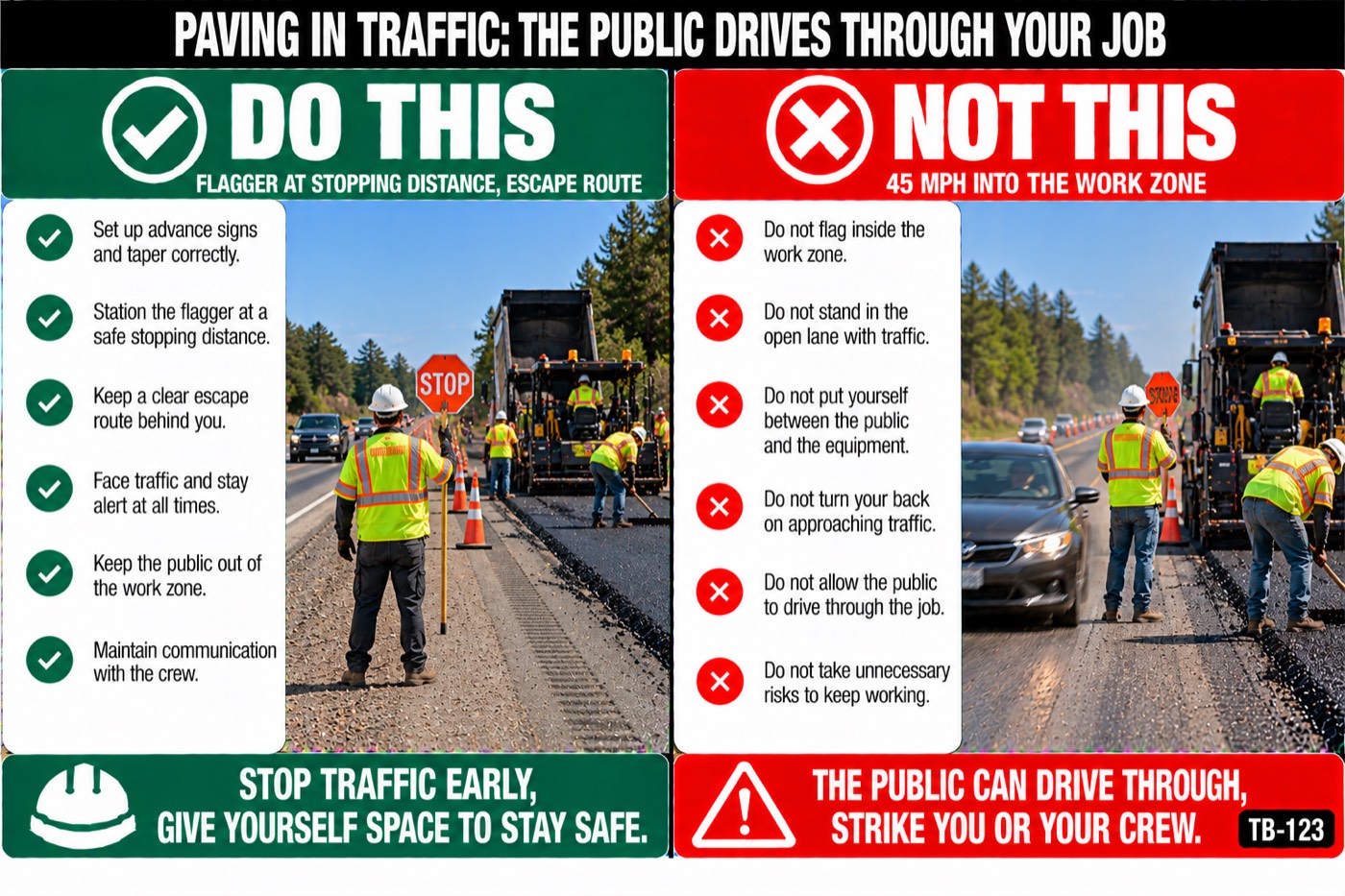
A car at 45 mph covers 66 feet every second and needs about 360 feet to stop once the driver sees the flagger. On a two-lane paving job the public is driving through the work zone a few feet from the crew, and the driver is looking at their phone.
The points
- The paving death that is not a machine is a car. A driver who follows the pilot car into the wrong lane, a driver who blows the flagger at the taper, a driver at night who sees the lights and steers toward them. The crew on the mat is on foot in the roadway with their backs to it.
- 1926.201 sends flagging to Part 6 of the MUTCD: the flagger's position, the STOP/SLOW paddle, and the high-visibility garment. Under Part 6 a flagger wears ANSI Class 2 at minimum, and Part 6 says Class 3 should be considered at night. A Class 2 vest meets the minimum. Class 3 adds sleeves and more reflective bands.
- The flagger stands where the driver can see them from the stopping distance for that speed, on the shoulder, never in the lane, and with an escape route. On a 45 mph road that is 360 feet or more upstream of the paver, not at the hopper.
- The public's lane is next to your work. Nobody steps into the open lane without looking upstream, no tools or mix on the line, and the crew works facing traffic or has somebody who does. The lane closure talk covers the taper; this one is about you standing next to it all shift.
- Night paving: lights on the paver aimed down at the mat and not into the oncoming lane. Glare from balloon lights or a light tower pointed wrong blinds the driver at exactly the moment they need to see the flagger.
Why it goes wrong
Stopping distance is why the flagger stands where they stand. MUTCD Part 6 tables put the sight distance a driver needs at roughly 155 feet at 25 mph, 360 feet at 45 mph and about 500 feet at 55 mph, on dry pavement, once the driver has actually looked up. The flagger's station is upstream of the crew by at least that far so a driver who sees the paddle late still stops before the taper. A flagger standing next to the paver is a witness, not a control.
1926.201 hands the details to the MUTCD. Under Part 6 flaggers wear high-visibility apparel that meets ANSI/ISEA 107 Class 2, and at night the guidance goes to Class 3, which adds sleeves and more reflective area. Class 2 is what the rest of the crew in the roadway wears, all shift, because the paving crew is in the road just as much as the flagger. A faded vest with the tape peeled off is not Class anything.
The flagger has one job, and it is not answering the radio for the paver. Face traffic, paddle up, eye contact with each driver, and a planned place to go when a car does not stop. That is off the shoulder, away from the crew, not toward the paver. Relief every hour or two in heat, because a flagger who has been baking on the shoulder for four hours is a flagger who waves cars through.
The open lane next to the work is where the crew gets hit. A rake hand stepping back to sight the joint, a laborer crossing for a tool, the screed operator walking around the paver on the traffic side. The rule on the crew is simple: nobody steps toward the open lane without looking upstream first, and the rake crew works the traffic-side joint facing traffic when they can.
Night paving trades heat and traffic volume for darkness. The mat and the machines are lit, the crew is lit, and drivers come out of dark road into a wall of light. Light towers aimed at driver eye level blind them 500 feet out. Aim lights down at the work, shield them on the traffic side, and put a lit sign sequence upstream so the driver's eyes have already adjusted. Every crew member in Class 3 at night, with reflective bands on the legs where headlights hit first.
Pilot cars and two-way flagging need radios that work and a plan for when they do not. A flagger who releases traffic because the other end's radio went quiet has sent cars head-on into the other queue. No radio, no release, until somebody drives the message.
Questions for the crew
- What is the posted speed on this road, and how far upstream is our flagger going to stand?
- Who on this crew is not in Class 2 right now, and who is in Class 3 tonight?
- When a car does not stop for the paddle today, where does the flagger go, and where does the rake crew go?
To close
Today the flagger stands at stopping distance in Class 2 with an escape route, and nobody on the crew steps toward the open lane without looking upstream first.
To hold this talk with your crew
1
Read it aloud. Five minutes, before the work starts.
2
Ask the questions. A crew that talks is a crew that remembers.
3
Have them sign on their own phones, and the record is sealed.