Crack sealing: 375 °F rubber and a propane kettle
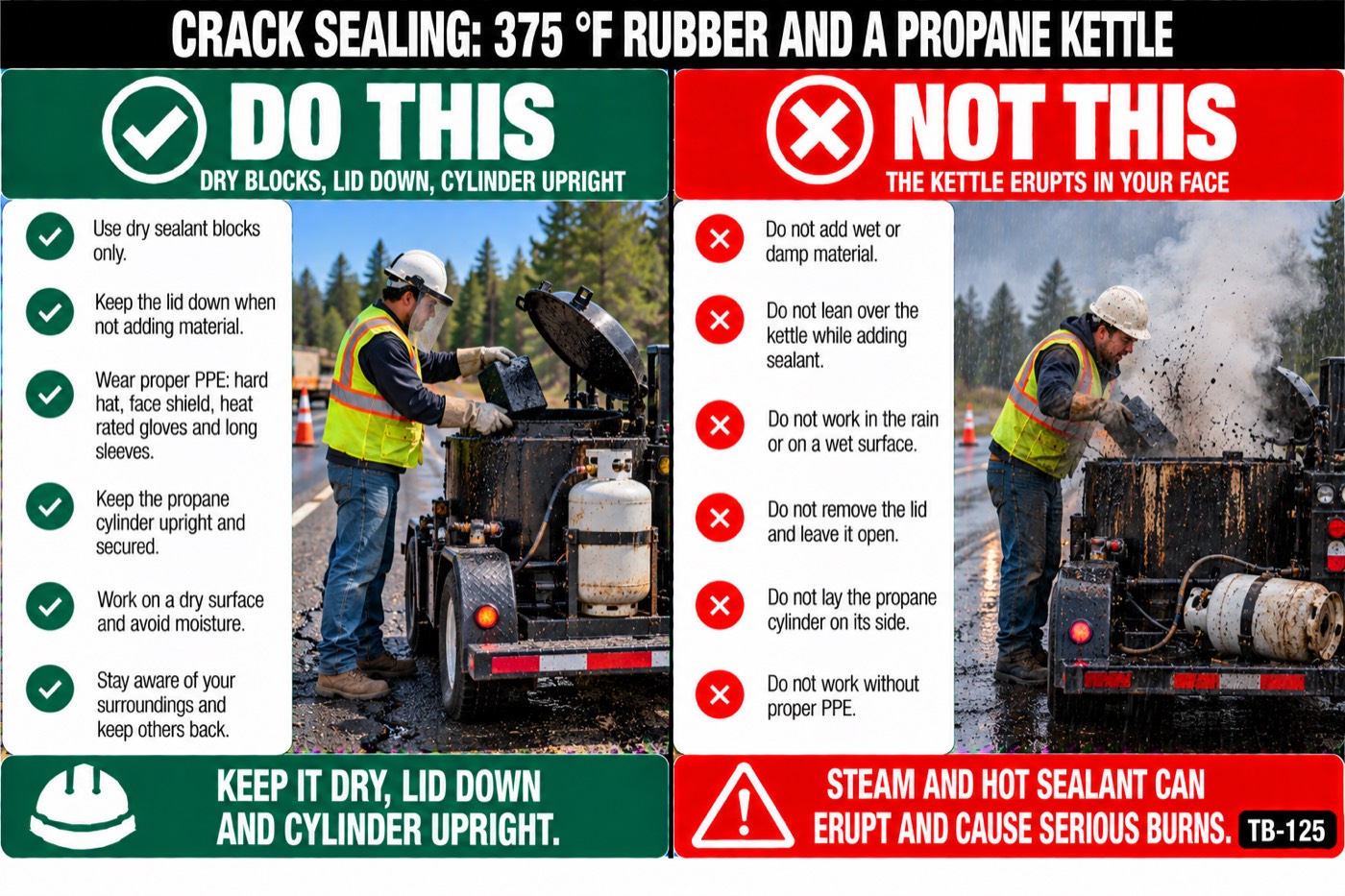
Hot-pour crack sealant runs at 350 to 400 °F, hotter than the mix on the paver, and it is heated by a propane burner in a kettle you are standing over with a wand. A cup of water dropped in that kettle turns into about 1,700 cups of steam in a second, and it comes out the top.
The points
- A steam eruption from the kettle when wet material or rain goes in, a sealant burn through a glove from the wand, and a propane fire from a cracked hose or a cylinder laid on its side in the truck. The kettle is the hottest and most flammable thing on a paving crew, and it is usually run by the newest person.
- 1926.153 governs the propane: containers, valves and regulators of an approved type, no welding on a cylinder, and cylinders stay outside and upright. A 100-pound cylinder rolling around in a truck bed with the valve open is a bomb that has not gone off yet.
- Nothing wet goes in the kettle. Sealant blocks are unwrapped dry, added slowly, and the lid goes back on. Rain or a wet block in 375-degree sealant is an eruption, and it goes onto whoever is leaning over the lid.
- Face shield over safety glasses, heat-rated gloves past the wrist, long sleeves, long pants over the boots, at the kettle and on the wand. The wand tip drips 375-degree rubber, and the drip lands on a boot or a bare forearm.
- Propane hose inspected before the burner lights, cylinder valve closed when the burner is off, and the kettle parked where its exhaust and its heat are not under a tree, a wire, or the fuel tank of the truck.
Why it goes wrong
Hot-pour sealants and rubberized asphalt run at 350 to 400 °F because they have to flow into a quarter-inch crack. That is 100 °F above the paving mix and it produces the same kind of burn, deeper and faster. A drip from the wand onto a canvas glove goes through it. Sealant that lands on skin is cooled with water and left in place, the same as hot mix; it does not get peeled.
Water expands roughly 1,700 times when it turns to steam. A wet block of sealant, rain in the kettle, or a bucket of water somebody set on the lid all put water into a bath at 375 °F, and the steam comes out the lid opening at once, carrying sealant with it. Blocks go in dry, one at a time, and nobody's face is over the opening when they go in. The lid stays closed in rain.
Melters and kettles have thermostats and a high-limit shutoff for a reason. Sealant heated past its safe heating temperature, usually about 400 °F, starts to break down and can flash. Overheated sealant also does not seal; it cracks in the first winter. Check the gauge against the sealant's data sheet and run the burner accordingly, not at full open to get it going faster.
1926.153 is the LP-gas section. The cylinder, the regulator and the hose have to be of an approved type, cylinders are not stored inside buildings, and nobody welds on a cylinder. In the field that means the cylinder rides upright and secured, valve closed, in a rack on the truck or trailer, not loose in the bed and not in the cab. The hose is checked for cracks and burns from the kettle heat, because a propane hose that runs next to a 375-degree kettle ages fast.
A propane leak at the kettle finds the burner. Propane is heavier than air and pools low, so a leaking fitting at a kettle parked in a low spot or a closed garage collects at knee height and the burner or a truck exhaust lights it. Soap-test the fittings when the cylinder is changed, and if the smell is there, the burner goes off and the valve closes before anybody looks for the leak.
The burner exhaust and the kettle body are hot enough to ignite dry grass, a tarp, or the sealant boxes stacked next to it. Park the kettle on pavement with 10 feet of clear ground around it, and keep the cardboard and the fuel can away from it.
Questions for the crew
- Who runs the kettle today, and have they been shown what goes in it and how?
- Where does the propane cylinder ride on this truck, and is the valve closed right now?
- If it starts raining this afternoon, what happens to the kettle lid and the wand?
To close
Today the kettle runs at the sealant's temperature with the lid down, dry blocks only, and the propane cylinder rides upright, secured, valve closed, every time the burner is off.
To hold this talk with your crew
1
Read it aloud. Five minutes, before the work starts.
2
Ask the questions. A crew that talks is a crew that remembers.
3
Have them sign on their own phones, and the record is sealed.