The mat adds 20 degrees: heat on the paving crew
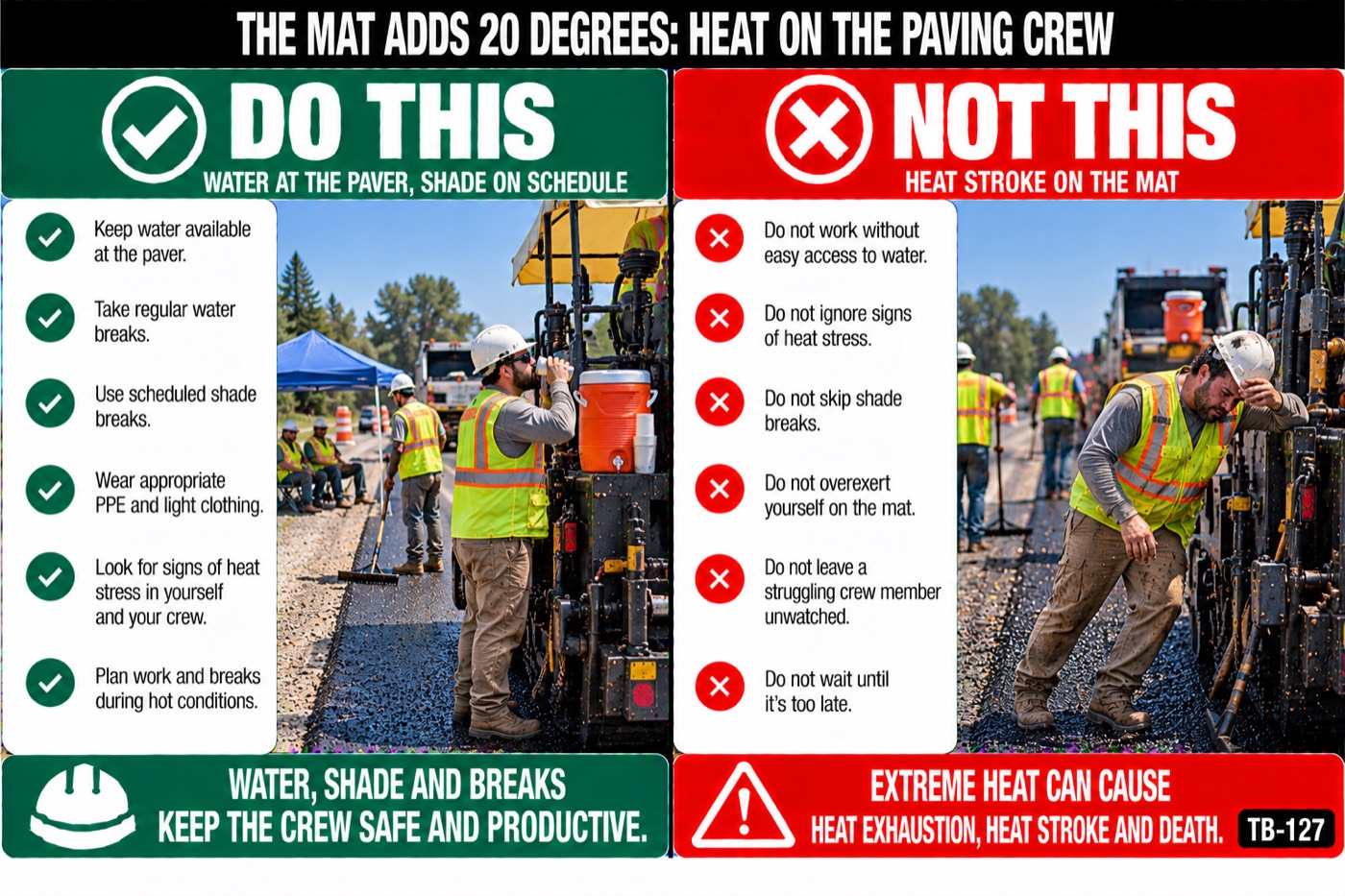
The air is 92 today. The mat under the crew is 280 °F and radiating up, the paver's engine and screed heater are adding to it, and there is no shade on a road. What the rake crew's body feels is closer to 110 than 92.
The points
- The person who dies of heat stroke on a paving crew stops sweating first. Hot, dry, red skin on somebody who was drenched an hour ago, confusion, staggering, then collapse. Body temperature over 104 °F cooks the brain and the kidneys, and the difference between a recovery and a death is how fast the crew cools them.
- There is no OSHA construction section with a heat number in it. The duty is the employer's general duty and 1926.20(b): a program, competent people inspecting, and no machinery, tool, material or equipment used that is not in compliance. On a paving job that program is water, shade, rest, a buddy, and a foreman who pulls people off the mat.
- Water at the paver, not at the truck 300 feet back. A cup every 15 to 20 minutes for anyone on the mat, and the foreman watches who is not drinking. Thirst is a late signal; by the time you are thirsty you are already a quart down.
- Shade within reach: the paver's canopy, a pop-up on the shoulder, the cab with the AC on. Breaks on the mat in the mat's heat are not breaks. The rake crew rotates to the shade, on the clock, whether the pull is going well or not.
- Buddy up. Every person on the mat has somebody watching them for the stumble, the quiet, the confusion. If somebody stops making sense or stops sweating: shade, water on them, ice under the arms and at the neck, and 911. That person does not go back on the mat today.
Why it goes wrong
The mat is a radiant heat source. Fresh mix at 275 to 300 °F gives off heat the way a stove element does, and a person bent over it is absorbing that on the face, chest and arms on top of the air temperature and the sun. The effective load on the body is well above the number on the thermometer. The paver deck is worse: engine heat, the screed heater, and the auger chamber all vent upward past the operator and the screed hand.
Heat exhaustion comes first: heavy sweating, weakness, nausea, headache, a fast pulse, cool clammy skin. That person goes to the shade and drinks and rests and comes back only when they are right, if at all that day. Heat stroke is the next step and it is different in kind: the body's cooling has failed, the skin can be hot and dry or still wet, and the person is confused, slurring, or unconscious. That is a 911 call and aggressive cooling on the spot. Ice water on the body, ice packs at the neck, armpits and groin, and a fan. Cool first, then transport.
Acclimatization is the number most crews skip. It takes 7 to 14 days of working in the heat for the body to sweat efficiently and hold salt. The new hire, the person back from a week off, and the person who moved from the shop to the mat are the ones who go down in the first week. A new hire gets no more than 20 percent of a day in the heat on day one and 20 percent more each day; a returning hand starts at half a day, and the foreman knows who is in that first week.
Water and salt. On a hot paving day a person on the mat can lose a quart of sweat an hour. Plain water replaces the fluid; a meal and an electrolyte drink replace the salt. Energy drinks and coffee are not water, and yesterday's beer is a head start on dehydration. Dark urine at the porta-john is the crew's own gauge.
1926.20(b) is the section that carries this. The employer initiates and maintains a program, inspections are made by competent persons, and no machinery, tool, material or equipment that is not in compliance gets used. There is no paving heat rule with a temperature in it, so the program is the rule: a written plan, water and shade at the work, rest breaks that scale with the heat, acclimatization for new people, and a foreman with the authority to stop the pull.
Shift timing is a control. Paving at 5 a.m. instead of 9 a.m. in July, or paving at night, moves the crew out of the worst three hours of the day. When the schedule cannot move, the rest schedule does: more breaks, shorter rotations, and the foreman calling them, not the crew asking.
Questions for the crew
- Where is the water at the paver right now, and who fills it when it runs out?
- Who on this crew is in their first week of this heat, and what is their rotation today?
- If the screed hand goes quiet and stops sweating at 2 p.m., who cools them, with what, and who calls?
To close
Today the water is at the paver, the rake crew rotates to shade on the clock, and anyone who gets confused or stops sweating comes off the mat and gets cooled before anything else happens.
To hold this talk with your crew
1
Read it aloud. Five minutes, before the work starts.
2
Ask the questions. A crew that talks is a crew that remembers.
3
Have them sign on their own phones, and the record is sealed.