Stretching wire: the tension that lets go at your face
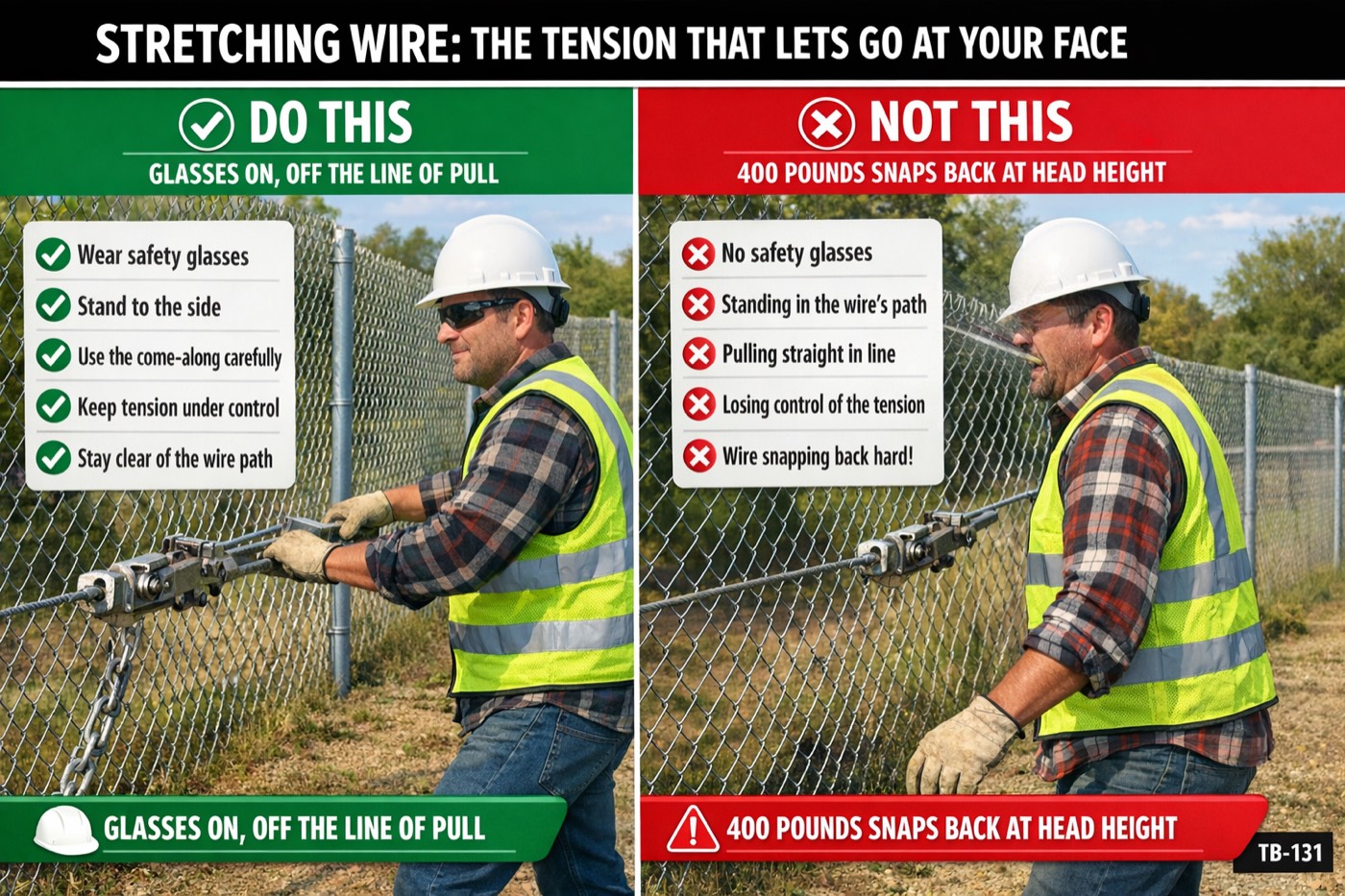
A run of chain link under a come-along is holding a few hundred pounds of pull. When the stretcher bar slips, all of it comes back at the man behind it, at head height.
The points
- Stored tension in fence wire does not care what it hits: a stretcher bar that lets go at 400 pounds swings the whole fabric like a whip, and a barbed wire strand that snaps under tension takes an eye or opens a cheek.
- Safety glasses with side shields on everybody on the stretch, not just the man at the come-along. A wire end under tension is a flying object, and that is exactly what the eye protection rule is written for.
- Nobody stands in line with the pull. The come-along, the cable and the stretcher bar make a straight line, and you work from the side of that line, never inside the bend of the fence.
- Check the come-along before you load it: cable not kinked or birdcaged, hook latch closes, pawl clicks and holds. A 2-ton come-along is only a 2-ton come-along when the cable is whole.
- Barbed wire and high-tensile wire get tensioned with a stretcher and a gauge, not by the truck. Wire pulled by a bumper has no limit and nobody at the release.
Why it goes wrong
Chain link fabric is pulled until the diamonds have no slack, which is a few hundred pounds on the stretcher bar and more on a long run. The bar is the part that fails: it is threaded through the diamonds, and if it is not in every row it tears out of the ones it is in and the fabric springs back. Check that the bar goes through every mesh and that the come-along hook is on the bar, never on the fabric.
Come-alongs fail at the cable near the hook, at the pawl when it wears, and at the handle when it bends. A cable that breaks under load recoils at hundreds of feet per second. Use a rated come-along, not a ratchet strap, and never extend the handle with a pipe; that is how the pawl skips and the handle comes around into your teeth.
Two-strand 12.5-gauge barbed wire breaks around 950 pounds and high-tensile smooth wire around 1,300 to 1,800. Working tension is 200 to 250 pounds, which is plenty to whip a loose end 30 feet. A kink in wire under tension is where it breaks, and a barb that hits at whip speed goes through a cheek. Face shield over glasses when you are at the crimp or the tie on a loaded strand.
29 CFR 1926.102 requires eye protection with side protection where there is a hazard from flying objects, and it has to be marked to ANSI Z87.1. The common mistake is the man 20 feet away at the post with no glasses because he is not doing the pull. The wire flies further than 20 feet.
Tension comes off slowly and under control, with everyone told first. A strand that has to be cut under tension gets tied off on both sides of the cut with grabs and a chain so the release is inches, not the whole run. Tie wire and hog rings flick when they are cut; turn the pliers away from your face and keep the glasses on for the small stuff too.
The inside of a corner is the worst place to stand during a stretch: if the corner post moves or the brace fails, the fence closes on whoever is inside it. Work the corner from outside the line, and set the brace before you load the corner, not after.
Questions for the crew
- Who is on the pull today, and who is standing where when the come-along is loaded?
- When did anybody last look at the cable on that come-along, and what did it look like?
- If a strand has to be cut under tension today, how are we tying it off first?
To close
Nobody loads a come-along today until everybody within a fence length has glasses on and is out of the line of the pull.
To hold this talk with your crew
1
Read it aloud. Five minutes, before the work starts.
2
Ask the questions. A crew that talks is a crew that remembers.
3
Have them sign on their own phones, and the record is sealed.