Automatic gates: the gate that closes on a child
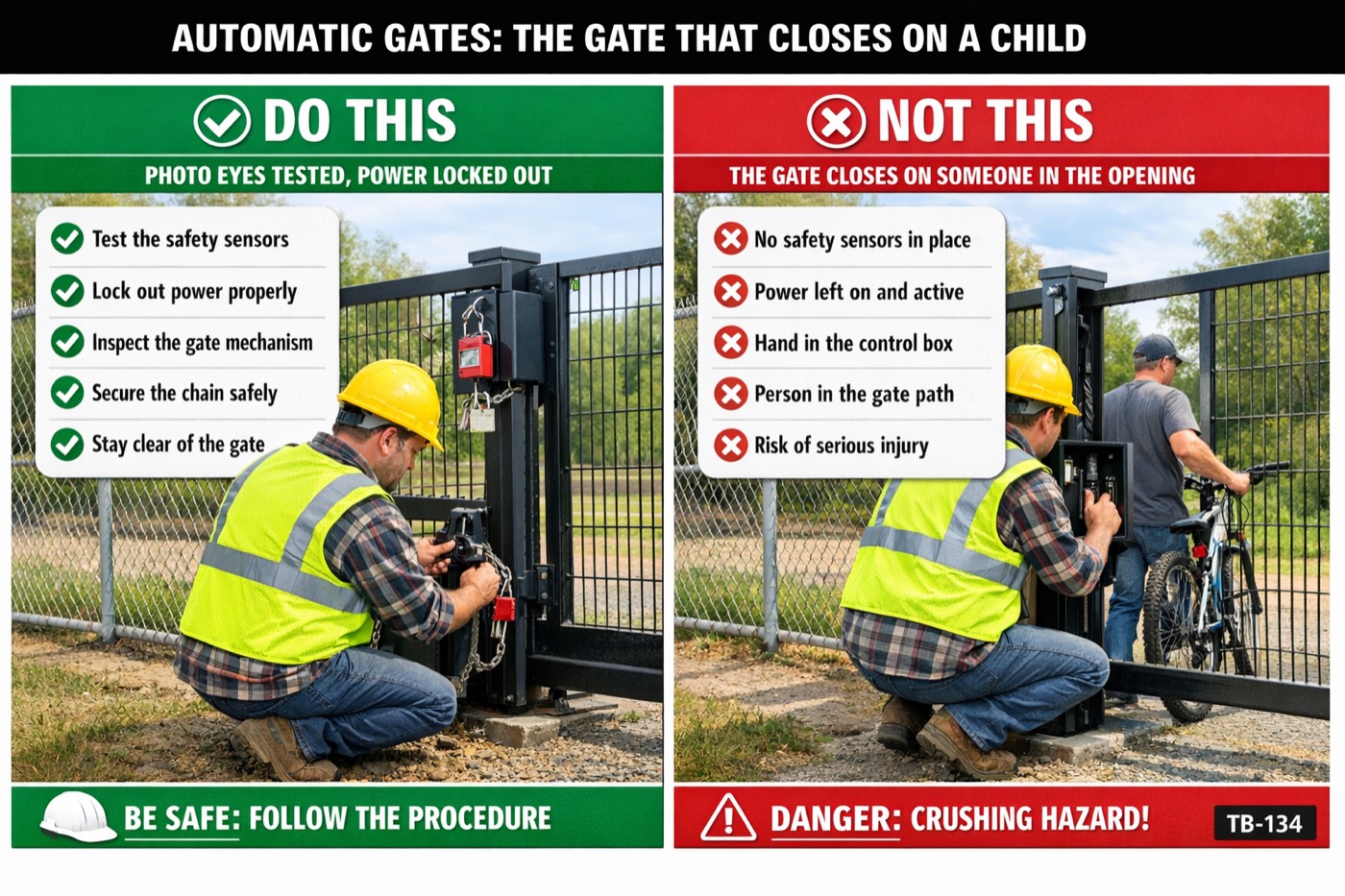
A 20-foot steel slide gate weighs 500 to 800 pounds and the operator moves it at about a foot a second. It does not know the difference between a car in the way and a child.
The points
- Automatic gates kill children two ways: the gate closes on them and the operator keeps pushing, or the gate comes off its track and falls over on them. Both have happened at gates a fence crew installed and walked away from.
- UL 325 and ASTM F2200 are the rules for gate operators and the gates they move. The operator needs monitored entrapment protection, photo eyes or sensing edges, on every zone where the gate can pinch, and it will not run if that device is missing or dead.
- A slide gate has to pass the 2-1/4 inch ball, and swing gates have their own opening limit: no opening in the gate, or between the gate and the post, big enough for a hand or a head in the travel zone, and a slide gate has positive stops so it cannot leave the track.
- Power off and locked at the disconnect before anybody works on the operator, the chain, the rack or the arm. A gate under power that gets a stray signal from a loop or a remote moves with you inside the guards.
- On a cantilever or vertical lift gate, the tail or the counterweight is the second gate: the tail sweeps the yard behind the fence when the gate moves, and a counterweight held by a cable drops when the cable does.
Why it goes wrong
The entrapment zones on a slide gate are the closing edge against the post, the space between the gate and the fence it slides past, and the rollers and the rack. On a swing gate they are the hinge side between the leaf and the post, the closing edge at the strike, and the leaf sweeping across a wall. The case that keeps repeating is a child who reaches through the bars for a ball while the gate is moving. UL 325 sorts operators into classes from residential to restricted-access, and the installer picks the class and puts the label on it.
Since the 2016 edition of UL 325, the operator monitors its entrapment devices: if a photo eye or edge is disconnected or fails, the operator will not run in that direction. Two independent means of entrapment protection are required for each entrapment zone, and which types count depends on the kind of gate. The common mistake is installing the operator without the photo eyes because the customer did not buy them. That gate does not comply, and it has the installer's name on it.
ASTM F2200 is about the gate: on slide gates, openings 2-1/4 inches or smaller from the bottom of the gate up to 6 feet or the top, guards over the roller and rack, no protrusions along the top edge, positive stops at both ends of slide gate travel, and a gate that will not fall past 45 degrees if it comes off its hardware. A 600-pound gate that leaves the track tips over on the child who was hanging on it. Where people walk through, a separate pedestrian gate goes in so nobody walks through the vehicle gate.
Operators run on 120 or 240 volts, and a loop detector, a keypad or a remote in a car pulling up can start the gate while you are inside the guards. Disconnect at the operator, lock it or keep the key in your pocket, engage the manual release, and try to move the gate before you reach in. The lockout tagout talk covers the general rule; this is the fence version.
A cantilever slide gate has a tail section about half the length of the opening that swings through the yard behind the fence line every time the gate moves, and it pinches against the fence posts. Vertical lift and barrier gates use counterweights of hundreds of pounds on cables and springs; a cable that fails drops the weight and the gate together. Both areas get guarded, and neither gets adjusted under power.
Handing it over is part of the install: warning placards on both sides of the gate, the manual release shown to the customer, the entrapment devices tested in front of them, and the instructions left. The gate is a machine you leave running at a house with kids in it. Test every device before you drive off.
Questions for the crew
- Where on this gate can a hand, a foot or a head be caught when it moves, and what stops the operator there?
- When the operator is being wired or adjusted, where is the power off and who holds it off?
- If a kid from this house rides a bike up to this gate next week, what happens?
To close
No gate operator gets powered up today without the photo eyes and edges installed and tested, and nobody reaches into the operator without the disconnect off.
To hold this talk with your crew
1
Read it aloud. Five minutes, before the work starts.
2
Ask the questions. A crew that talks is a crew that remembers.
3
Have them sign on their own phones, and the record is sealed.