Roadside and front yards: the public in your work zone
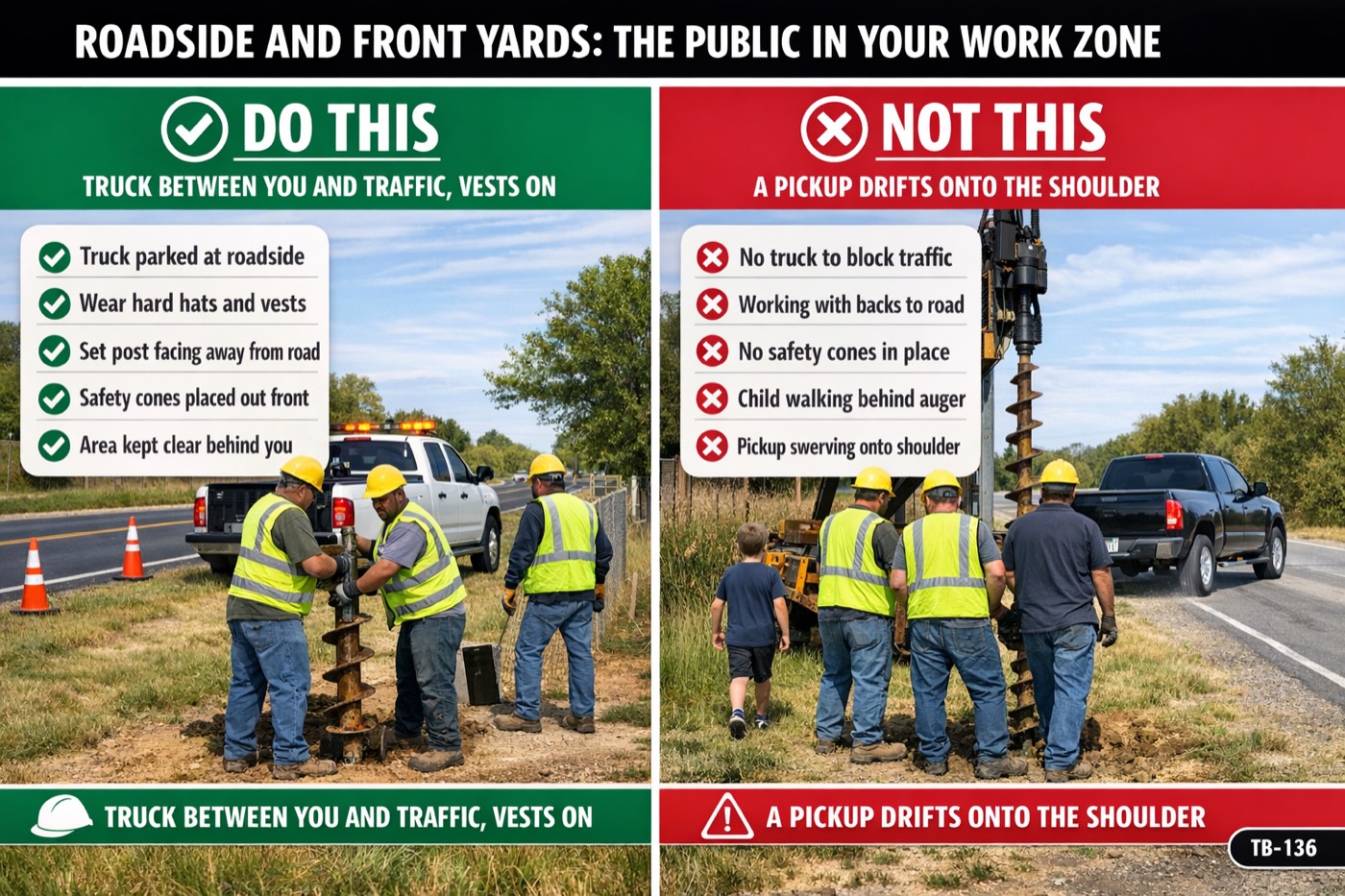
A pickup at 35 miles an hour covers 50 feet a second. The man setting a post at the road frontage with his back to traffic has about a second between the sound of the tires and the hit.
The points
- The struck-by on a road-frontage fence is a car that drifts onto the shoulder. The second injury is the kid from the house who walks up behind the auger, or the dog that takes the man on the come-along off his feet.
- Any work within 15 feet of the pavement gets the truck parked between you and traffic with the flashers on, cones on the approach, and Class 2 high-visibility vests on the whole crew all day, not on the man closest to the road.
- Signs and cones on a public road follow Part 6 of the MUTCD, and if the fence is on the shoulder of a road posted over 40, that is a shoulder closure with an advance sign 350 to 500 feet back, not a truck with its flashers on.
- Kids and dogs: the homeowner hears before the auger starts that the yard is a work site today, the dog stays inside, and a running machine stops when a kid is in the yard. No kid sits in the skid steer, ever.
- The sidewalk stays clear: no cords, no pipe, no open holes, and tools go back on the truck, not the curb. A neighbor pushing a stroller past an open post hole at dusk is your problem.
Why it goes wrong
A driver looking at a phone for 4.6 seconds at 35 miles an hour travels 240 feet blind, and a man bent over a post hole is three feet tall and below the hood line. Park the truck upstream of the work with the wheels turned away from the crew, so if it is hit it goes away from you, and never stand between the truck and the traffic. A pickup is not a crash cushion, but it is better than a cone.
29 CFR 1926.200 says traffic control devices used to protect construction workers conform to Part 6 of the MUTCD. For short work on a low-speed street a vehicle with flashers and a few cones may be all Part 6 asks; on a higher-speed road, shoulder work gets advance signs and a taper, and a lane closure is its own talk. Most cities and counties require a permit to work in the public right of way, so find out who owns the road before the crew is standing in it.
High-visibility vests are ANSI/ISEA 107 Class 2 near traffic and Class 3 at night or on roads over 50 miles an hour. A vest faded to pink does not count, and a vest under a jacket does nothing. Vests go on before the first tool comes off the truck, because the man unloading the trailer is the one nearest the road.
A front yard is the work zone with the least control you will ever have: neighbors, kids, dogs, the mail carrier, the meter reader. A 10-inch post hole 3 feet deep is a broken leg for any of them, so holes get covered or coned before lunch and before you leave, and cords do not cross the sidewalk. The homeowner conversation at the start of the day covers what we are doing, where they cannot go, and that the dog stays in.
The truck and the panel stack change the sight lines on the street. A stack of panels on the corner of the driveway blocks the neighbor backing out, and the truck parked on a corner lot blocks the intersection for everyone. Backing the truck or trailer into the yard gets a spotter, and the spotter is the one looking for the kid on the bike, not the driver.
When the crew leaves for the night: no open holes, no panels leaning on the sidewalk, no rebar or wire ends at ankle height, and the trailer either off the street or lit and coned. The complaint the office gets in the morning is the cheap outcome; the other one is the lawsuit.
Questions for the crew
- Where is the traffic coming from on this job, and where does the truck sit to be between it and us?
- Who is in this house today, kids or dogs, and who told them the yard is a work site?
- What is on the sidewalk right now that a stranger could trip over or step into?
To close
Vests on before the first tool comes off the truck, the truck between us and the road, and the sidewalk walked clear before lunch and before we leave.
To hold this talk with your crew
1
Read it aloud. Five minutes, before the work starts.
2
Ask the questions. A crew that talks is a crew that remembers.
3
Have them sign on their own phones, and the record is sealed.