Skid steers on a fence line: the swing and no riders
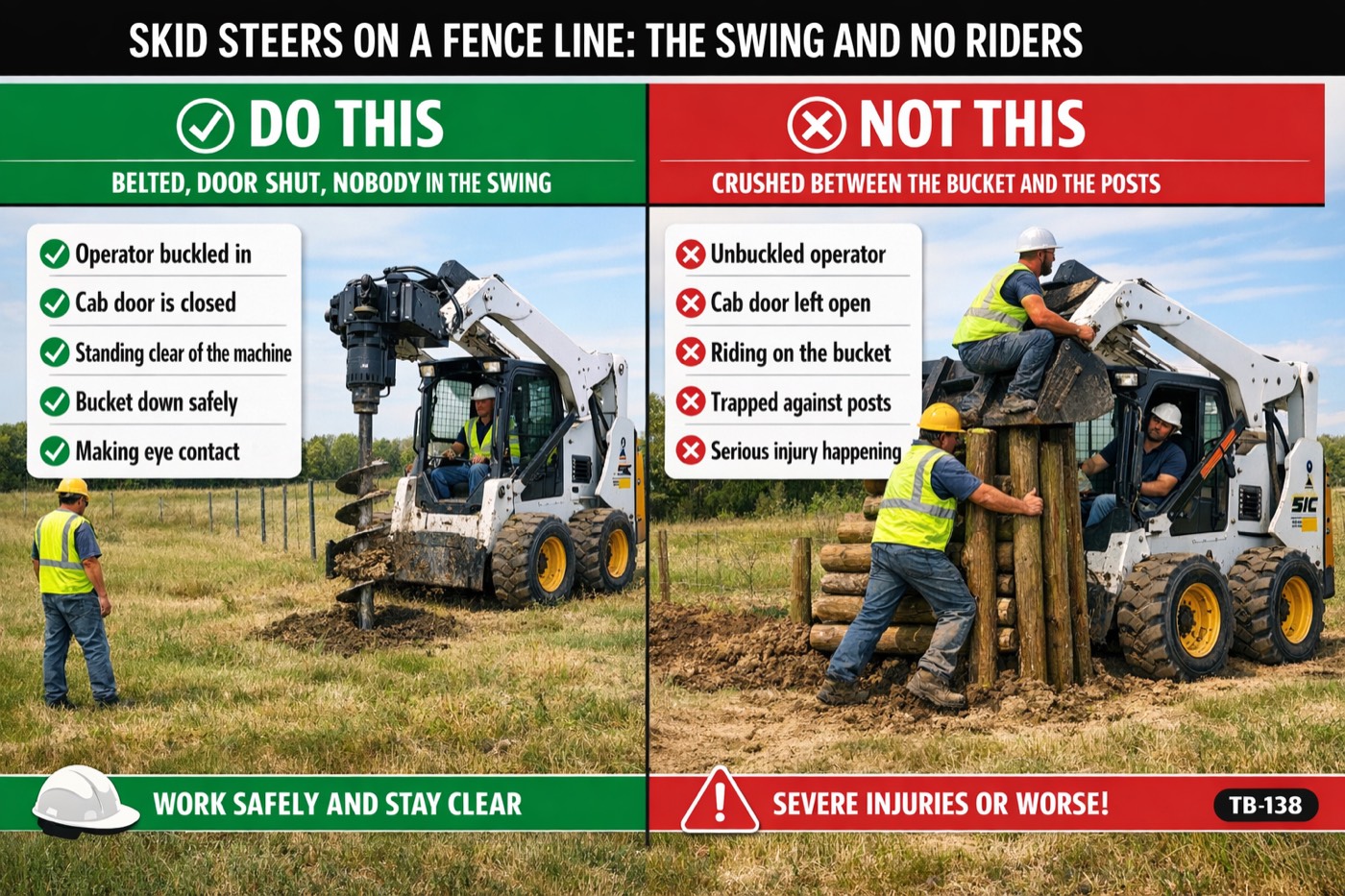
A skid steer weighs 7,000 to 9,000 pounds and turns in its own length. The man standing at the corner to line up the auger is inside the swing before the operator sees him.
The points
- The machine injuries on a fence line are the man crushed between the bucket and the post pile, the helper rolled under a track when the machine spins, and the rollover on the ditch bank with the operator half out of the cab because the belt was not on.
- Nobody on the ground within the swing of the machine while it is moving: about 15 feet from a skid steer, and the full boom reach plus tail swing on a mini excavator. To talk to the operator, wait for the bucket down and eye contact.
- Seat belt on every time, door closed on a skid steer. The belt is what keeps you inside the roll cage in a rollover; without it the cage crushes you against the ground on the way over.
- No riders: not in the bucket, not on the step, not on the forks, not for 50 feet to the next post. A bucket ride has no restraint and no view, and the machine stops hard when the auger catches.
- On a slope, travel straight up and down with the heavy end uphill and the bucket low, and never turn across the slope with the auger or a load raised. A mini excavator digging at a ditch bank sets its tracks square to the edge, never parallel to it.
Why it goes wrong
A skid steer operator cannot see the right rear, close in front below the bucket, or either side of the cab, and a man of average height standing beside the machine disappears when the arms are up. Skid steers kill people on the ground, not just operators. The ground man is visible and stopped, the machine is stopped before anyone approaches, and the hand signals are agreed before the engine starts, not shouted over it.
OSHA's earthmoving rule, 1926.602, sets skid steers aside, and 1926.1000 requires a ROPS on skid steers built after July 15, 2019. The maker's manual requires the belt and bans riders. The roll cage on a skid steer is designed around an operator who is belted in it, and the restraint bar is not a seat belt. The operator who steps out of a running skid steer with the arms up is the classic fatality: the arms drop, and the cab opening is where his body was.
The center of gravity on a skid steer moves up and forward as the arms rise and the load grows. On a 15 to 20 degree slope with the auger raised, a turn tips it. Heavy end uphill means an empty machine backs up the slope and a loaded one drives up it. A ditch bank fails under a track; stay back from the edge at least the height of the bank.
The hydraulic auger on the skid steer is thousands of foot-pounds through a planetary drive, and when the bit catches a root the machine bucks. No hand and no foot goes near the bit: the mark is a stake, the plumb is checked by eye from 15 feet, and bit changes happen with the engine off and the arms down or locked. The auger also swings when the arms move, so a 4-foot bit on an extension covers a lot of ground the operator is not watching.
Nobody goes under raised arms unless the arm locks are engaged, and the operator gets on and off with three points of contact on a stopped machine with the arms down. On a mini excavator the counterweight sweeps the same circle as the bucket, on the opposite side, and a zero-tail-swing machine still swings its cab. The man on the ground stands where the operator can see him and outside the circle, every swing.
Questions for the crew
- Where is the ground man standing when the auger goes down, and can the operator see him from the seat?
- Which part of this line has a slope or a ditch, and how does the machine work there?
- When was the last time somebody rode in the bucket on this crew, and why did it seem fine?
To close
Today the machine does not move with a man within 15 feet, the belt is on before the engine, and nobody rides in the bucket to the next post, not once.
To hold this talk with your crew
1
Read it aloud. Five minutes, before the work starts.
2
Ask the questions. A crew that talks is a crew that remembers.
3
Have them sign on their own phones, and the record is sealed.