Miles from anything: water, signal and the plan
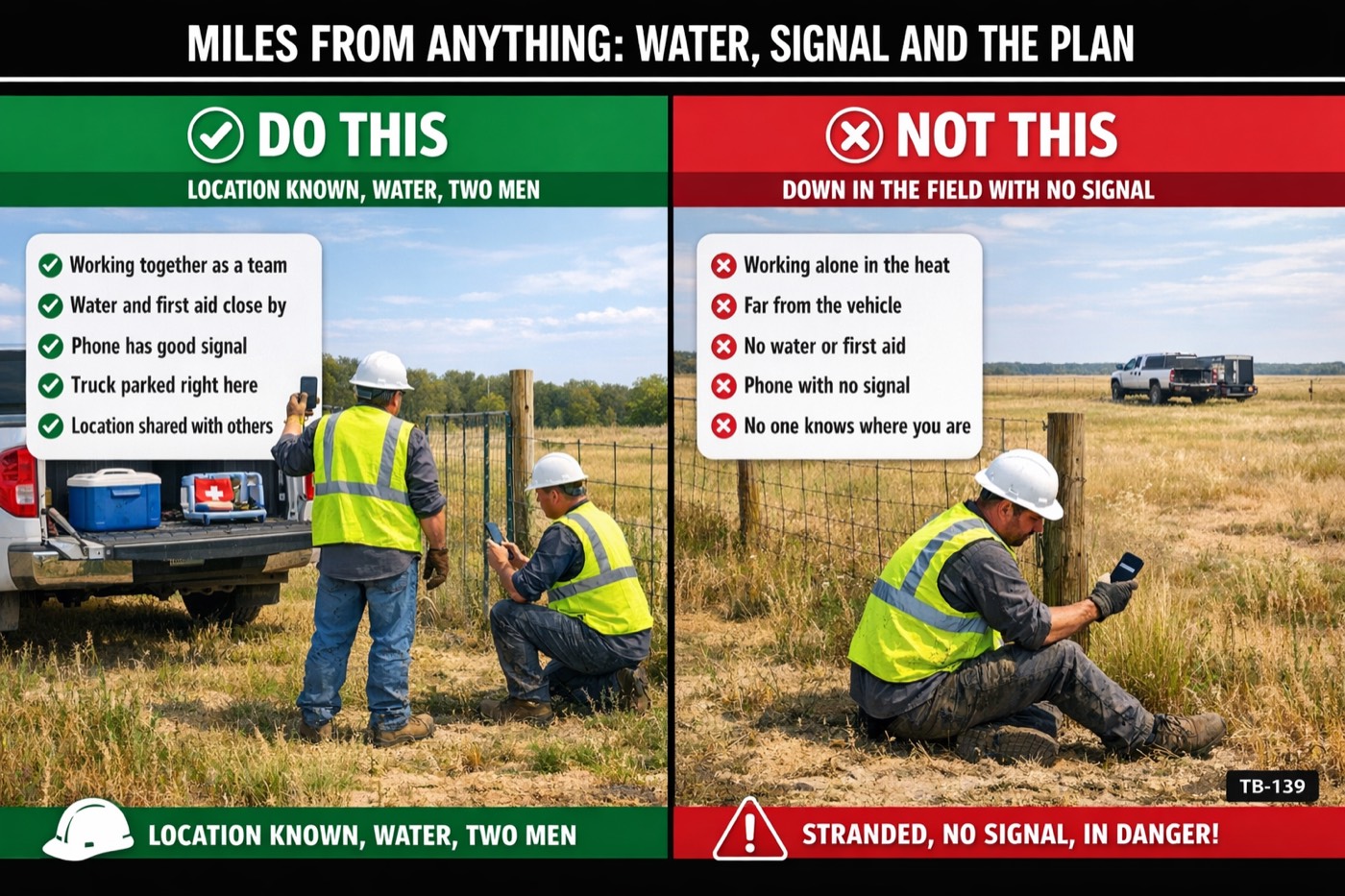
The farm fence job is 40 minutes from the nearest ambulance station, and that is after the dispatcher figures out where you are. On a hot day a man who goes down has less time than that.
The points
- What kills on the long field job is that nobody knows where you are and nobody can call: heat stroke past 104 degrees, a sting that closes a throat, a post through a leg, and a phone with no bars in the low spot where the fence runs.
- Before the day starts, everybody knows the address or the coordinates of the gate we came in, where the phone has signal, and who the first aid person on this crew is. The rule says if a clinic is not close, somebody trained in first aid is on site.
- The first aid kit is on the truck, checked this week, with the sealed packages full, and the truck is parked so it can leave, not blocked in by the trailer and the post pile.
- Water: about a quart an hour in the sun, which is a cup every 15 minutes, not a jug at lunch. The truck is the shade; if there is no tree, the doors are open and the tailgate is where you sit.
- Somebody off the job knows where you are and when you will call, and if the crew goes quiet past that time, they come looking. Two people at a minimum on a field job, and nobody stretches wire a mile from the truck by himself.
Why it goes wrong
29 CFR 1926.50 says that where no clinic, hospital or physician is reasonably close in time and distance, a person with a valid first aid certificate is at the worksite. OSHA reads reasonably close as a few minutes for life-threatening injuries, so a farm fence 40 minutes out means someone on this crew holds a current card. The same section requires first aid supplies in a weatherproof container with sealed packages, checked before the job goes out and weekly on the job, and, unless the phone gives the 911 dispatcher the location on its own, the site's coordinates or location posted at the site.
Rural 911 does not always get a good location from a cell phone, so the dispatcher gets the county road and the mile, or the coordinates from the compass app, said first, before anything else. Mark the gate you came in with the truck or a flag, and send a man to the road to wave the ambulance in, because the driver has never been down that lane either.
Heat stroke is the remote emergency: confused, stumbling, maybe stopped sweating, core past 104 degrees. Cooling starts before the call is finished: shade, clothes loosened, water on the skin, ice from the cooler on the neck, armpits and groin, and fanning. Do not drive the man to town yourself unless there is no signal at all and you know the hospital; the ambulance carries what the truck does not. The cooler with ice is a first aid device out here; keep it full.
A quart of water an hour in the sun, and not much more than that, with something salty or an electrolyte drink after the second hour. Thirst arrives late; a man who has stopped sweating or stopped talking is behind. The truck is the shade when there is no tree, and 15 minutes in it every couple of hours in the afternoon is not lost time. The long drive home after 10 hours in the sun is where the microsleep happens; that is its own talk.
Know where the phone works before you need it. A text goes through where a call will not, satellite SOS on newer phones works with no bars, and a two-way satellite messenger costs less a month than a box of screws. Test it in the morning at the truck. If someone goes down: the work stops, the first aid person goes to him, a second man makes the call from the spot with signal, and a third goes to the road.
The farm job has its own extras: the bull in the pasture, the energizer on the existing electric fence, the pond, the farmer's dog, the propane tank by the barn. Ask the owner what is in the field before you walk it, and tell the crew. Stings and nests are their own talk; the point here is that out here the first aid is you for a long time.
Questions for the crew
- What is the address or the coordinates for the ambulance, and who on this crew can say it without looking?
- Who has a first aid card right now, and when did anybody last open that kit?
- Where does the phone work on this property, and what do we do if it does not?
To close
Before the first post today, everybody has the location for 911 in their phone, knows where the signal is, and the cooler has ice and water enough to last past three o'clock.
To hold this talk with your crew
1
Read it aloud. Five minutes, before the work starts.
2
Ask the questions. A crew that talks is a crew that remembers.
3
Have them sign on their own phones, and the record is sealed.