Emergencies: say this site's address out loud
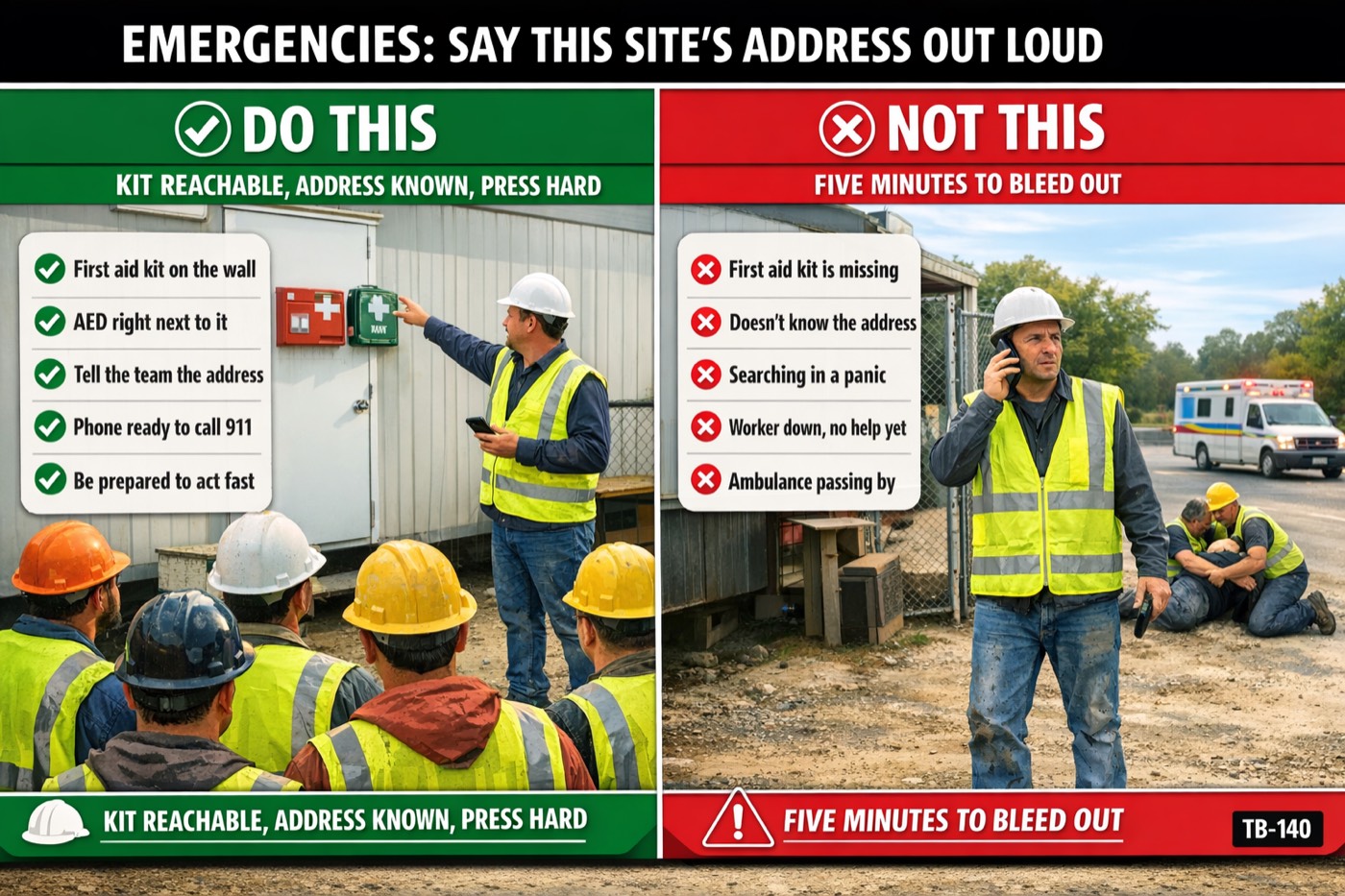
The first thing the 911 dispatcher asks is where you are. If nobody on this crew can say this site's address without looking, the ambulance is sitting still while we figure it out.
The points
- A cut femoral artery can bleed a man out in under five minutes. Cardiac arrest gives you about the same window before the brain starts dying. Neither waits for an ambulance.
- The rule: with no clinic close by, somebody on site holds a current first aid certificate, the kit is easy to reach and checked weekly, and there is a way to call an ambulance and a posted address to give them.
- Everybody on this crew knows three things before work starts: who is trained, where the kit is, and where the AED is or that there is not one.
- Bleeding: press hard on it with whatever is clean, and if it soaks through and keeps coming, tourniquet two to three inches above the wound, tighten until it stops, write the time on it.
- The 911 call: address first, then what happened, then stay on the line. Send somebody to the gate to wave the ambulance in.
Why it goes wrong
1926.50 says that where no infirmary, clinic or hospital is reasonably close, a person with a current first aid certificate must be on site. OSHA's interpretation letters put reasonably close at about three to four minutes for a site where a serious bleed or cardiac arrest is possible, which is every site with a saw on it. That means the trained person is one of you, not the office.
The kit has to be weatherproof, easy to reach, and checked before each job and at least weekly. A kit in a locked truck that left for parts is not on site. Look at it today: gauze, a real pressure bandage, a tourniquet, gloves, and nothing that has expired.
In a 911 area the rule says the site's location must be posted in plain view at the site unless the phone gives the dispatcher the location on its own. Say it out loud at the tailgate. On a new subdivision with no numbers yet, the dispatcher needs the nearest cross street and a landmark, and the caller stays on the line until the crew at the gate has the ambulance.
The AED: survival from sudden cardiac arrest drops roughly 7 to 10 percent for every minute without a shock. With an AED on the truck and CPR started right away, more than half of those people can live. The machine talks you through it; the only mistake is not opening it.
Bleeding control: direct pressure, hard, with your whole weight, for real minutes, not a dab with a paper towel. Arterial bleeding from an arm or leg that will not stop under pressure gets a tourniquet high and tight, two to three inches above the wound and not over a joint, cranked until the bleeding stops. It will hurt. Note the time; the hospital needs it.
The common mistake is driving the injured man in the truck. A pickup has no oxygen, no suction, no way to work on him in the seat, and a scared driver drives badly. Call 911, start the help you can give, and get somebody to the gate.
Questions for the crew
- Who on this crew is actually holding a first aid card right now, and when does it expire?
- What is this site's address, and who is the guy standing at the gate when the ambulance comes?
- Where is the tourniquet, and has anyone here ever put one on?
To close
Before the first cut today, everyone here can point at the kit and say the address.
To hold this talk with your crew
1
Read it aloud. Five minutes, before the work starts.
2
Ask the questions. A crew that talks is a crew that remembers.
3
Have them sign on their own phones, and the record is sealed.