Tools: the grinder with the guard taken off
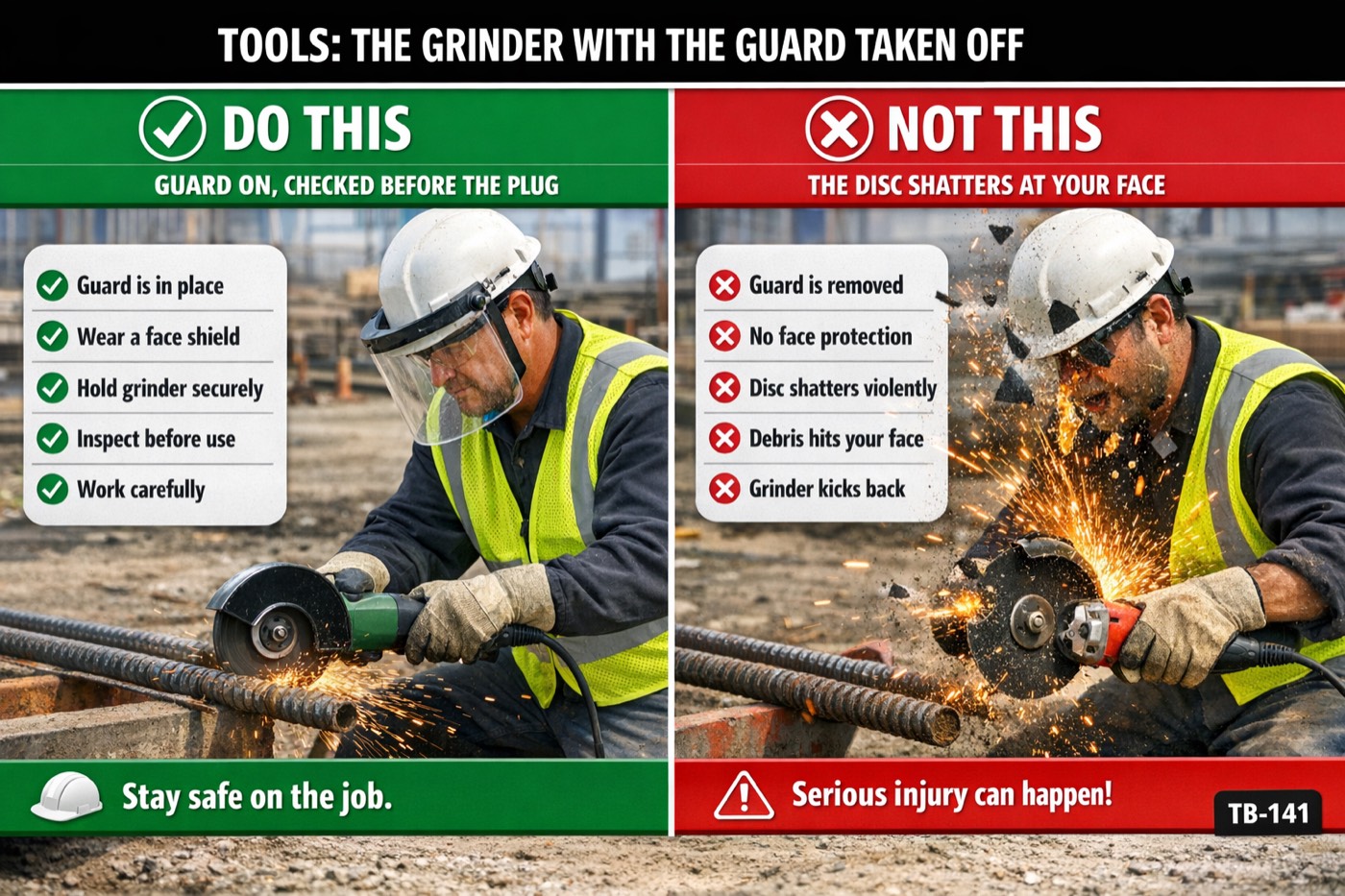
A 4-1/2 inch grinder turns about 11,000 RPM. The edge of that disc is moving close to 150 miles an hour, and the guard is the only thing between it and your face when it lets go.
The points
- A grinder disc that shatters at speed throws pieces faster than a big-league fastball, around 140 miles an hour, in whatever direction the missing guard would have covered. Cut-off wheels kick back into the leg, the wrist, the neck.
- The rule: every hand and power tool on this site stays in safe condition, whether the company bought it or you did, and the guards stay on. A tool that is not safe gets tagged and pulled, not set aside for later.
- Inspect before you use it, every time: guard on and tight, cord and plug whole, trigger releases when you let go, disc rated for the tool's RPM and not chipped.
- The borrowed tool is your problem the second you pick it up. If you would not run your own grinder without a guard, you do not run someone else's.
- Electric tools are double insulated or grounded, cords never carry the tool, and the plug comes out before you change the blade or the disc.
Why it goes wrong
1926.300(a) covers tools furnished by the employee as well as the employer, which is the sentence that matters for the personal drill and the grinder that came from home. Once it is on this site it meets the same standard as anything out of the company trailer. (b) covers guarding, and a guard someone removed because it was in the way is a guard that is missing.
Why the guard matters on a grinder: an abrasive disc is bonded grit, and it fails from a chip, a drop, a wrong RPM rating, or side load on a cutting wheel. When it breaks at 11,000 RPM the pieces leave the tool faster than you can flinch. The guard is set so those pieces go toward the floor and not toward you, and it takes the hit when the tool kicks.
Cords: a cord with the ground pin broken off or the jacket cut down to the wire is a shock waiting for a wet floor. 1926.302(a) says electric tools are double insulated or grounded, and cords are not for lifting or lowering the tool. Look at the plug and the last foot of cord before you plug in, because that is where they fail.
The trigger lock-on: a saw or grinder that keeps running when you drop it walks across the slab toward whoever is nearest. If the trigger does not release, the tool is done for the day. Tape holding a trigger down is a tool that will run without a hand on it.
Right tool, right accessory. A 7-inch disc on a 4-1/2 inch grinder spins past its rated speed; a wood blade on a grinder has no guard designed for it and no speed rating for it; a wrench used as a hammer chips and throws steel. The rating printed on the disc is a number, the tool has a number, and the disc's number has to be the same or higher.
Borrowed and shared tools are where inspection breaks down, because everyone assumes the last guy checked. He did not. Under 1926.20(b)(3) a tool out of compliance gets tagged or locked out or physically removed. Tape and a Sharpie on the handle, and it goes on the truck, not back in the pile.
Questions for the crew
- Which tools on this site right now came from somebody's own truck, and who has looked at them?
- Is there a grinder or saw here with the guard off or wired back, and why?
- What would you do if the trigger on the saw you were handed did not release?
To close
Every grinder and saw on this site gets a hand on the guard and an eye on the cord before it plugs in today.
To hold this talk with your crew
1
Read it aloud. Five minutes, before the work starts.
2
Ask the questions. A crew that talks is a crew that remembers.
3
Have them sign on their own phones, and the record is sealed.