Fatigue: 17 hours awake drives like a 0.05
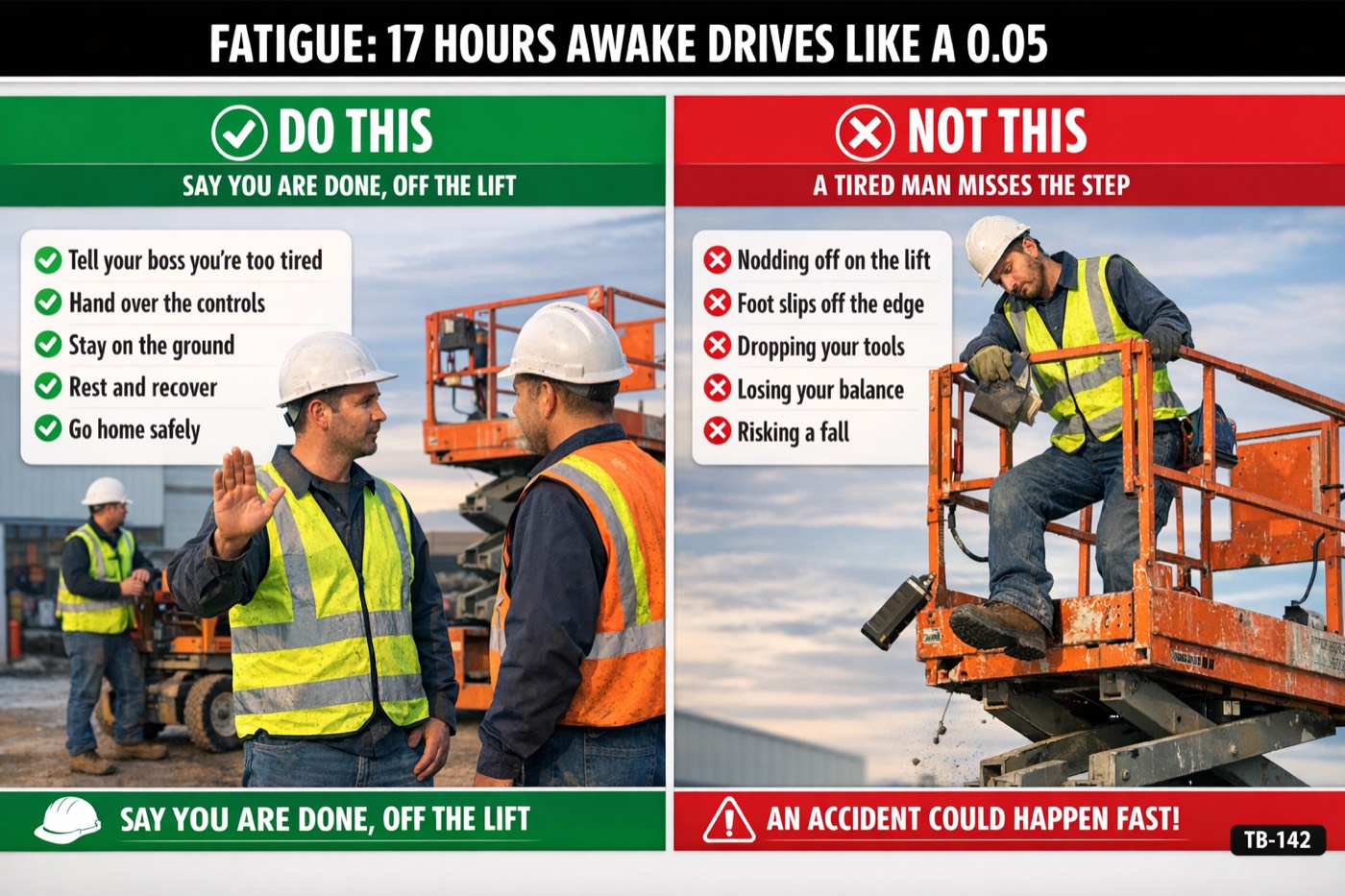
After 17 hours awake your reaction time matches a person with a blood alcohol of 0.05. If you got up at 4:30, that is 9:30 tonight, and the second job usually starts before that.
The points
- A tired man does not fall asleep on the saw. He misses the step, drops the end of the load, and reads the tag wrong, and he does it at the same speed as somebody who has been drinking.
- The numbers: 17 hours awake is about a 0.05, 24 hours awake is about a 0.10. Injury risk on a 12-hour shift runs roughly a third higher than on an 8, and it climbs every hour after that.
- The rule that covers it is the employer's duty to keep an unsafe condition off the site, and a crew that cannot stay awake is one. That is why the foreman asks and why you answer straight.
- The second job, the sick kid, the drive from two hours out, count as hours awake. Nobody here is grading you on it; we need to know before you get on the lift.
- Saying you are done is a safety call, not a weakness. Say it before the last lift of the day, not after.
Why it goes wrong
Sleep research, and Dawson and Reid's 1997 study is the one everybody cites, measured hand-eye coordination against hours awake and against blood alcohol. At 17 to 19 hours awake, performance matched 0.05 BAC. At 24 hours it matched 0.10, which is over the legal limit for driving in every state. Your body does not know it is fatigue and not beer.
Long shifts: a study of about 10,000 US workers found injury rates on shifts over 12 hours were roughly 37 percent higher than on standard shifts, and overtime weeks past 60 hours ran about 23 percent higher. The hazard on the site did not change. What changed was how well the man saw it.
What fatigue actually does: it slows reaction time, narrows attention to the thing in front of you so you stop scanning for the truck behind you, and it makes you decide to skip the step you would normally take. The tired man is not clumsy so much as he is confident about a shortcut.
The microsleep is real: two to ten seconds of sleep with the eyes open, usually with no memory of it. At a saw, on a ladder, on a lift control, or on the drive home at 65 miles an hour, that is the whole accident. The drowsy driving talk covers the road; this one covers the site.
1926.20(b) puts the duty on the employer to run a program that keeps unsafe conditions off the site, with inspections by a competent person. There is no OSHA hours-of-service rule for construction the way there is for drivers, so the rule is the company's, and the company's rule is that a foreman can send a man to sit down or go home, and the man can say it first.
The long week: a 12-hour day means about 5 or 6 hours of sleep once you count the drive, food and a shower. Sleep debt stacks. By Thursday of a 60-hour week you are running on the same reserve as the guy who pulled an all-nighter, and Friday is the day the crew has the accident.
Questions for the crew
- Who here has been awake more than 15 hours by the end of today's shift, counting the second job or the drive?
- Which task on this site today is the one you would not want a tired man on, and who is on it?
- If you told me you were done at 2 p.m., what do you think would actually happen?
To close
Anybody on this crew who is running on four hours of sleep says so now, and that man is off the lift and the saw today.
To hold this talk with your crew
1
Read it aloud. Five minutes, before the work starts.
2
Ask the questions. A crew that talks is a crew that remembers.
3
Have them sign on their own phones, and the record is sealed.