The new hire: hurt in month one, not year ten
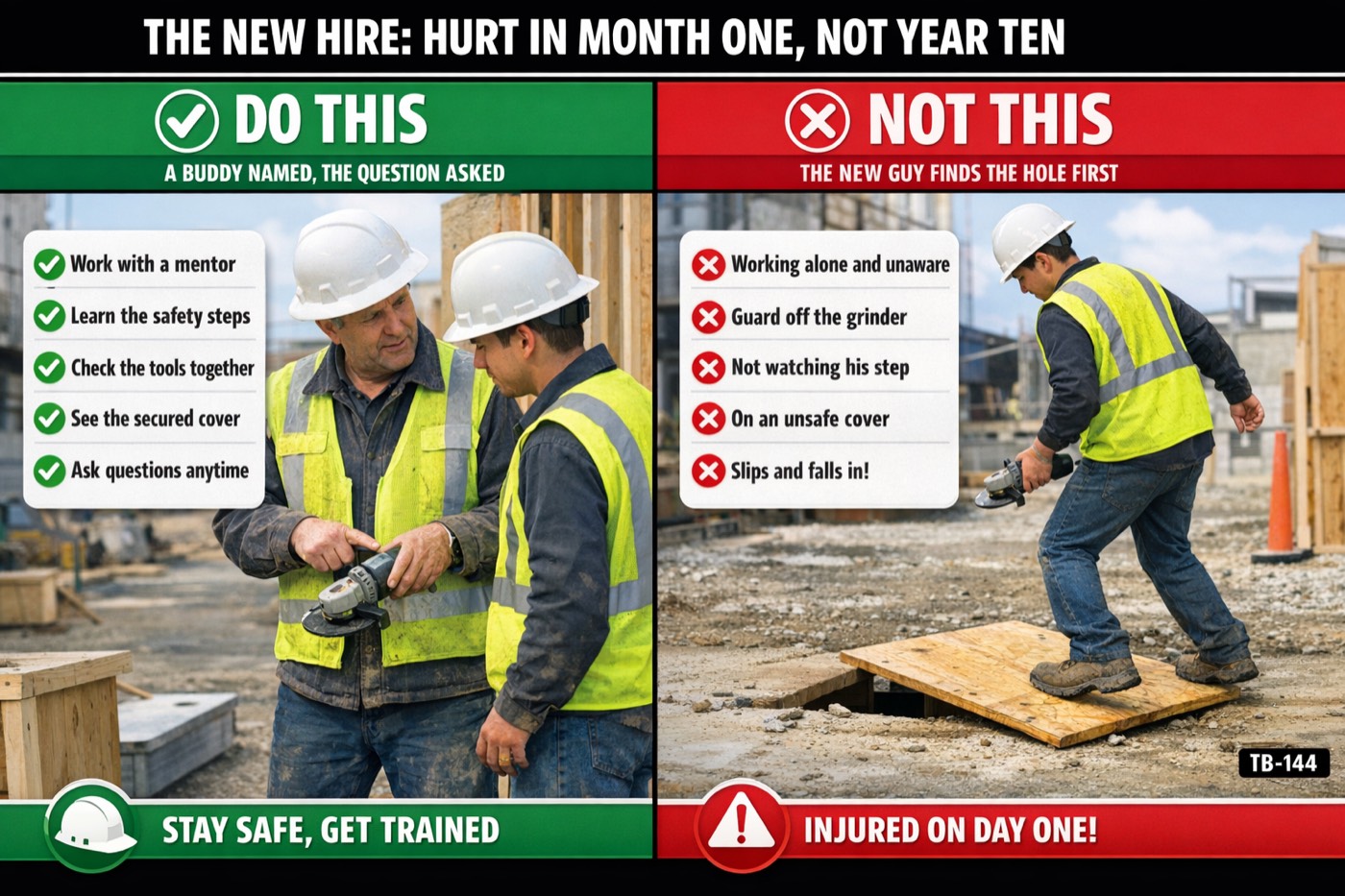
Insurance claim data says about a third of workplace injuries happen in the worker's first year on the job, and the first month is the worst of it. The new guy is not careless. He does not know what he does not know.
The points
- The new hire gets hurt on the thing everyone else stopped seeing: the hole in the floor with the plywood cover, the grinder without a guard, the pinch at the trailer hitch. He also gets hurt because he will not ask.
- The rule: the employer instructs each employee in recognizing and avoiding unsafe conditions and in the rules that apply to his work. Instruct means shown, on this site, not handed a binder.
- Every new hire on this crew has a name attached to him for the first week. That person knows where he is, what he is doing, and whether he has done it before.
- The question he will not ask is the one that hurts him. Ask it for him: have you run this before, do you know what it does when it binds, where is the cut-off.
- Nobody hands the new guy the worst job because he is new. Nobody hands him a tool he has not been walked through, and nobody laughs at the question.
Why it goes wrong
The numbers: a large US insurer's review of its workers' compensation claims found about 35 percent of injuries happened in the first year of employment, across every industry, and construction ran higher. Studies out of Canada found workers in their first month had roughly three times the claim rate of workers with a year on the job. Experience is a form of protection, and the new hire does not have it yet.
Why the first weeks: the new man is learning the task, the crew, the foreman, the site and the tools at the same time, so the part of his attention that should be scanning for the excavator swing is used up on remembering names. He also wants to look capable, so he says yes to things he has never done. Both of those are normal, and both are on the crew to cover.
1926.21(b)(2) says the employer instructs each employee in the recognition and avoidance of unsafe conditions and the regulations that apply to his work. A safety video in the office does not cover the hole on this site. The instruction that counts is a walk with somebody who points: that is the edge, that is the line overhead, that is the man you listen to on the crane.
The buddy: assign one by name. Not to babysit, to be the person the new hire asks. Cousins and brothers-in-law often bring new hires in; that is fine, but the buddy is the one with the years, not the one with the ride. For the first week the buddy checks in before each new task, not just at start-up.
What the new hire does not know includes the words. Tag line, competent person, hot stick, lockout, spotter, the hand signal for stop. If he speaks Spanish and the foreman gives instructions in English, or the other way around, the instruction did not happen. Find out on day one which language the safety talk needs to be in, and give it in that one.
The common mistake is assuming the guy with ten years in another trade is not new. He is new here. A journeyman electrician has never been in a trench box; a framer has never stood under a crane load. Ask what he has done, not how long he has done it.
Questions for the crew
- Who on this crew has been here less than a month, and who is his buddy by name?
- What is the one hazard on this site that everybody stopped noticing and the new hire has not seen yet?
- What question did you not ask in your first week that you should have?
To close
Every man here with less than a month on this crew has a buddy named out loud before we start today.
To hold this talk with your crew
1
Read it aloud. Five minutes, before the work starts.
2
Ask the questions. A crew that talks is a crew that remembers.
3
Have them sign on their own phones, and the record is sealed.