Working alone: the fall nobody was there to see
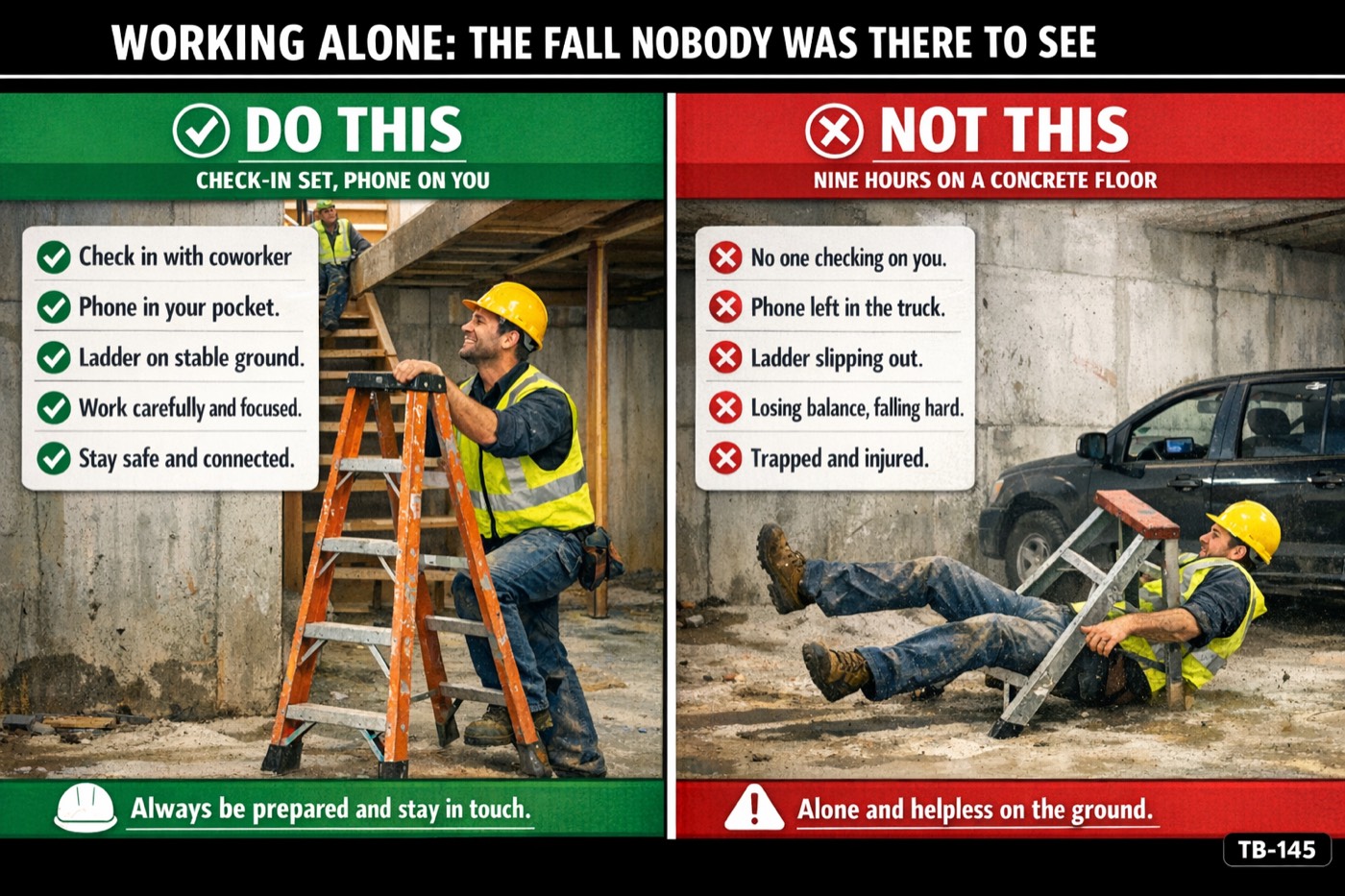
A man who falls in an empty basement at 9 a.m. with a broken pelvis and a phone in the truck is found when someone notices he did not come home. That is eight or nine hours on a concrete floor.
The points
- Alone, an injury that is survivable with help becomes the one that kills: the bleed nobody presses on, the fall nobody hears, the CO in the closed room, the heat stroke in the attic with nobody to notice you stopped making sense.
- The rule underneath this is the employer's duty to keep hazards under control with regular inspection, and a man nobody can reach is a hazard nobody is inspecting. So the company rule is: nobody works alone without a check-in.
- Check-in means somebody knows exactly where you are, what you are doing, and when you are due to call, and the interval is short enough to matter. Every hour on a normal task. Every 15 minutes on a ladder, in a crawl space, in an attic in summer.
- The phone is on you, charged, with a signal you tested where you are working, not in the cup holder. A missed check-in gets a call back, and a missed call back gets someone driving there.
- Some jobs are never done alone: confined space, live electrical, anything on a ladder above 10 feet, hot work, a trench. If the job is one of those and the second man did not show, the job waits.
Why it goes wrong
The job nobody knows you are on is the dangerous one: the Saturday service call, the punch-list item you went back for, the one-hour fix on the way home. Nobody is expecting you, so nobody misses you. Before you go, one text to the foreman or the office with the address and when you expect to be done, and one when you are.
What alone changes: a compound fracture with a 911 call and pressure on the bleed is a bad month. The same fracture with no call is shock, and shock unattended for hours is death. A carbon monoxide headache with a partner is a walk outside; alone it is confusion and then unconsciousness. The hazard is the same; the time to help is what changed.
Working at height alone is where most of these deaths are. A fall from a ladder into a dark mechanical room, a roof edge with no one to see you go over, an attic where the heat gets you before you get down. The fall protection rules in 1926.502 do not care whether anyone is watching, but a rescue plan for a man hanging in a harness assumes a second person. Alone, there is no rescue plan, so there is no harness work alone.
The check-in system does not have to be an app. A text at a set time, a call to the office every hour, a radio on a shared channel, or a GPS tracker on the phone shared with the foreman all work. What does not work is 'I'll call if I need something,' because the injuries that matter are the ones where you cannot call.
Under 1926.20(b) the employer's program provides frequent and regular inspections of job sites by a competent person. A one-man job at a remote site still gets that: the foreman knows the site, the task and the hazards before the man leaves, and the man does the walk-around before starting. If he finds a hazard that needs two people, he calls, he does not improvise.
Set the return time, and make somebody responsible for noticing. The failure in most working-alone deaths is not that nobody was told; it is that the person told assumed he was fine. Whoever gets the check-in owns the callback, and the callback is a drive, not a shrug.
Questions for the crew
- Who on this crew is working alone today, where, and who is he checking in with and how often?
- If you fell in the space you are working in today, could anyone hear you, and does your phone have a signal there?
- What is the job on this week's schedule that somebody will go back to alone, and does the office know?
To close
Nobody on this crew works alone today without a named person, a check-in time, and a phone that has been tested where the work is.
To hold this talk with your crew
1
Read it aloud. Five minutes, before the work starts.
2
Ask the questions. A crew that talks is a crew that remembers.
3
Have them sign on their own phones, and the record is sealed.