The weather call: 30 seconds of thunder, 30 mph of wind
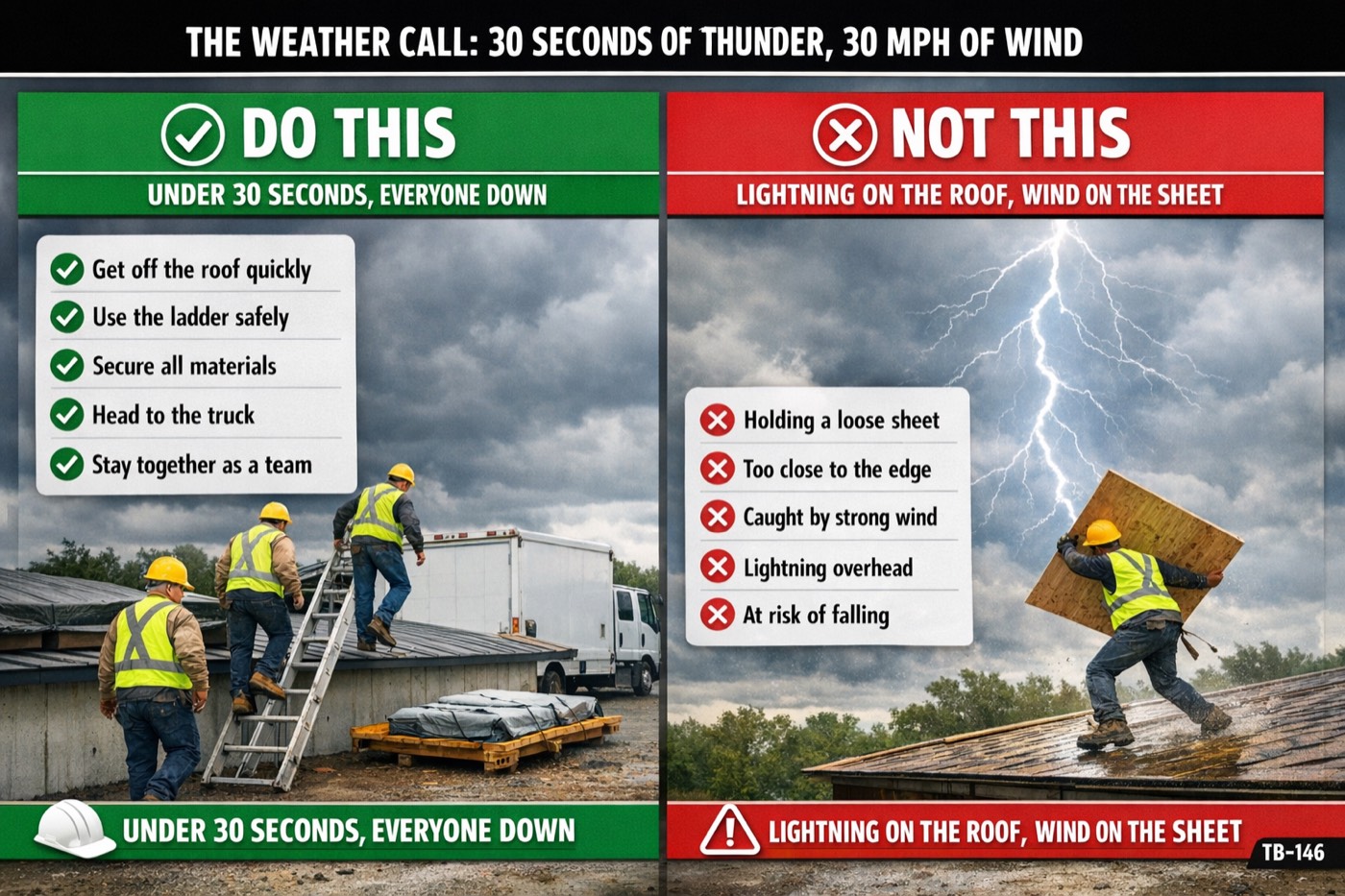
Sound covers a mile in about five seconds. If you count less than 30 seconds between the flash and the thunder, that strike was inside six miles, and the next one can reach you. Lightning has hit people ten miles from the rain.
The points
- Lightning kills about 20 people a year in the US and hurts hundreds more, mostly outdoors, mostly men, and the roof, the scaffold and the open field are the worst places to be. Wind takes men off roofs holding sheet goods and tips lifts and cranes.
- The 30-30 rule: flash to thunder under 30 seconds, everyone off the roof and the lift and into a building or a hard-topped truck with the windows up. Wait 30 minutes after the last thunder before anyone goes back.
- Wind: a 4x8 sheet in a 30 mph gust carries about 75 pounds of push. At 40 mph it is over 130. A man on a roof or a scaffold does not win that, so sheet goods stay down in gusts over about 25 and the lift stays down at the manufacturer's limit, usually 28.
- The rule under this is the employer's duty to inspect and keep unsafe conditions off the site, and weather is a condition. The foreman makes the call; anyone on the crew can call for it, and the answer is never 'after this one'.
- When the day ends early, it ends: tools stowed, materials weighted, the trench covered, the lift lowered. Then the crew goes, and the question about pay goes to the office, not to whoever is still on the roof.
Why it goes wrong
Lightning physics: thunder travels about a mile every five seconds, so 30 seconds means six miles. Storms move at 20 to 40 miles an hour and lightning routinely strikes 10 miles ahead of the rain, which is why the sky above you being blue means nothing. Safe places are a building with wiring and plumbing, or a hard-topped vehicle with the windows up. Not a canopy, not a porta-john, not under the one tree, not the open cab of the skid steer.
On the site, height and metal are the problem. A man on a roof, a scaffold, a lift or a crane is the tallest thing around; a man holding rebar, conduit or a wet rope is connected to it. When the count hits 30, the lift comes down first because it takes the longest, and the crane boom gets lowered or the operator gets out and away from it.
Wind pressure goes with the square of speed: 0.00256 times the speed in miles per hour squared gives pounds per square foot. That is why a gust from 20 to 40 mph is not twice as bad, it is four times. A sheet of plywood, a panel, a door, or a sheet of metal decking becomes a sail, and on a roof the sail pulls the man toward the edge he was walking away from.
Equipment limits are printed numbers. Most boom lifts are rated to 28 mph and the manual says so; scissor lifts used outdoors often the same or lower; crane load charts drop as wind rises and the manufacturer sets a shutdown speed, often 20 to 30 mph at the boom tip, which is faster than at the ground. A phone weather app gives you the gust forecast; a $20 handheld anemometer gives you the number where you are.
Who decides: the foreman makes the call and says it out loud, and the job goes on hold with nobody arguing the schedule on the roof. But anybody sees the flash, anybody counts, anybody can say 30. The thing that kills is the man who thinks he can finish the row. 1926.20(b) puts the duty on the employer to keep the site safe through competent-person inspection; the competent person on weather is the one with the count and the wind number.
Ending early is its own hazard. In a hurry to beat the storm, men skip the tie-off to get the last sheet, leave the trench open with no cover, leave a lift up that gets blown over, and drive off with the load half strapped. Ten minutes of securing before the storm is cheaper than what the storm does to an unsecured site, and the drive home in the rain gets the same care as any other.
Questions for the crew
- If the count hit 30 right now, where is the closest safe place from where each of you is working, and how long to get there?
- What on this site today turns into a sail, and who is holding it?
- Who is the one making the weather call on this crew, and does everyone know it is not up for argument?
To close
Anyone who counts under 30 today says it out loud, and the whole crew is off the roof and the lift before the next flash.
To hold this talk with your crew
1
Read it aloud. Five minutes, before the work starts.
2
Ask the questions. A crew that talks is a crew that remembers.
3
Have them sign on their own phones, and the record is sealed.