After hours: the open trench, the ladder, and the kid
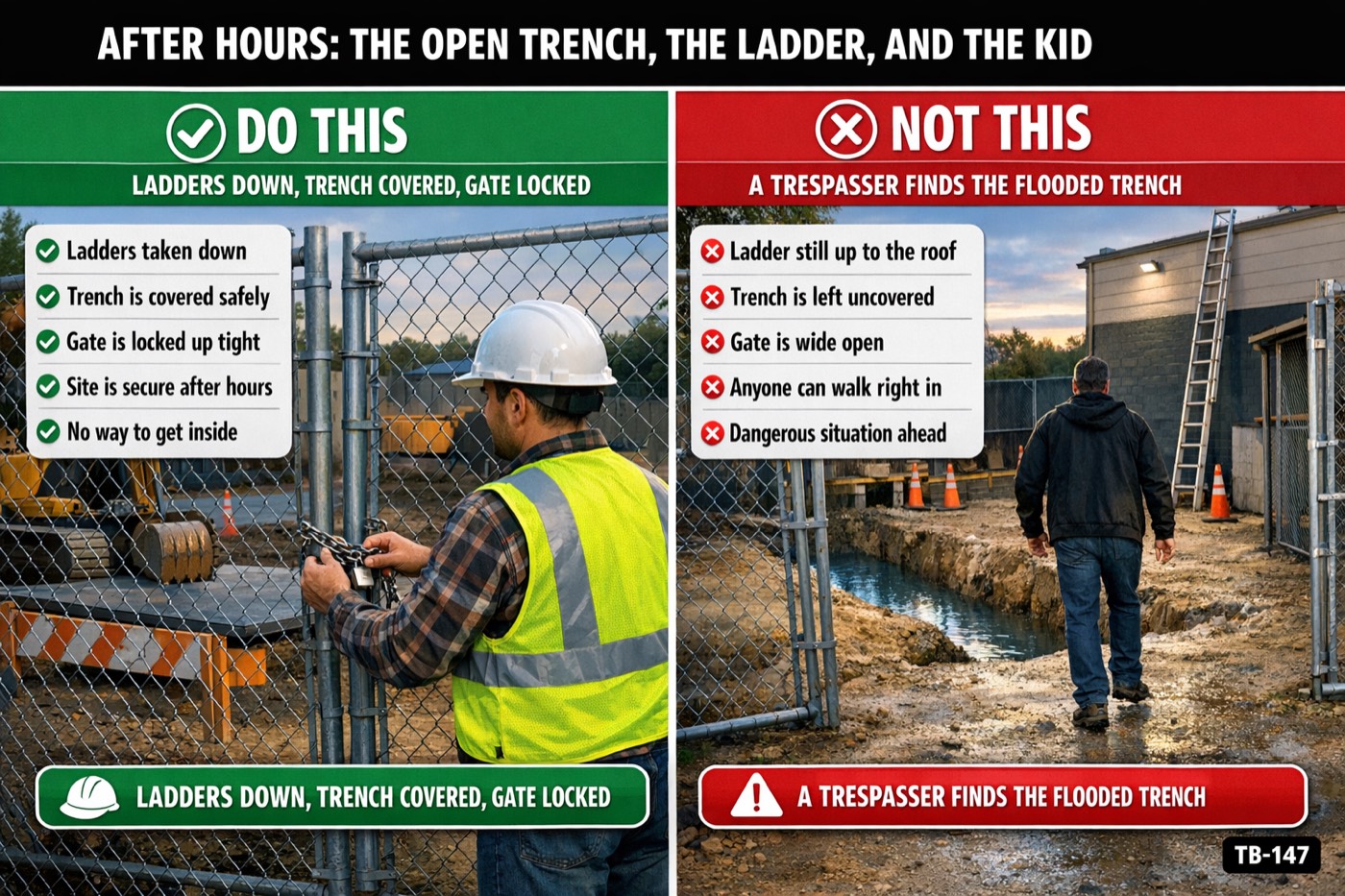
A child can drown in two feet of water, and by morning after a rain the trench you left open has more than that in it. The fence is not for the tools. It is for the kid who thinks the site is a playground.
The points
- After the crew leaves, the site still kills: the trench with water in it, the extension ladder left up to the roof, the excavator with the key in it, the stack of block that tips, the open floor hole with the plywood kicked off.
- The law calls it an attractive nuisance: a site that draws children in and hurts them can be on the company, and a sign alone does not get it off the hook, because a nine-year-old does not read Danger.
- The rule is the employer's duty of regular inspection by a competent person, and the last inspection of the day is the walk to the gate. Nobody leaves until it is done.
- The end-of-day list: fence closed and locked, gaps closed, trench covered or barricaded or backfilled, ladders down and chained, keys out, buckets and forks on the ground, holes covered and the cover secured, materials stacked so they cannot fall.
- Signs stay up and visible while the hazard exists, and come down when it is gone. A Danger sign on a fence with a hole in it is a sign for the lawyers, not for the kid.
Why it goes wrong
What draws kids and drunks and thieves is the same list: the machine, the ladder, the pile of sand, the hole, the water. A trench that is 4 feet deep with 2 feet of water is a drowning for a child and a hypothermia case for an adult who fell in at night. Cave-in odds go up with the water and with the freeze-thaw, so the trench you walk into on Monday is not the one you left Friday.
1926.651(k) requires a competent person to inspect the excavation before each shift and after every rain; that is what tells you the walls changed overnight. For the public the fix is simpler: an excavation that will be open overnight gets covered with plates or decking rated for the load, or barricaded with something a child cannot get through, and on a public street it gets the plates and the cones the permit calls for.
The ladder: an extension ladder left set up to the roof is an invitation, and the kid who climbs it is 20 feet up with no rail and no idea how to get down. Ladders come down at the end of the day, get laid flat or chained to a post, and the roof hatch or the stair to the deck gets closed. The 1926.1053 rules are about you using it; taking it down is about who uses it after you leave.
Machines: keys out, doors locked, buckets and blades on the ground, the lift lowered and the key pulled. A skid steer with the key in it and a teenager who has seen videos is a fatality on somebody else's kid and a lawsuit that ends the company. Fuel cans locked in the box, not next to the fence.
Holes and floors: floor holes and skylight openings get a cover that is secured and marked, per 1926.502(i), because a loose sheet of plywood over a hole is worse than no cover: it looks like floor. Second-floor edges with no rail yet get a rail before you leave or the stair gets blocked. Stacked material gets banded or stepped back so a shove does not bring it down.
The fence is the last line, not the first. It gets checked at the gate every night: panels clamped, no gap a kid fits through, the gate chained, the padlock actually locked and not just hung there. 1926.200(a) says signs are visible whenever work is going on and come down when the hazard is gone, and we keep them up overnight while the hole is still there; the sign is for the adult who can read it, and the fence and the cover are for the ones who cannot.
Questions for the crew
- What on this site right now would you not want your own kid to find at 7 tonight?
- Who does the walk to the gate today, and what is on the list for this site specifically?
- Is there a trench or a hole here that will still be open when we leave, and what goes over it?
To close
The site gets a walk to the gate tonight, and nothing a kid can climb, fall into, or start is left the way it is now.
To hold this talk with your crew
1
Read it aloud. Five minutes, before the work starts.
2
Ask the questions. A crew that talks is a crew that remembers.
3
Have them sign on their own phones, and the record is sealed.