The SDS: the chemical you did not know was in it
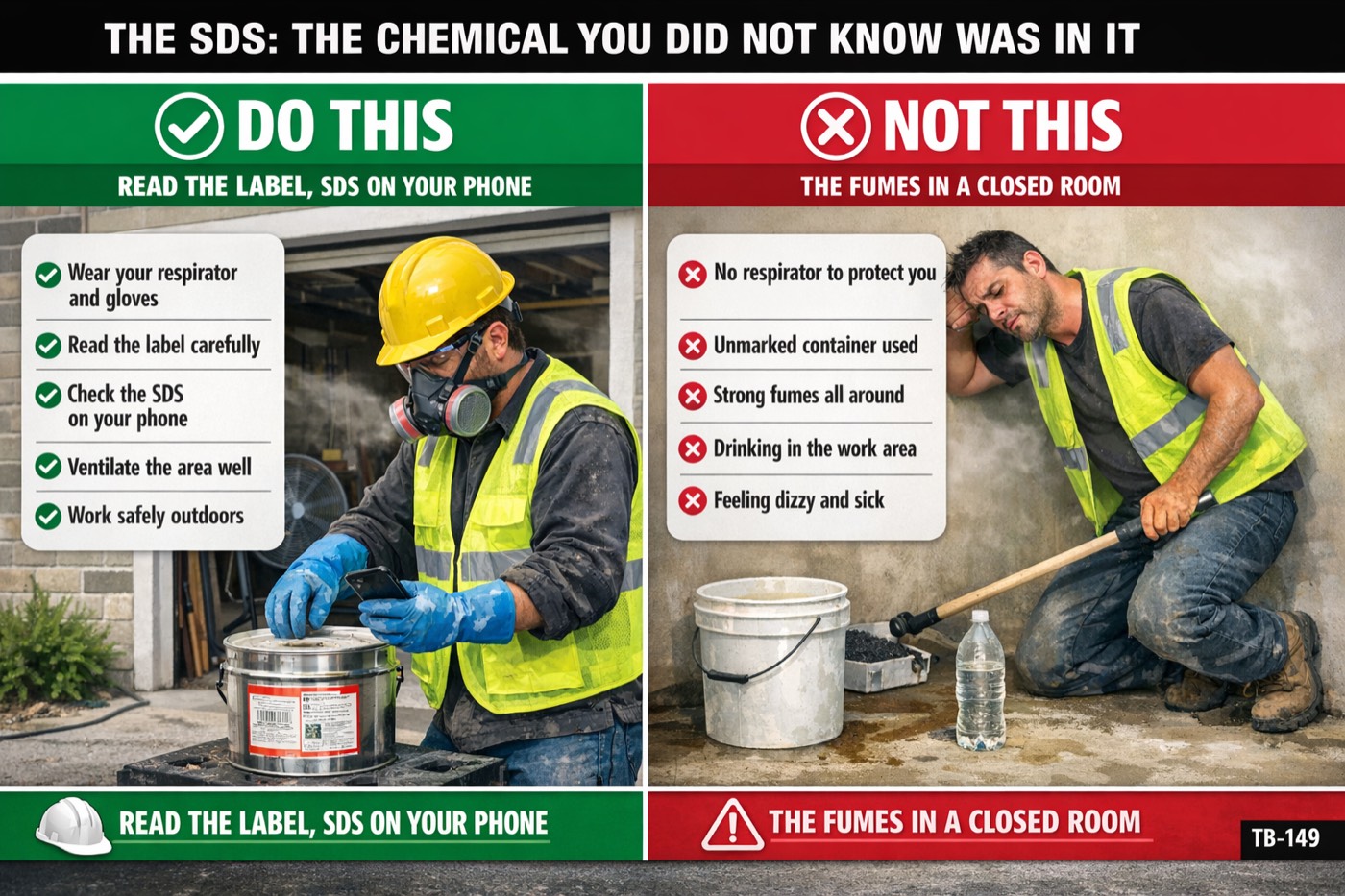
The concrete sealer you rolled on last week is mostly xylene. The form release is diesel. The 'natural' stripper has methylene chloride in it, and methylene chloride has killed men in bathtubs in under an hour. The label knew. Did you?
The points
- Chemicals on a site hurt in three ways: the burn or the rash you feel today, the lungs and the liver you lose in ten years, and the fire or the fumes in a closed room that kill in minutes. The SDS tells you which one you are holding.
- The rule: every hazardous product on this site has a label, a safety data sheet you can get to during your shift, and training on what it does. Same rule as general industry, 1910.1200, applied to construction by 1926.59.
- The label: product name, signal word Danger or Warning, the pictogram, and what to do. Read it before you open it. If a container has no label, you do not know what is in it, and it goes to the foreman, not into use.
- The SDS is 16 sections, same order every time. Section 2 is the hazard, 4 is first aid, 8 is the PPE, 10 is what it must not touch. Get it on your phone: the manufacturer's site, a QR on the pail, or the binder in the trailer.
- The pour-off: a hazardous product moved into a smaller container is labeled unless you are the one who filled it and you use it up the same shift. Gasoline in a water bottle has killed people who took a drink.
Why it goes wrong
1926.59 makes 1910.1200 the construction rule, word for word. What it requires of the employer: a written hazard communication program, a list of the hazardous chemicals on the site, labels on containers, an SDS for every one of them readily accessible during each shift, and training before you work with it and again when a new hazard shows up. What it requires of you: read the label, know where the SDS is, wear what section 8 says.
The chemical you did not know was in it: cement is caustic enough to burn to the bone through a wet knee; the cure-and-seal is 40 to 60 percent solvent; two-part epoxies and urethane foams carry isocyanates that sensitize your lungs permanently; brake and parts cleaners carry chlorinated solvents; the tile cleaner is muriatic acid, which is hydrochloric. Section 3 of the SDS lists the ingredients over 1 percent, and section 11 says what they do to you.
The label under the current rule has six parts: the product identifier, the signal word (Danger for the worse category, Warning for the lesser), hazard statements, the pictograms in red diamonds, precautionary statements, and the maker's contact. The flame is flammable, the skull is acutely toxic, the exploding chest is a long-term health hazard like cancer or organ damage, the corrosion symbol is a burn to skin or eyes. Four seconds of looking tells you what you need.
Getting the SDS: it has to be readily accessible, which OSHA reads as available without leaving the work area or hunting for a key. A phone with signal and the manufacturer's website meets that; so does a binder in the trailer that is actually kept current. What does not meet it is a binder at the shop 40 minutes away. Before you start with something new today, pull section 4 up, because the moment you need first aid instructions is not the moment to start searching.
Unlabeled containers: 1910.1200(f)(8) allows a portable container with no label only when the person who transferred the chemical uses it up in the same shift, immediately. The coffee can of thinner that sits on the shelf for a week, the sprayer with something in it from last job, the water bottle with gas, are all violations, and the water bottle one kills. Take it to the foreman to identify or dispose of it; nobody sniffs it to find out.
Mixing and the closed room: bleach and acid cleaner make chlorine gas; two solvents in a bucket can flash; any solvent in a bathroom with the door shut and a pilot light in the water heater is a fire or an unconscious man. Section 10 of the SDS, stability and reactivity, is the one for what not to mix. Section 7 says how to store it, and section 8 says whether you need a respirator, which means a fit test, not a paper mask from the truck.
Questions for the crew
- What product on this site today would you not be able to name the main ingredient of, and where is its SDS?
- Is there a container here right now with no label, and what is the plan for it?
- If the guy next to you got the sealer in his eyes, what does section 4 say to do, and how many minutes does it say to flush?
To close
Before anyone opens a new pail today, the label gets read out loud and the SDS is on a phone that is on this site.
To hold this talk with your crew
1
Read it aloud. Five minutes, before the work starts.
2
Ask the questions. A crew that talks is a crew that remembers.
3
Have them sign on their own phones, and the record is sealed.