Hearing you won't get back
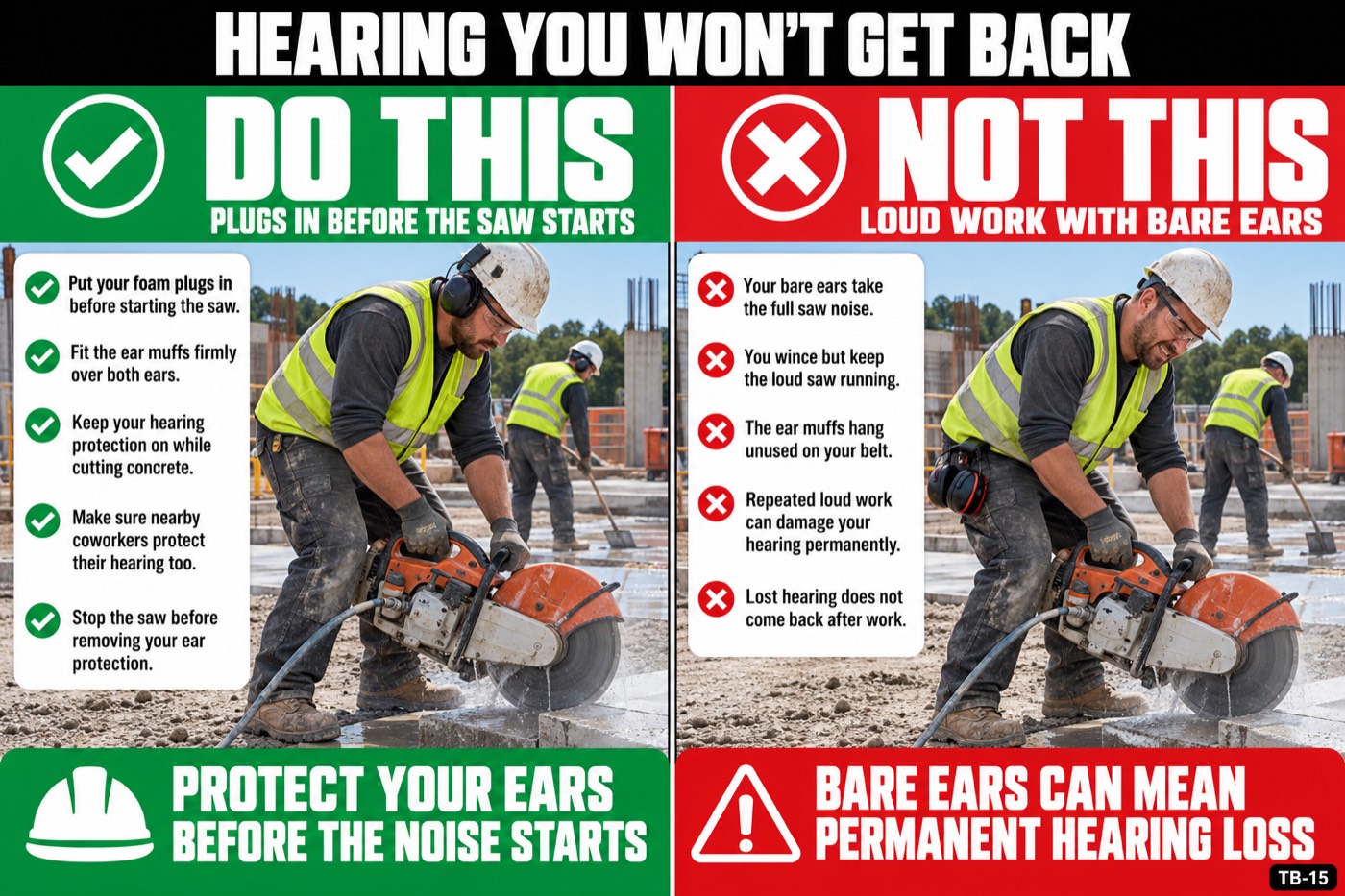
Hearing does not come back. There is no surgery, no hearing aid that undoes it. Whatever you have left at the end of this career is what you keep.
The points
- Noise damage is permanent, painless, and gradual. By the time you notice it, it's already done.
- At 90 decibels averaged over eight hours, hearing protection is required. Most power tools exceed that easily.
- If you have to raise your voice to be heard three feet away, you need protection.
- Plugs, muffs, or both for very high noise. Both together gets you more than either alone.
- Ringing in your ears after a shift is a warning sign, not a normal part of the job.
Why it goes wrong
Noise-induced hearing loss takes the high frequencies first, which is where consonants live. That's why people with it can hear that you're talking but can't make out the words, especially in a noisy room.
Foam plugs only work when they're inserted properly. Roll them thin, pull the ear up and back, insert deep, and hold while they expand. A plug sitting in the opening of your ear canal is doing almost nothing.
The damage is to hair cells in the inner ear, and those do not regenerate. That is the whole reason this talk is different from most: there is no recovery period, no light duty, no healing. Every loud shift adds to a total that only goes one direction.
It is also painless and gradual, which is why nobody stops in time. The loss accumulates over years, and the person adapts without noticing - turning the TV up, asking people to repeat themselves, avoiding restaurants. By the time it is obvious, decades of exposure are already banked.
OSHA's limit is 90 decibels averaged over eight hours, and above that limit the rule requires a hearing conservation program. Many companies start one at 85. Most power tools pass both easily - a circular saw, a grinder, a hammer drill, a chop saw. The three-foot rule is the practical version of the meter: if you are raising your voice to be understood at arm's length, you are in it.
Ringing after a shift is not normal and is not the ears being tired. It is a sign that damage occurred that day.
Questions for the crew
- What's the loudest tool we're running today?
- Who here already notices ringing or trouble hearing in a crowd?
- Do we have the right protection on site, and does it fit?
To close
If you have to raise your voice to be heard three feet away, put something in your ears.
To hold this talk with your crew
1
Read it aloud. Five minutes, before the work starts.
2
Ask the questions. A crew that talks is a crew that remembers.
3
Have them sign on their own phones, and the record is sealed.