Night work: five foot-candles and the shadow at the edge
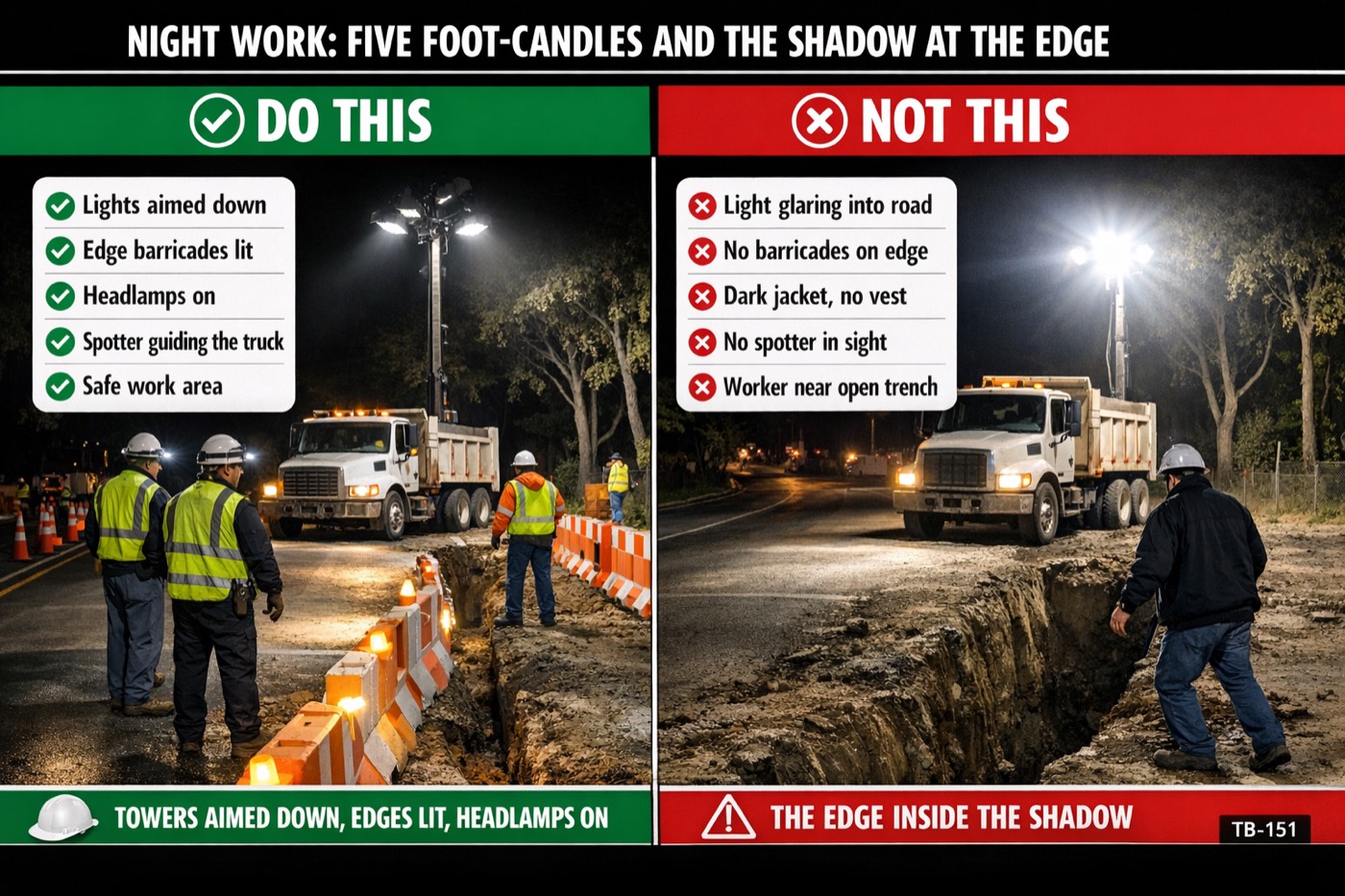
A full moon gives you about a hundredth of a foot-candle. The rule for a construction area at night is five. What you can see by moonlight is a shape; what kills you is the edge inside the shadow the light tower throws.
The points
- At night the hazard is the one you cannot see: the trench edge past the lit area, the rebar in the shadow of the pile, the truck backing with its lights in your eyes, the man in dark clothes the driver never saw.
- The rule: 1926.56 Table D-3 sets 5 foot-candles for general construction areas, 3 for excavation and access ways and refueling, 10 in shops and plant areas, 30 at the first aid station. That is measured where the work is, not at the tower.
- Light towers get set so the work is lit and the beams are not in anyone's eyes: aimed down, away from the road and the equipment operator's line of sight. A driver blinded by your tower is driving toward you.
- Everyone in Class 2 high-visibility at night, Class 3 if there is traffic, and it is clean. A vest under a jacket is a dark jacket. Headlamps on for the walk between lit areas, and the walk goes where the light is.
- Edges and holes get lit or barricaded, both if you can. Nobody walks past the last tower without a light in hand, and nobody backs a truck without a spotter who can be seen.
Why it goes wrong
Foot-candles: one foot-candle is the light of one candle at one foot. A bright office runs 30 to 50; a well-lit parking lot 1 to 5; full moon 0.01. Table D-3's 5 foot-candles for a general construction area is the floor, and it is measured on the work surface, which is why a single tower 100 feet away that reads 5 at its base reads well under 1 where you are cutting. A $30 light meter or a phone app tells you the number.
Where the light falls off: light drops with the square of distance from the source, so doubling the distance cuts it to a quarter. Every tower makes a bright circle and a hard shadow behind anything in it, and the shadow behind the spoil pile or the stack of forms is where the edge is. Set towers to cross-light from two sides so there is no black side to anything a man walks around.
Glare is a hazard by itself. A light tower aimed level puts 4,000 watts into the eyes of the excavator operator or the driver coming down the haul road, and for the two seconds it takes his eyes to recover he cannot see the man in front of him. Aim the fixtures 30 degrees or more below level, put the tower behind the operator's back, and never point it at the road.
High visibility: ANSI/ISEA 107 Class 2 is the vest with enough reflective tape to show up from far off in headlights; Class 3 adds sleeves and is the standard for night roadway work where cars are moving. Reflective tape only works if headlights hit it, so a man bent over in the shadow shows nothing; a headlamp or a light stick on the hard hat shows from any angle. Mud on the vest is a vest that does not reflect.
Backing and moving equipment at night is where the deaths cluster; the backing talk covers it, and at night the spotter needs a lit wand or a headlamp so the driver can see the signal, not just hear it. Nobody walks behind a truck, and the driver stops when he loses the spotter, which at night happens the moment the spotter steps into a shadow.
The body at night: alertness bottoms out between 2 and 5 a.m., reaction time is slower, and the tired eye adapts to the dark more slowly, so the walk from the tower into the dark takes 30 seconds before you can see the ground. Move the tower before you move the work, and if the generator dies everyone stops where they stand, turns on the headlamp, and waits for the light before walking.
Questions for the crew
- Where on this site tonight is the light under five foot-candles, and what is in that shadow?
- Which tower is in a driver's or an operator's eyes from where they sit, and who moves it?
- If the generator quit right now, who is standing next to an edge, and does he have a light on him?
To close
Before the shift starts tonight, the towers get aimed down and away from the road, every edge gets a light or a barricade, and every man has a headlamp and a clean vest.
To hold this talk with your crew
1
Read it aloud. Five minutes, before the work starts.
2
Ask the questions. A crew that talks is a crew that remembers.
3
Have them sign on their own phones, and the record is sealed.