Dry cutting tile indoors: shroud, vacuum, respirator
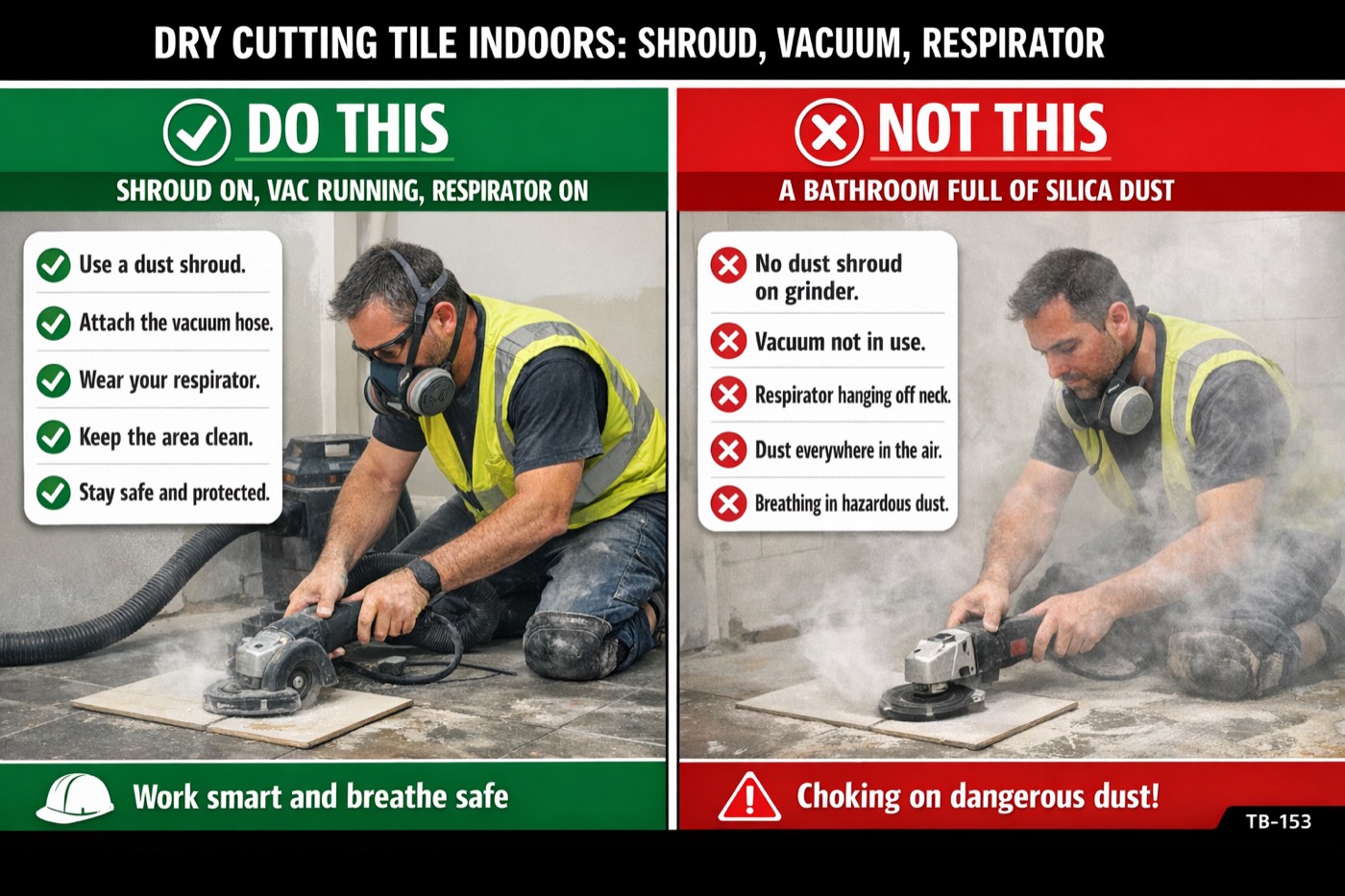
The legal limit for silica dust is 50 micrograms per cubic meter averaged over a day. One dry cut on porcelain with a bare grinder in a bathroom can put more than that in the air in the time it takes to make the cut.
The points
- Porcelain, quartz and stone dust is respirable crystalline silica. It scars the lungs permanently, and fabricators in their thirties have needed lung transplants after a few years of dry cutting.
- Table 1 of the silica rule tells you exactly how a handheld grinder is allowed to be used: water fed to the wheel outdoors, or a shroud with a vacuum that pulls 25 cubic feet per minute for every inch of wheel diameter. A bare 4-1/2 inch grinder in a house is not on the table.
- Indoors, the grinder with shroud and vacuum still needs an N95 or better if you are on it more than four hours in the day, and a handheld saw cutting wet indoors needs the respirator no matter how long.
- The rule also says: indoors, provide exhaust to keep visible dust down, no dry sweeping, no compressed air to blow off your clothes or the floor. HEPA vacuum or wet wipe.
- Take the cut outside whenever the piece can be carried. The homeowner's family breathes that room after you leave, and their return duct is in the hall.
Why it goes wrong
Silicosis is not a cough. Respirable quartz particles are too small to see or to cough up, and they lodge in the deepest part of the lung, where the body walls them off with scar tissue. Enough scar and the lung cannot exchange oxygen. There is no treatment that reverses it. The classic case takes ten to twenty years of exposure; the accelerated version, seen in engineered-stone countertop shops, has put men in their thirties on transplant lists after five years of dry work.
The permissible exposure limit is 50 micrograms per cubic meter as an 8-hour average, with an action level at 25. Those are tiny numbers. Air sampling of uncontrolled dry cutting and grinding on tile and masonry routinely measures in the thousands of micrograms per cubic meter. A single cut is not your whole day's average, but a morning of dry notches for outlets and drains adds up to a day well past the limit, and the house holds the dust for you to keep breathing all afternoon.
Table 1 in 1926.1153 is a list of tasks with the controls that are deemed enough. For a handheld grinder on anything other than mortar removal, the choices are a water-fed grinder outdoors, or a commercially made shroud connected to a dust collector rated at 25 cfm or more per inch of wheel diameter, with a 99 percent filter and a cyclonic pre-separator or filter-cleaning mechanism. For a 4-1/2 inch wheel that is about 113 cfm. A shop vac with a clogged paper filter does not meet that, and a shroud with a chunk missing does not either.
Follow the table and the respirator column is clear: shroud and vacuum indoors, four hours or less, no respirator required; more than four hours, an APF 10 respirator, which is a fitted N95 or a half-mask with P100 filters. A handheld saw with water indoors needs the APF 10 respirator for any duration. A tool used dry with no control is not on the table at all, which means the employer has to measure exposure and prove it is under the limit, and it will not be.
The rule adds three things people forget. Indoors, provide exhaust as needed to keep visible dust from building up, which in a house means a fan in the window blowing out and the HVAC shut off with the return covered. No dry sweeping where it adds to exposure; use a HEPA vacuum or wet methods. No compressed air to clean clothes or surfaces. The dust you brush off your shirt in the truck goes home in the cab.
The best control is the one that moves the cut. Porcelain notches, L-cuts and holes can be done outside on the wet saw or with a wet drill on a board across two buckets, and the piece carried back in. When a cut has to happen in place, the shroud goes on, the vac runs, the door closes, the respirator is on the face before the trigger and stays on until the dust settles. A minute of setup buys a lung that still works at sixty.
Questions for the crew
- Which cuts today cannot be carried outside, and what tool are they getting done with?
- What is the shroud and vacuum on the grinder rated for, and when was the filter last cleaned or changed?
- Where is the return air duct in this house, and is the system off?
To close
Today no dry cut happens inside this house without the shroud on, the vac running and the respirator on your face first.
To hold this talk with your crew
1
Read it aloud. Five minutes, before the work starts.
2
Ask the questions. A crew that talks is a crew that remembers.
3
Have them sign on their own phones, and the record is sealed.