Kneeling all day: the knee at 40 and the 80-pound box
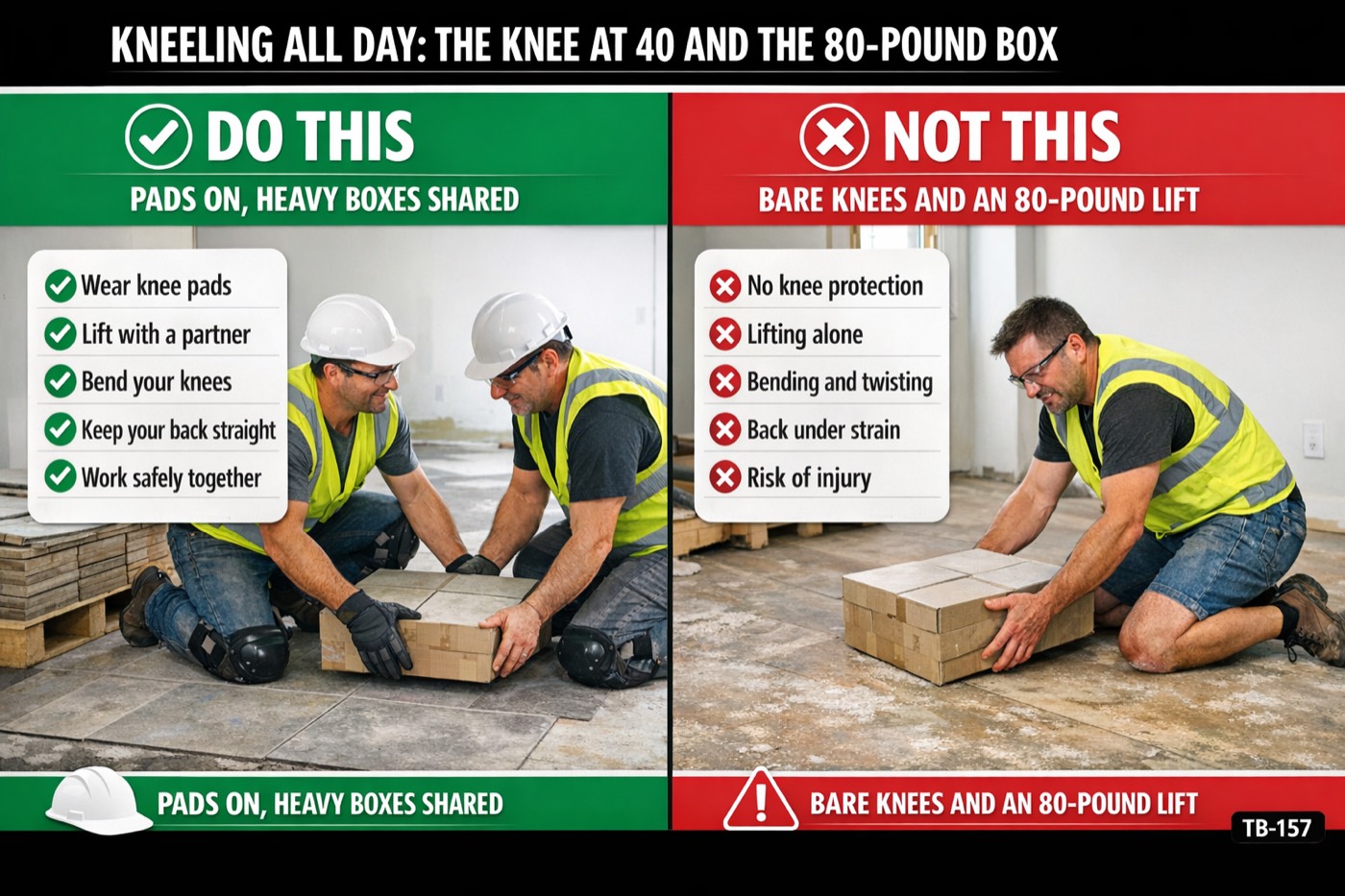
Floor layers get knee replacements at several times the rate of trades that stand up. The knee does not fail on a bad day; it fails after six thousand days of kneeling on a subfloor.
The points
- Kneeling on a hard floor loads the kneecap and the bursa under it with your full upper body weight, hundreds of times a day. That is bursitis in a year, cartilage gone in ten, and a replacement at 50.
- Knee pads with a hard shell and gel or foam behind it, on both knees, every time you go down. A folded towel is not a knee pad, and a pad with the strap cut off is on the floor next to you, not on your knee.
- A box of 12-by-24 porcelain weighs 60 to 70 pounds and a box of 24-inch stone can pass 80. The safe lift under ideal conditions is about 50 pounds; anything heavier is two people, a cart, or the box opened and carried in halves.
- Stack material at knee to waist height on a pallet or a stack of boxes, never on the floor, so the last box of the day is not lifted from your toes with a twist.
- Stand up and straighten every 20 to 30 minutes, and rotate the cutting, the mixing and the setting so nobody spends the whole day on the floor.
Why it goes wrong
Kneeling puts the weight of your torso on a patch of skin, a fluid sac called the bursa, and the kneecap, on a surface with no give. Sliding sideways on the knees, which every setter does with every tile, adds shear. The bursa swells first, which is the tight, warm, puffy knee after a big job; then the cartilage behind the kneecap wears; then the meniscus tears; then the joint is bone on bone. Studies of floor layers show knee osteoarthritis at several times the rate of trades that do not kneel, and it shows up years earlier.
There is no OSHA ergonomics section for floors, and the rule that governs is the employer's duty in 1926.21 to instruct every employee in recognizing and avoiding the unsafe conditions of their work. Nobody is going to cite you for a bad knee. You are going to pay for it yourself, at 45, with a joint that will not let you kneel and a trade that requires it.
The knee pad that works has a hard or semi-rigid outer shell so it slides instead of grabbing, and gel or closed-cell foam behind it thick enough that you cannot feel the tile edge through it. It has to be strapped so it stays over the kneecap when you slide; a pad that rides down to the shin protects the shin. Pads that hurt behind the knee get taken off, so buy the ones that do not, and replace them when the foam has packed down flat. A foam kneeling board for long runs takes half the load off the pad.
The lifting numbers are physics. NIOSH's lifting equation gives about 51 pounds as the most a person should lift under ideal conditions: close to the body, at waist height, no twist, no reach. A box of tile is never lifted under ideal conditions; it is on the floor, in a stack, in a hallway, and you turn to set it down. A 70-pound box lifted from the floor with a twist puts several hundred pounds of compression on the lower spine. Open it, carry it in halves, use a hand truck, or get a second pair of hands. The box does not care how strong you were at 25.
Stack material at knee to waist height, on a pallet, a plank across two buckets or the top of the previous stack, and keep it stacked so it cannot slide onto a foot. Sixty pounds falling off a stack breaks the metatarsals. Bring the stack to the work instead of walking every box across the house. Keep the wet saw and the mixing station at standing height on a stand or a bench so the cutting and the mixing are the part of the day where your knees are straight.
Time is the exposure you control. Set a rhythm: every 20 to 30 minutes stand up, walk to the saw, straighten the back, roll the shoulders. Rotate the crew between cutting, mixing, carrying and setting so nobody kneels for eight hours straight. A carpet stretcher and a knee kicker have their own talk; the short version is that the power stretcher exists so your knee does not have to be the tool. Ice a swollen knee that night, and a knee that stays swollen for a week is a doctor visit, not something you work through.
Questions for the crew
- Who on this crew is kneeling the most today, and what are they kneeling on?
- What is the heaviest box on this job, and how is it getting from the truck to the room?
- Is anybody carrying a knee or a back that is already sore, and what changes for them today?
To close
Today every knee that touches the floor has a pad on it, and every box over 50 pounds gets a second person, a cart or a split.
To hold this talk with your crew
1
Read it aloud. Five minutes, before the work starts.
2
Ask the questions. A crew that talks is a crew that remembers.
3
Have them sign on their own phones, and the record is sealed.