Knee kicker: the knee that quits at 45
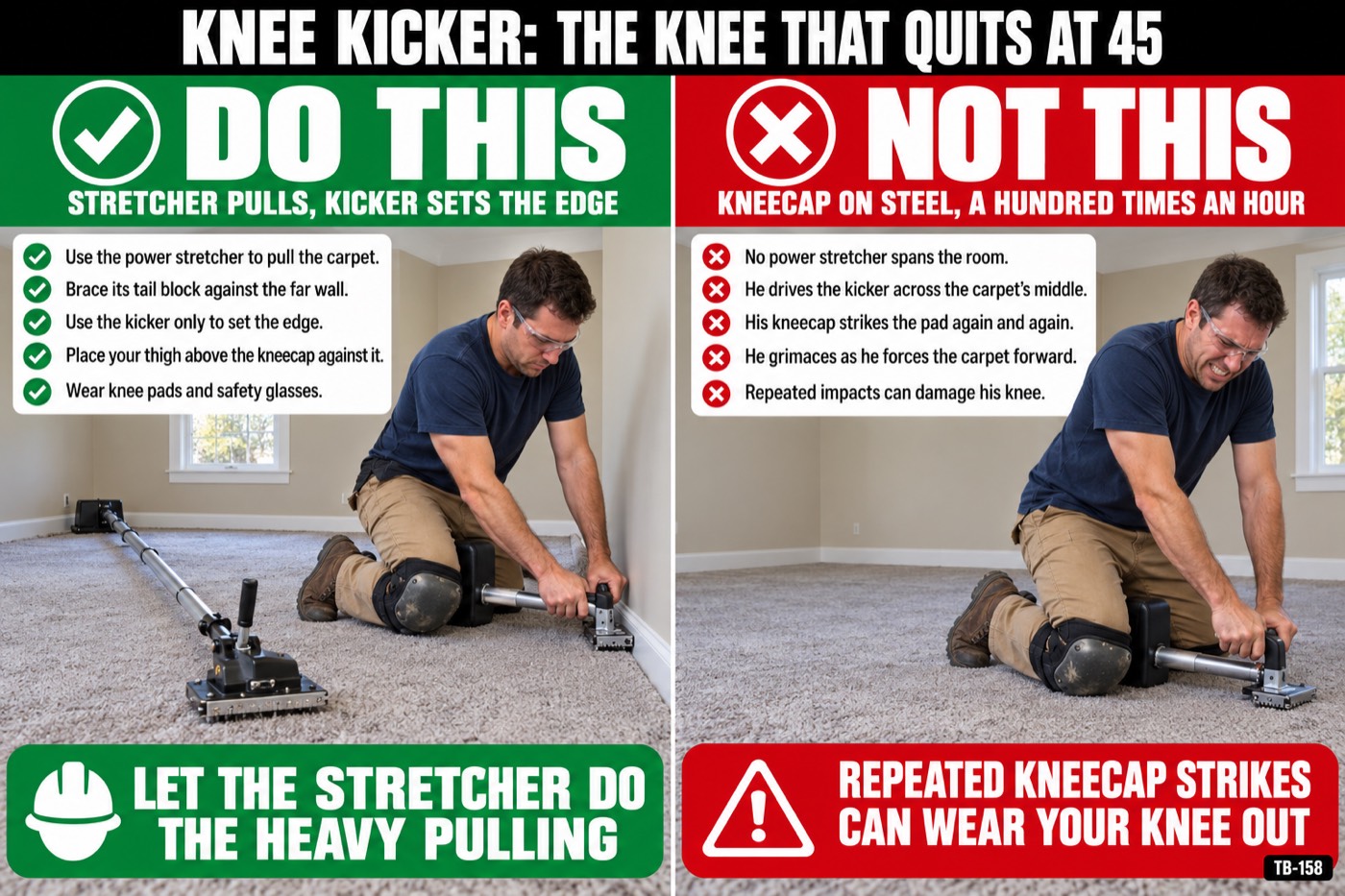
A carpet installer hits the knee kicker well over a hundred times an hour. Every strike is your kneecap driving a steel pad, and the bursa under it fills with fluid until the day it will not take the next hit.
The points
- The kicker is a hammer and your knee is the handle. Prepatellar bursitis, the swollen bag on the front of the kneecap, is so common in this trade it has the trade's name, and the knee that keeps kicking on it ends in surgery.
- The power stretcher does the stretch; the kicker only positions the carpet. If the kicker is doing the pull across a room, the stretcher is still in the truck and your knee is paying for the walk.
- Strike with the thigh just above the kneecap, never the kneecap itself, with a kicker set so the pins bite the backing and not the pad. Bad pin depth means a harder strike to get the same move.
- A power stretcher head under load lets go when the pins tear out or the tube joint slips. Nobody is in front of the head or in line with the handle, and the tail block sits against a stud, a plank across studs, or a wall that can take it.
- Tack strip pins are 1/4 inch of sharpened steel in rows along the wall, angled toward the wall. Gloves to handle and cut it, kneel on a board over it, and never slide a hand along a wall you have already stripped.
Why it goes wrong
The rule at 1926.300 says every hand tool, employer-owned or your own, is kept in a safe condition. On a kicker that means the teeth are sharp and set to the right depth, the head is tight on the tube, and the pad is not split or hard. A dull kicker needs a harder hit for the same grip, and a harder hit is the difference between a knee that lasts and one that does not. On a power stretcher it means the pins are all there and sharp, the tube locks engage fully, and the lever handle is not bent.
Prepatellar bursitis is fluid building in the sac between the skin and the kneecap after repeated impact. It swells, it warms, and it can get infected through a scrape from tack strip, which is a hospital stay on antibiotics. Under it, the cartilage on the back of the kneecap takes the same impact, and floor installers show knee arthritis at rates several times that of trades that stand. Nerve damage in the front of the knee from years of kicking is common enough to have a name too.
The power stretcher exists so the knee is not the tool. It multiplies your arm on the lever into hundreds of pounds of pull at the head, which is what a room-width stretch actually takes. The kicker is for hooking the carpet onto the strip at the edge and moving it a couple of inches. A crew that stretches a whole living room by kicking is spending knees to save the four minutes of setting up the stretcher.
When you do kick, strike with the padded area of the thigh just above the kneecap, keep the leg moving through the strike rather than jabbing from a stop, and keep the other knee behind you so you are not twisting the hip. Alternate legs when you can. A kicker head set too deep grabs the pad and moves nothing; set too shallow it slips out and you strike air, which is how the handle end comes back into your face.
The stretcher lets go in two ways: the pins tear through the backing under a heavy stretch, or a tube coupling that was not fully locked slips. Either way the head jumps toward whoever is ahead of it and the lever whips. Keep everyone out of the line between the tail block and the head, keep your face off the handle, and put the tail block against something solid, because a stretcher through drywall is the cheap version of that failure.
Tack strip is a row of sharpened pins angled toward the wall, and every one of them is a puncture wound to a knee or a palm. Handle it with gloves, cut it with snips or a strip cutter and not a hammer that throws splinters of it, and stack the cutoffs where nobody kneels. The pins do not know the carpet is in yet; a hand sliding along the wall at the end of the day to check a seam finds them. Puncture wounds from strip get infected; wash them and watch them.
Questions for the crew
- Where is the power stretcher today, and what rooms is it getting set up in?
- How many kicks is the kicker doing on this job, and could the stretcher take any of them?
- Which walls have strip down already, and where are people kneeling next to them?
To close
Today the stretcher does the stretching, the kicker only sets the edge, and nobody kneels on a wall with strip down without a board.
To hold this talk with your crew
1
Read it aloud. Five minutes, before the work starts.
2
Ask the questions. A crew that talks is a crew that remembers.
3
Have them sign on their own phones, and the record is sealed.