Self-leveler and thinset: the dust before the water
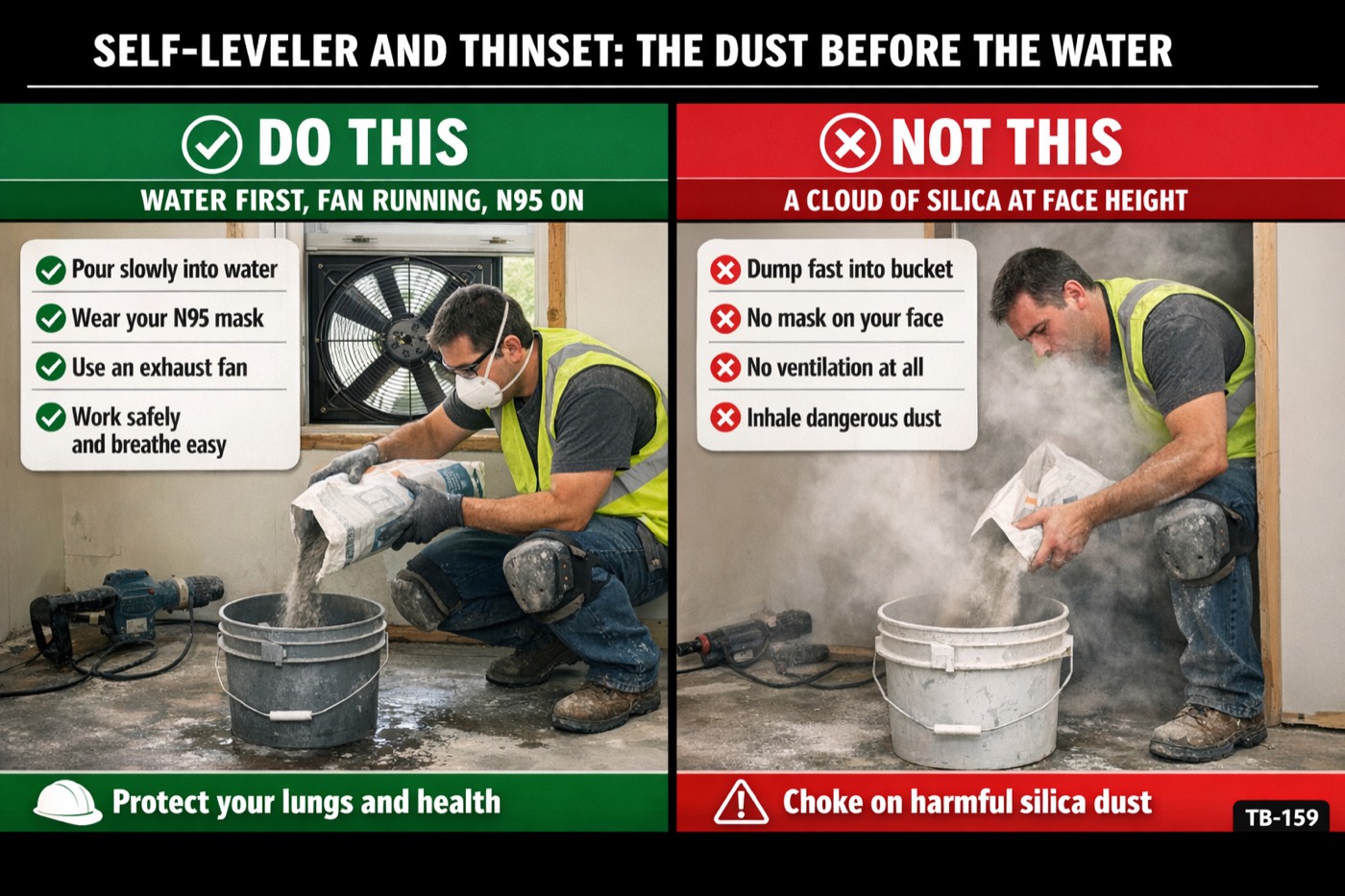
The worst silica exposure on a tile job is often not the saw. It is the ten seconds when a 50-pound bag of thinset gets dumped into a bucket in a closed bathroom and the cloud rises past your face.
The points
- Thinset, self-leveler and grout are cement and silica sand. The cloud off a bag is respirable quartz, and it hangs in the room for hours after the bag is empty.
- The rule's Table 1 does not list mixing bagged mortar, which means the employer has to keep the exposure under 50 micrograms per cubic meter another way: mix outside or with a fan exhausting, water in the bucket first, cut the bag low and pour slow, and an N95 on the mixer indoors.
- No dry sweeping and no compressed air on the spilled powder. HEPA vacuum or wet it down.
- Wet mortar is pH 12 to 13. A shin or a wrist that sits in it through the afternoon is a chemical burn you feel at dinner; rinse skin right away, and change out of soaked knee pads and pants.
- The paddle mixer twists the drill out of your hands when it catches the bucket bottom or a lump. Two hands on a D-handle, the drill unplugged before you clear the paddle, and nobody's foot holds the bucket.
Why it goes wrong
The silica rule at 1926.1153 covers every construction task with exposure above the action level, and mixing dry cementitious products indoors is one of the tasks OSHA's own guidance flags. Table 1 lists saws, grinders and drills with their controls, but there is no Table 1 row for pouring a bag into a bucket. That puts you under the general part of the rule: the employer has to assess the exposure and keep it under 50 micrograms per cubic meter as an 8-hour average, with engineering controls first and respirators to make up the difference.
What that looks like on a job: mix outside or in the garage with the door open when you can. When you cannot, a fan in a window pulling air out of the mixing room, the HVAC off, the water in the bucket before the powder, the bag cut low and close to the water so the powder falls a few inches instead of a few feet, and a fitted N95 on whoever is mixing. Mixing stations with a vacuum hood exist and pay for themselves fast on big jobs. The dust that settles on the floor becomes airborne again every time you walk through it, so the housekeeping rule applies: no dry sweeping, no compressed air, HEPA vacuum or wet methods.
Self-leveling underlayment adds a few problems of its own. It is mixed fast, in volume, often with a barrel mixer or a pump, and the crew pours a whole floor in the 15 or 20 minutes before it sets. That means many bags opened quickly in a closed space, which is the biggest dust cloud of the job. Get the bags staged, the fan running and the masks on before the first bag is cut. It also flows to level and fills every gap, including the heat register you forgot to tape, and it is as slick as wet ice until it skins over.
Cement burns have their own talk in this library; the short version is that wet mortar is strongly alkaline, and it keeps burning as long as it is on skin. It does not hurt at first. The knee pads that soaked through at 10 a.m., the thinset down a boot, grout on the back of a hand under a glove, all show up that evening as a burn that can go deep enough to graft. Rinse with water right away, change out of wet gear, and wear waterproof gloves for grouting instead of bare hands because it feels better.
The paddle mixer is a half-inch drill with a lot of torque turning a paddle in 40 pounds of mud. When the paddle hits the bucket bottom or a hard lump, the drill body tries to spin the other way, and a one-handed grip means a sprained wrist or a drill spinning into your shin. Use a mixer with a D-handle or a side handle, both hands on, feet outside the bucket, and start the paddle submerged at low speed. Unplug it before you scrape the paddle; the trigger lock has been bumped on by a thumb while a hand was on the blades.
Keep the mixing bucket away from the cord and the puddle. A 5-gallon bucket of mixed thinset is about 60 pounds; it is carried short distances with a straight back or it is mixed where it is used. A bag of thinset is 50 pounds and a pallet of them stacked ten high needs to be stepped back and cross-keyed so it does not slide when the bottom bags get pulled. Empty bags go in the trash, not on the floor where they become a slide.
Questions for the crew
- Where is the mixing happening today, and what is moving the dust out of that room?
- How many bags are going into the self-leveler pour, and who is on the mask and the fan before the first one is cut?
- Whose knee pads or gloves have soaked through, and when did they last change them?
To close
Today no bag gets cut inside this house without the fan running and an N95 on the person pouring, and nobody sweeps the powder dry.
To hold this talk with your crew
1
Read it aloud. Five minutes, before the work starts.
2
Ask the questions. A crew that talks is a crew that remembers.
3
Have them sign on their own phones, and the record is sealed.