Cutting laminate and vinyl plank: the saw and the knife
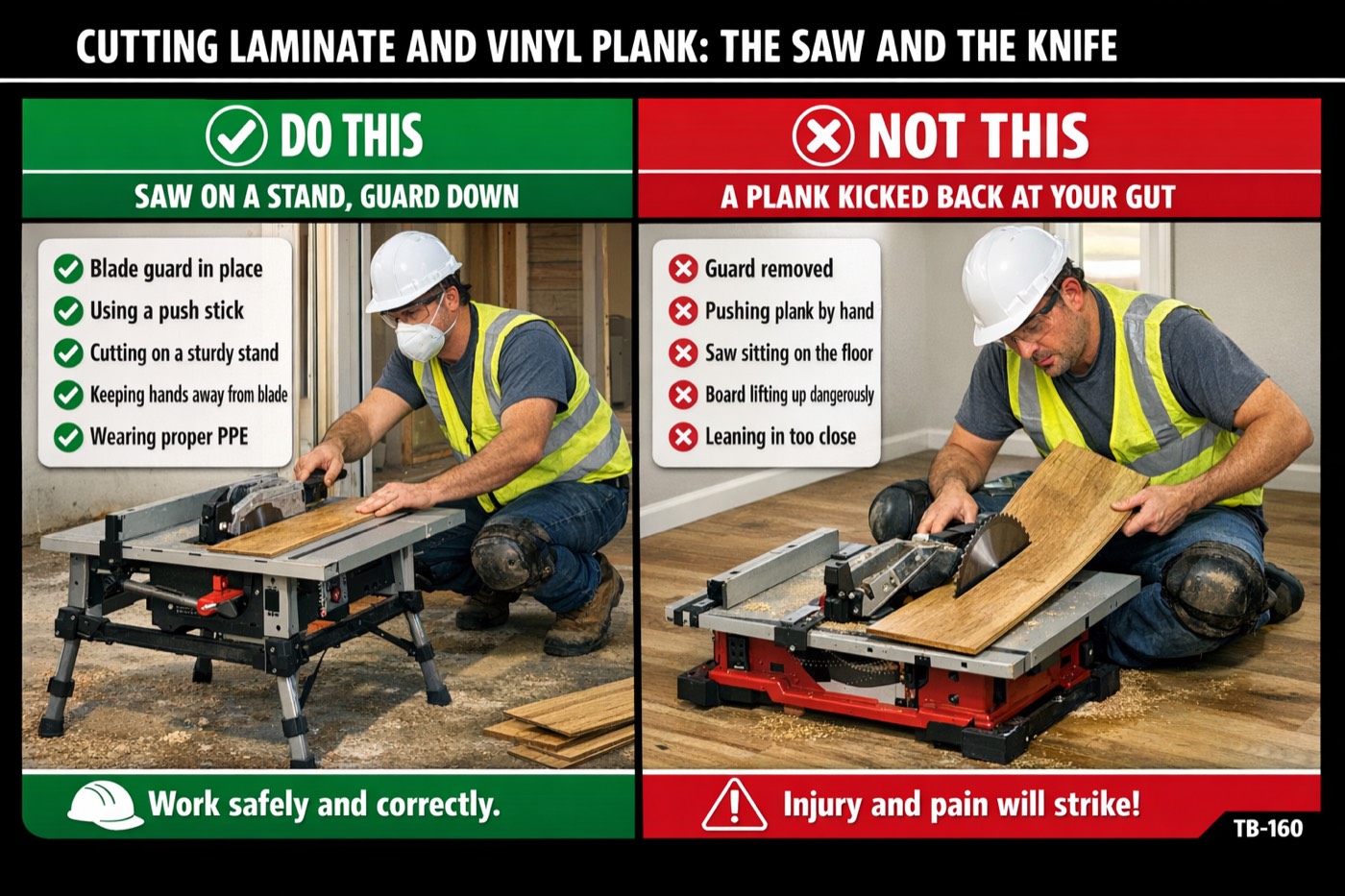
The rim of a 10-inch table saw blade is moving at over 100 miles an hour. Laminate is a compressed fiberboard core with an aluminum-oxide face that dulls a carbide blade in a day, and a dull blade is the one that kicks the board back at you.
The points
- Laminate throws a plank back at your gut when it pinches the blade, and a hand on the blade side of the fence is a hand in the blade. A dull blade, a plank ripped without the fence, or a cutoff left against the blade sets it up.
- The rule requires the hood guard over a table saw blade to cover the part above the material and the part above the table, and a portable circular saw to have a lower guard that snaps back on its own. A saw with the guard wired up is out of service.
- Laminate dust is fine wood fiber and resin, and the resin is urea-formaldehyde. Cut outside or in the garage with the door open, with the vacuum on the saw and an N95 on, not in the bedroom the boards go in.
- Vinyl plank is scored and snapped, or cut on a guillotine cutter with no dust and no motor. The utility knife goes with the blade pulling away from the hand that holds the plank, and the plank sits on a board, not on your thigh.
- A miter saw on a stand at waist height, a table saw with the fence set for the rip and a push stick in reach. Nobody cuts on the floor on their knees with a saw between their legs.
Why it goes wrong
Kickback on a table saw happens when the wood closes on the back of the blade or catches a rising tooth behind the arbor; the blade lifts the board and throws it toward the operator at the rim speed. On a 10-inch blade at about 3,500 rpm that is roughly 9,000 feet a minute, better than 100 miles an hour. Laminate is dense, thin and easy to pinch, and its wear layer takes the edge off a blade faster than any hardwood. A dull blade burns, binds and kicks. Change or sharpen it when the cut starts to smoke.
The rule at 1926.304 says a hand-fed ripsaw's hood encloses the blade above the table and above the material, rides on the material, and takes a blow without breaking, and a portable circular saw has an upper guard and a lower guard that returns on its own the instant the saw leaves the cut. Laminate installers pull the hood off to see the line and pin the lower guard back because it hangs up on the plank edge. That is the saw the rule says not to run, and it is the one that gets the hand.
Set the table saw with the rip fence, use a push stick for anything under 6 inches wide, stand to the side of the blade line and never reach over the blade for a cutoff. Let the blade stop before you clear the table. On the miter saw, hold the plank against the fence with the hand well outside the blade path, cut, let the blade stop, then lift. The short end of a plank cut on the miter saw wants to spin into the blade; clamp it or let it fall free, and keep fingers 6 inches from the kerf.
Laminate flooring is a high-density fiberboard core bonded with urea-formaldehyde resin under a melamine and aluminum-oxide wear layer. Cutting it makes a fine dust of wood fiber and cured resin that carries formaldehyde; the air contaminant rule sends formaldehyde exposure to its own section at 1910.1048 and treats wood dust as a nuisance particulate at best. Cut it outside, use the dust port and a vacuum, wear an N95, and do not let the pile build up on the floor of the room the family sleeps in. Cut planks on the miter saw, not the table saw, whenever the cut allows; it makes less dust and no kickback.
Luxury vinyl plank is the safest material on the list if it is cut the way it was designed. Score across the face with a sharp utility blade, snap it over the knee or the edge of a plank, and finish the cut through the backing. The knife pulls toward the body along a straightedge with the other hand behind the blade, never in front of it, and the plank lies on a sacrificial board or the stack, not across a thigh. A flooring guillotine or shear cuts laminate and LVP with no dust, no noise and no motor, and it is the right tool for the notches and the last row.
Set the saws up on stands at waist height, outside or in the garage, with the cord run so nobody trips into a spinning blade. The saw on the floor between an installer's knees with the plank held by hand is how laminate jobs produce hand injuries: the plank is not supported, the guard cannot work, and the cutoff lands in the lap. Ten minutes to set up the stand is the cost. Sharp blade, fence set, push stick within reach, guard on.
Questions for the crew
- Where are the saws set up today, and is the guard on and working on each one?
- Who is doing the rips on the table saw, and where is the push stick right now?
- How many of today's cuts can be done on the guillotine or the knife instead of a saw?
To close
Today the saws run on stands with the guards on and the dust pulled outside, and nobody cuts a plank on the floor between their knees.
To hold this talk with your crew
1
Read it aloud. Five minutes, before the work starts.
2
Ask the questions. A crew that talks is a crew that remembers.
3
Have them sign on their own phones, and the record is sealed.