Occupied home: the kid and the saw you left plugged in
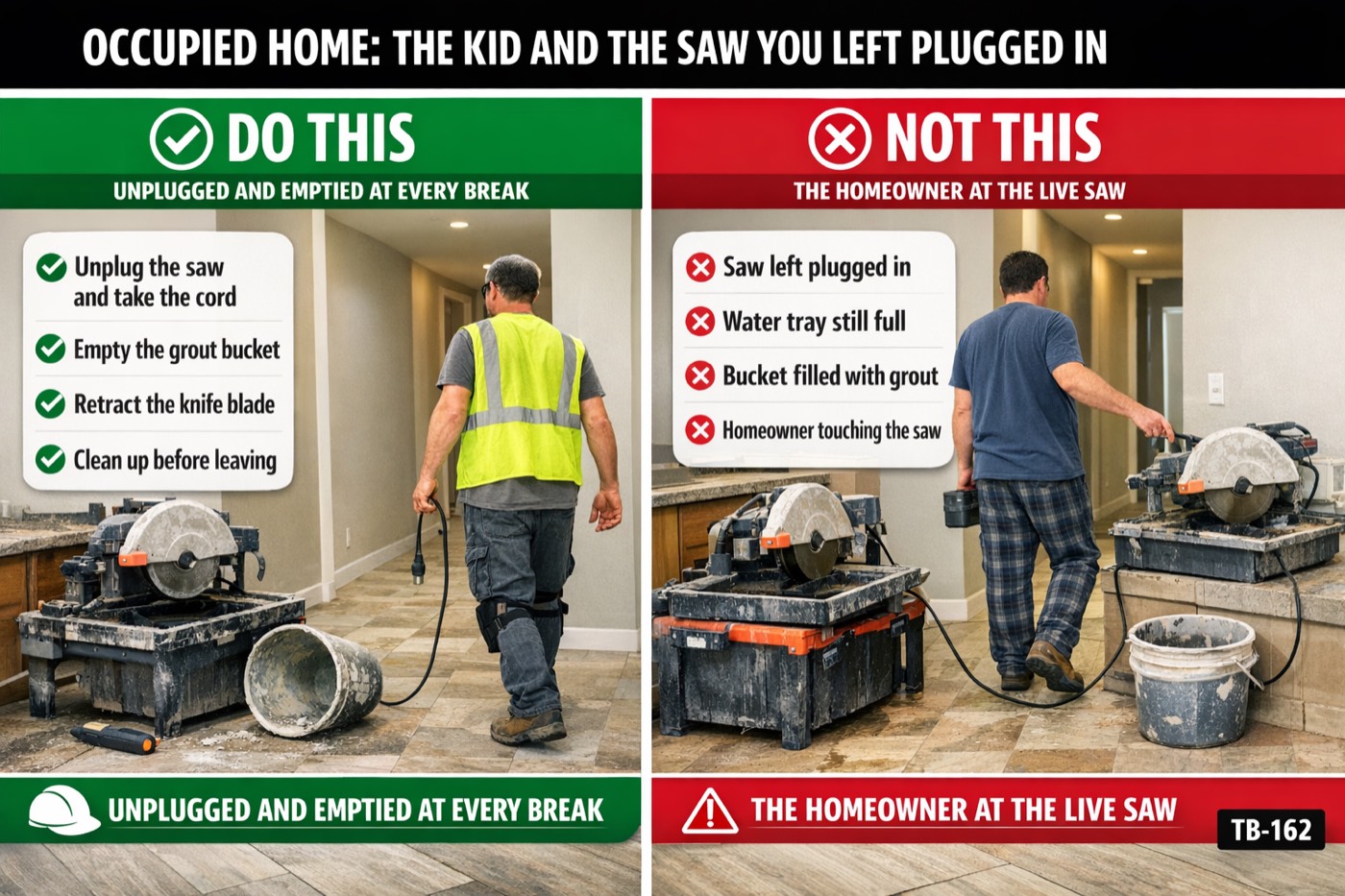
A toddler can drown in a 5-gallon bucket with 4 inches of water in it, and it has happened hundreds of times. Your grout bucket sat in the hall through lunch.
The points
- An occupied house has people in it who do not know what a wet saw, a bucket of water, an open pail of adhesive or a utility knife on the counter can do. The four-year-old, the grandmother and the dog are on your site, and you are responsible for what they can reach.
- The rule puts the employer in charge of a program, with regular inspections of the site and its equipment, and any tool that is not safe tagged, locked or removed. In a house that is the foreman walking the rooms at every break and at the end of the day.
- Every tool unplugged or with the battery out at every break. Blades retracted, buckets emptied, pails lidded, the wet saw's cord out of the wall. A kid finds the trigger before you find the kid.
- The outlet you unplugged for the saw may be the freezer, the sump pump, the fish tank or an oxygen concentrator. Ask before you unplug anything, plug it back in, and say so.
- Dust and fumes do not stay in your room. HVAC off, the return covered, the door to the work sealed, and the family told what is in the air and when they can come back.
Why it goes wrong
A construction site has a fence and a sign. A house has a family that walks through the work zone to get to the bathroom. The rule at 1926.20(b) puts it on the employer to run a program of frequent, regular inspections of the site, the materials and the equipment by a competent person, and to tag, lock or remove anything unsafe. On a residential job that competent person is the foreman, and the inspection is the walk through every room you have touched before lunch, before you leave for material, and before the truck pulls away.
Start the day by agreeing with the homeowner where the work zone is and how the family stays out of it. A closed door, a baby gate, a strip of tape across a hallway, whatever fits the house. Ask about kids, ages, nap times, pets, and who else is home during the day. Ask what is on the circuits you are going to load and what is plugged into the outlets near the work. Write the re-entry time for adhesives and finishes on the estimate and say it out loud.
The tool left plugged in is the classic. A wet saw on a stand with the cord in the wall, a miter saw, a paddle mixer in a bucket, a nail gun on the hose. A child pulls a trigger without knowing what it does; an adult moves it and starts it by the trigger lock. At every break the cords come out, the batteries come off, the hoses are disconnected and the tools are set where a child cannot reach them or in the truck. Blades in utility knives are retracted every time the knife leaves your hand.
Buckets are a drowning hazard that surprises people. A toddler top-heavy enough to tip into a 5-gallon bucket cannot push back out, and a few inches of water is enough. The Consumer Product Safety Commission has counted more than 275 of these deaths since 1984. Empty every bucket when you walk away from it, and not into the customer's sink if it has thinset in it. Pails of adhesive, primer and finish get their lids on between uses; the fumes matter and so does a hand in the pail.
Unplugging things is how flooring crews cause damage that nobody notices until the next day. A chest freezer in the garage, the sump pump in the basement, the aquarium pump, a CPAP or an oxygen concentrator in a bedroom, a wine cooler. You unplugged it for the saw, the breaker tripped on the saw, or you plugged your GFCI pigtail in and never reset the outlet. Ask first, use a different circuit where you can, plug it back in before you leave, and tell the homeowner which outlets and breakers you touched.
The air is shared. Silica from a grinder, wood dust from a sander, adhesive and finish vapors, all travel through the return duct and into the bedrooms. Shut the HVAC down while you are making dust or vapor, cover the return grille, seal the door with plastic if the job is big, and vent the work room out a window. Tell the family what was in the air, when the room is safe, and what to do if they smell it tonight. The end-of-day walk covers cords, blades, buckets, pails, the pilot light, the outlets and the dog, in that order, every day.
Questions for the crew
- Who is home today, and where is the line between the work zone and the family?
- Which outlets and breakers are you going to touch, and what is on them right now?
- Who is doing the walk-through before lunch and before the truck leaves, and what is on the list?
To close
Today every tool is unplugged and every bucket is empty at every break, and nobody leaves without the walk-through.
To hold this talk with your crew
1
Read it aloud. Five minutes, before the work starts.
2
Ask the questions. A crew that talks is a crew that remembers.
3
Have them sign on their own phones, and the record is sealed.