Vinyl flooring from 1980 or before: assume asbestos
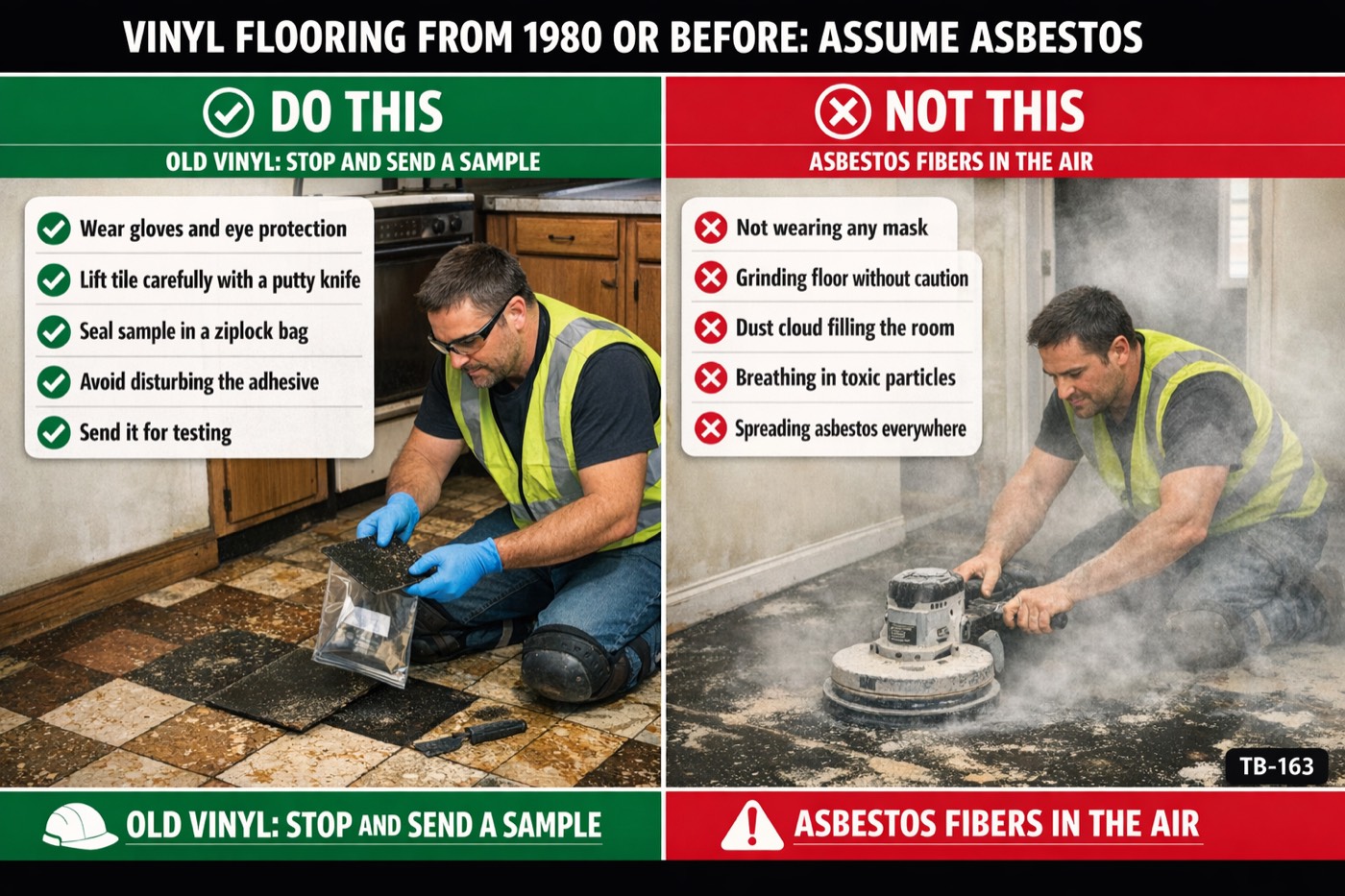
Nine-by-nine vinyl tile, the black mastic under it and the paper backing on old sheet vinyl were made with asbestos for decades. The fibers you release with a scraper or a floor grinder today show up as mesothelioma in 2056.
The points
- Asbestos fibers are too small to see and do not settle out; you breathe them for the rest of the day and the family breathes them for a month. There is no safe level, and the cancer comes 20 to 50 years later.
- The rule says vinyl and asphalt flooring installed in a building from 1980 or earlier is treated as asbestos-containing, mastic and backing included, until an industrial hygienist proves otherwise with a lab test. Nobody on this crew gets to decide it looks fine.
- Removing it is Class II asbestos work: trained people, a competent person, wet methods, HEPA vacuums and tiles lifted intact. Sanding the flooring or its backing is prohibited, ripping up sheet vinyl is prohibited, dry sweeping is prohibited, and so is a high-speed abrasive saw without HEPA exhaust.
- Never grind the old mastic off with a floor grinder or a bead blaster, never sand it, never dry-scrape it. The grinder is the single worst thing you can do to an asbestos floor.
- If the house is that old and the floor is not tested: stop, do not scrape, do not cut, call the office, and get the sample sent to a lab. The answer takes a few days and a few dollars.
Why it goes wrong
Asbestos was in vinyl-asbestos floor tile, in the cutback adhesive under it, and in the felt backing of sheet vinyl through the 1970s and into the early 1980s, and old stock kept being laid for years after that. Intact, the tile is not friable and the risk is low. The instant a scraper, a sander, a grinder or a heat gun breaks it up, the fibers are in the air, and they are far too small to see. The 12-by-12 tile can be asbestos too; the 9-by-9 is just the giveaway.
The rule at 1926.1101 is direct about flooring. Asphalt and vinyl flooring installed no later than 1980 must be considered asbestos-containing unless the employer proves it is not, and the proof is an industrial hygienist's determination from a lab analysis, not a look. The mastic and the backing count separately from the tile; the lab tests each layer, and the tile can be clean while the mastic is not. The building owner is required to share what they know, and you are required to ask.
Flooring removal is Class II work under the rule, and the work practices are spelled out. Flooring and its backing are not sanded. Floors are cleaned with a HEPA vacuum with a metal floor tool. Sheet vinyl is removed by cutting and wetting, never ripped up. Scraping residual adhesive and backing is done wet. Dry sweeping is prohibited. Mechanical chipping happens only inside a negative-pressure enclosure. Tiles come up intact wherever possible, and a heated tile that lifts intact may skip the wetting. High-speed abrasive saws without HEPA exhaust are banned on any asbestos work.
The crew that does that work has at least 8 hours of hands-on training for flooring, a competent person on site, respirators under a program, and a plan for the waste. A flooring crew that has not had that is not the crew that removes the floor, and it is not your call to make an exception because the room is small. Encapsulation, which usually means leaving the old floor intact and going over it with a proper underlayment or self-leveler, is often the right answer and it is the customer's and the office's decision, made with the test result in hand.
Mesothelioma is a cancer of the lining of the lung and abdomen that is caused almost only by asbestos, and it kills most people within a year or two of diagnosis. The latency is 20 to 50 years, which means the fiber you inhale at 25 kills you at 60, when you cannot connect it to anything. Asbestosis and lung cancer come from the same exposures, and smokers who breathe asbestos multiply their lung cancer risk many times over. The fibers on your clothes go home to your kids.
The practice is simple because it has to be. Old house, vinyl or asphalt tile, sheet vinyl with a felt back, black mastic, or an old floor under the floor you are pulling: stop. Do not scrape, chip, sand, grind, cut with a saw or heat it. Leave it intact, keep people out of the room, and call the office. A bulk sample sent to an accredited lab costs a few dollars per layer and comes back in a few days. If the office has not seen a lab report on that floor, you are not the person who takes it up, and the only thing the day costs is the day.
Questions for the crew
- What year was this house built, and what is under the floor we are here to replace?
- Has anybody seen a lab report on this flooring, and who has it?
- If the floor under this carpet turns out to be 9-by-9 tile on black mastic, what happens at that moment?
To close
Today nobody scrapes, sands, grinds or cuts an old vinyl floor in this house until the office has a lab result in hand that says it is clean.
To hold this talk with your crew
1
Read it aloud. Five minutes, before the work starts.
2
Ask the questions. A crew that talks is a crew that remembers.
3
Have them sign on their own phones, and the record is sealed.