Fiberglass and mineral wool: the itch and what you breathe
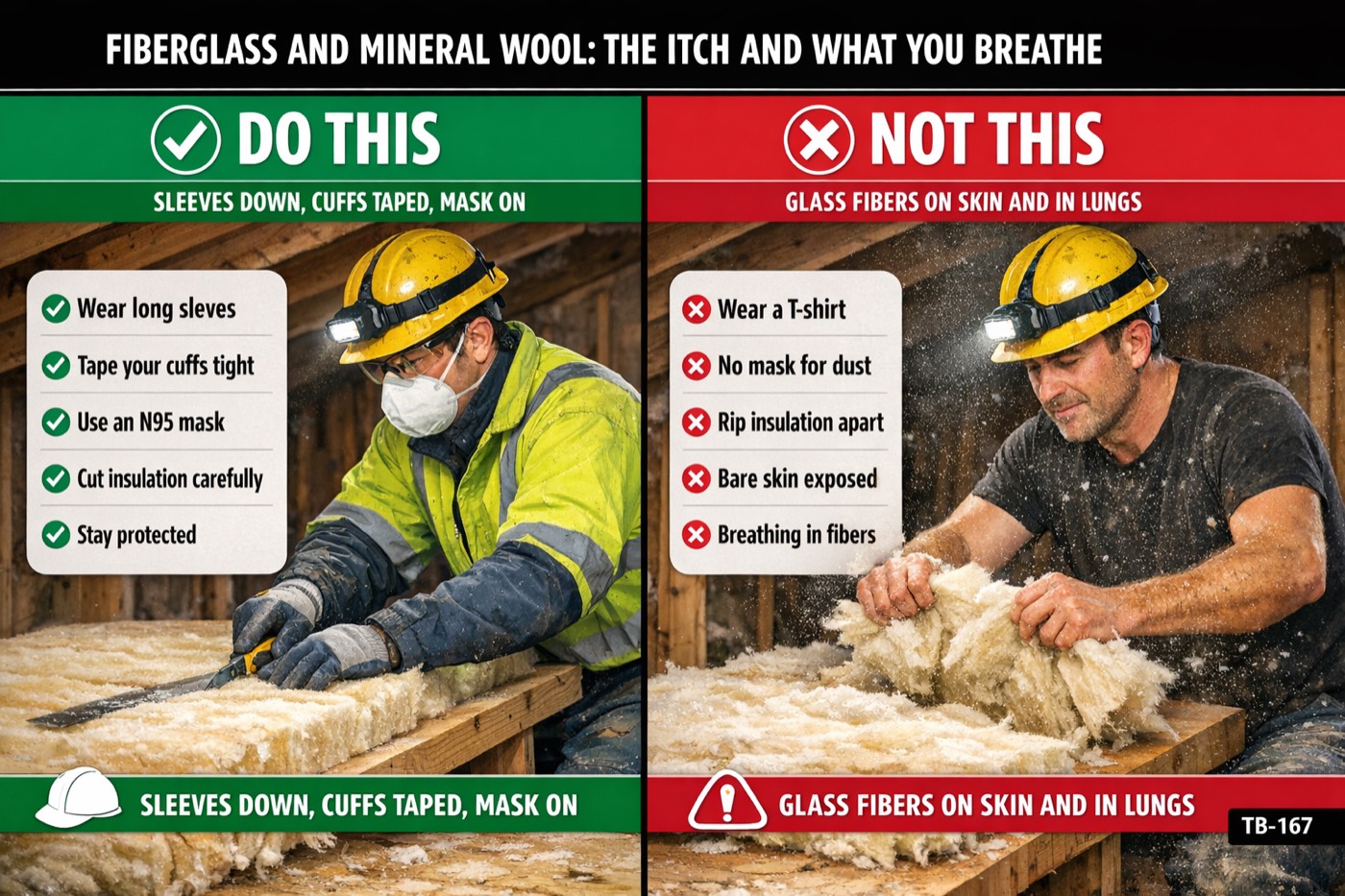
A fiberglass batt sheds glass. The itch on your forearms at lunch is thousands of glass slivers, and the ones you cannot feel are the ones you breathed.
The points
- Glass and mineral wool fibers cut skin, eyes and the lining of your nose and throat. The itch fades; the coughing after a week in attics is your airway reacting to what it caught.
- An N95 at minimum whenever you are cutting, tearing, stuffing or blowing it, and a half-mask with P100 filters in an attic where the dust hangs. The paper dust mask from the hardware store is not a respirator.
- Long sleeves, a loose collar, gloves and safety glasses, and the cuffs taped or tucked into the gloves. The fibers ride under a shirt where skin is sweaty and creased.
- Wash your hands and face with cool water before you eat, drink or smoke, and rinse forearms rather than scrub. Hot water opens the pores and rubbing drives the fibers in.
- Never blow yourself or a helper off with the compressor. It pushes fibers into your eyes and lungs, and the rule caps cleaning air at 30 PSI anyway.
Why it goes wrong
Glass and mineral wool fibers are mostly 3 to 15 micrometers across, big enough that most of what you breathe lands in the nose and throat and gets coughed or swallowed. The fine fraction goes deeper. The limit in 29 CFR 1926.55 for dust with no limit of its own is 15 milligrams per cubic meter of total dust, and an attic where you are pulling out old blown fiberglass with no fan can pass that in the first hour.
The skin reaction is mechanical, not an allergy: thousands of fibers stuck in the outer layer, worst where skin is sweaty and creased, the inside of the elbow, the neck, the waistband. Barrier cream before the shift helps. A cool rinse at the end, letting water run over the arm rather than scrubbing, floats fibers out instead of driving them in.
Old insulation is a different problem. Vermiculite that looks like gray-brown popcorn may carry asbestos, and blown material full of droppings or nesting is a rodent hazard; both are a stop, not a respirator upgrade. The asbestos talk and the crawl space talk cover what happens next.
An N95 worn by choice still needs the basics: a clean one each day, both straps on, the nose clip pinched, no beard under the seal. A half-mask with P100 filters, where the dust is heavy, is a required respirator and gets a fit test under 29 CFR 1910.134. Neither works over a beard.
A fiber in the eye is a flush, not a rub. Rubbing scratches the cornea with glass. Fifteen minutes with water, then a doctor if it still feels like something is there.
The common mistake is the sleeves rolled up and the collar open because the attic is 120 °F, and the shirt off at the truck with fibers going into the cab seat and home to the kids. Coverall off at the hatch, into a bag, and work clothes washed separately from the family's.
Questions for the crew
- How many N95s are on the truck, and are they today's?
- What is in the attic we are pulling out today, and has anybody looked at it?
- Where is the water for washing up before lunch?
To close
Sleeves down, cuffs taped and a mask on before the first bag opens, and nobody eats before washing.
To hold this talk with your crew
1
Read it aloud. Five minutes, before the work starts.
2
Ask the questions. A crew that talks is a crew that remembers.
3
Have them sign on their own phones, and the record is sealed.