Blowing machine: the agitator and the blocked hose
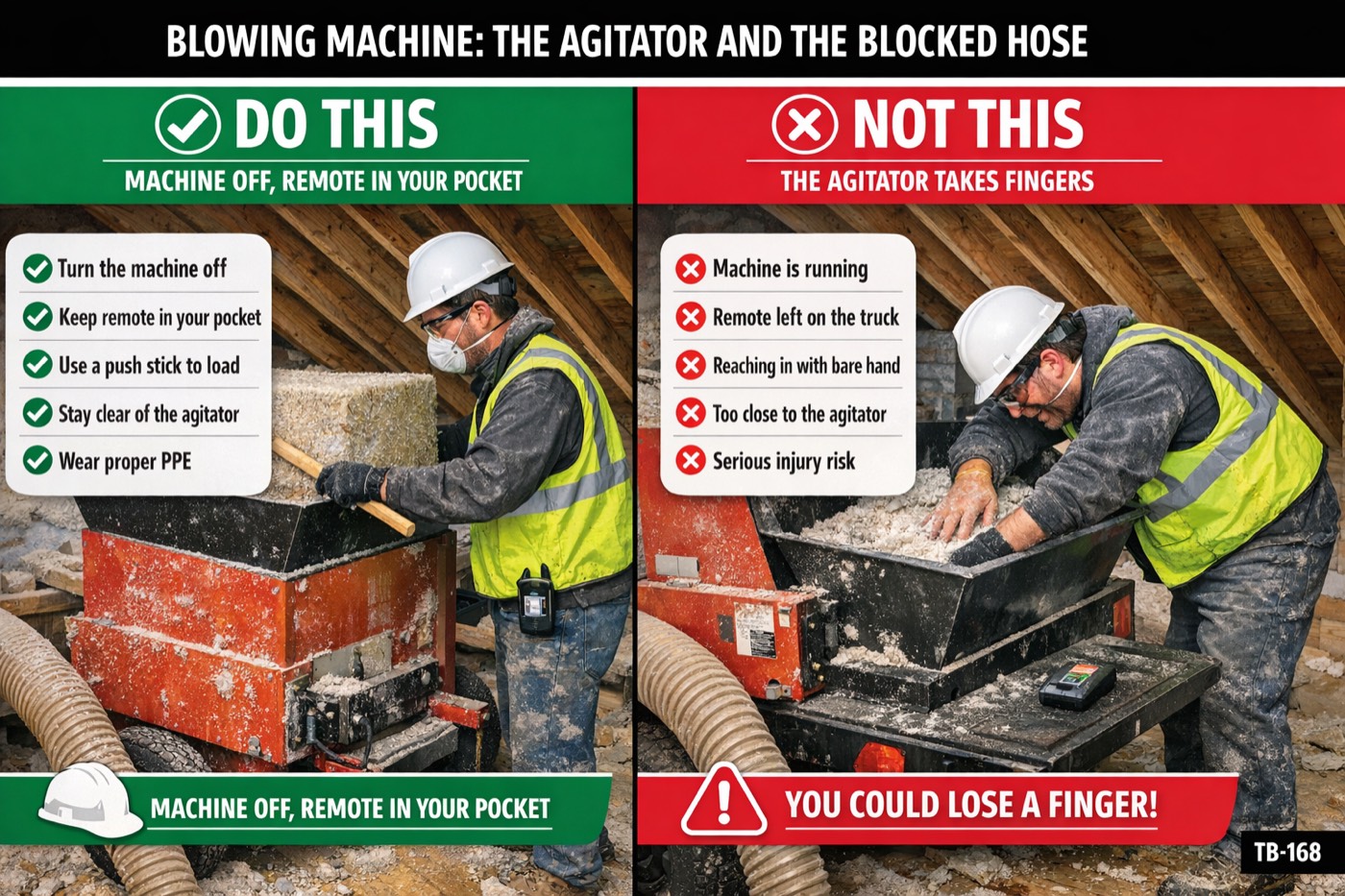
The agitator in that hopper shreds compressed cellulose into fluff. It does not know the difference between a bale and a hand, and it will not stop for either.
The points
- Hands go into a running hopper to push a bale or clear a bridge, and the agitator takes fingers. It turns slowly, with enough torque to tear a compressed bale apart, behind a slide gate; the gate is the only guard between you and it.
- Machine off and the remote in your pocket before a hand or a stick goes into the hopper. Never lean over an open hopper while it turns.
- Nobody in the attic looks into the hose end. A blocked hose lets go with a slug of material at blower pressure, and it hits the face of whoever is checking why nothing is coming out.
- The person at the machine and the person in the attic talk by radio, and the person in the attic controls the feed. Blocked hose means: feed off, blower off, then clear it from the machine end.
- Run the hose so it cannot pull the person in the attic off the joists, and do not drag it across the ladder at the hatch. A 150-foot hose full of cellulose has real weight when it surges.
Why it goes wrong
A blowing machine is a hopper, an agitator of rotating bars that tear the bale apart, a rotary airlock that meters fluff into the air stream, and a blower. The agitator and the airlock are both rotating parts you can reach, and 29 CFR 1926.300 requires them guarded where they are exposed to contact. On most machines the slide gate and the hopper lip are the guard; when the gate is open for a bridge, there is no guard.
A hose blocks when there is more material than air: feed too high, a damp bale, a kink behind the ladder, or a hose that got stepped flat. The clearing sequence is feed off, blower on to push, and if it does not move, walk the hose from the machine end squeezing for the hard spot. When it lets go, whatever was behind the plug arrives at once.
The person in the attic has the hose and the danger; the person at the machine has the controls. So the attic person runs the job by radio, and the machine person does nothing to the feed or the air without being asked. Test both radios on the ground, and agree on the words: feed on, feed off, air off, stop. Stop means everything off, now.
Most machines run on 240 volts or a generator, with the cord through the same door as the hose. Cord on a GFCI, off the wet ground, and the generator outside with the exhaust pointed away from the house and the machine person. The machine person breathes generator exhaust all day if it is set wrong.
Cellulose is ground newspaper with borate fire retardant; fiberglass blown-in is glass. Both are nuisance dust at the machine end and a fog at the hose end. N95 for both people, safety glasses for the attic person, and the attic exhaust fan running so the fog moves.
The common mistake is putting the new helper on the machine with no instruction. The attic asks for more, the helper opens the gate and turns the air up, the hose plugs, and the helper reaches into the hopper to see why. Whoever runs the machine gets shown the gate, the e-stop and the plug drill before the first bale.
Questions for the crew
- Who is at the machine, who is in the attic, and how are the two of you talking?
- What is the word for stop, and what happens when it is said?
- What do you do when the hose stops flowing?
To close
Machine off and the remote in a pocket before a hand goes near the hopper, and a plugged hose gets cleared from the machine end, every time.
To hold this talk with your crew
1
Read it aloud. Five minutes, before the work starts.
2
Ask the questions. A crew that talks is a crew that remembers.
3
Have them sign on their own phones, and the record is sealed.