Containment: the poly wall is only as good as the pressure
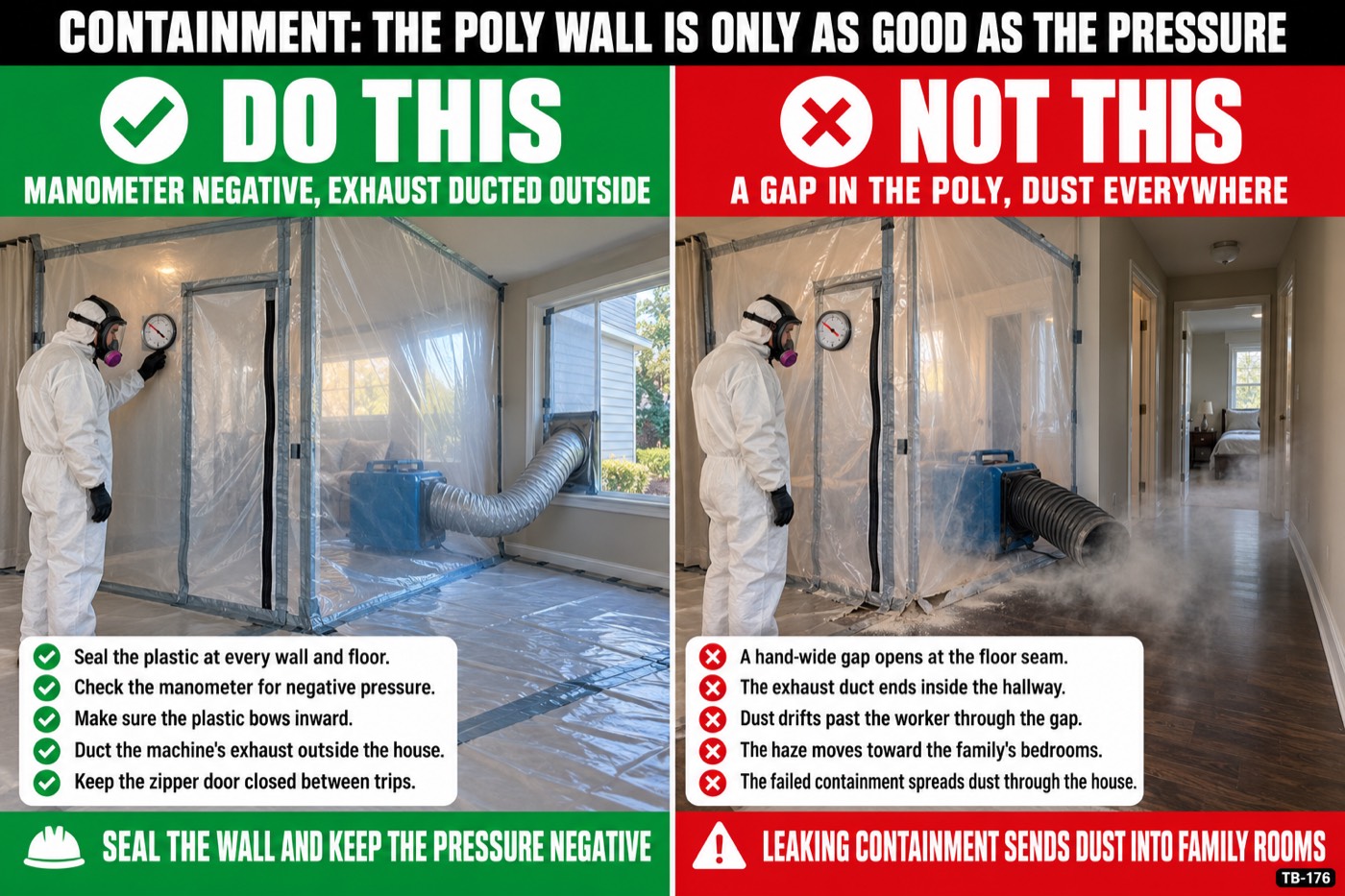
A 6 mil poly wall weighs nothing and stops nothing on its own. What makes it a containment is the fan pulling air through it, and that fan is either running or the whole house is the work area.
The points
- When containment fails, the spores, fibers or lead dust you are making go into the rest of the house, into the ductwork and onto the family's beds. The customer does not see it, and neither do you until the clearance sample fails or a kid gets sick.
- The wall is 6 mil poly, taped and sealed at floor, ceiling and every penetration, with a zipper or flap entry and a decon area for anything that carries fibers. A gap you can slide a hand through is a hole the size of a doorway to the air.
- The negative air machine pulls the room below the pressure of the rest of the house. The asbestos rule sets the number: at least four air changes an hour and at least minus 0.02 inches of water column, read on a manometer, not judged by how the poly is bowing.
- The exhaust goes outside through a HEPA filter, which stops 99.97 percent of particles at 0.3 microns. A machine exhausting into the hallway is a machine spreading the problem faster than you can make it.
- Check the pressure at the start of the shift and any time a door opens or a machine stops. If the manometer reads zero, stop cutting, find the breach, and do not start again until it reads negative.
Why it goes wrong
Negative pressure means air leaks inward, not outward. Every gap in the poly becomes an intake instead of an exhaust, so a small breach is tolerable as long as the fan is winning. When the fan stops, or the breach gets bigger than the fan can handle, the pressure goes to zero and air moves whichever way the house wants, usually toward the return grille and every room on the system.
The numbers come from 29 CFR 1926.1101, the asbestos rule, which is the one standard that spells out a negative pressure enclosure: minus 0.02 inches of water, four air changes an hour, smoke tested for leaks before you start. Mold and lead work borrow the same setup because it is the same physics. Size the machine from the room's cubic feet times four, divided by 60, and add a margin for a dirty filter.
The HEPA filter is the containment's last line. A pre-filter that is never changed loads up, airflow drops, and the machine that pulled 1,000 cubic feet a minute on Monday pulls 400 on Thursday with the same green light on. A machine with a torn gasket or a filter seated crooked blows unfiltered air out the back at full speed.
The common breach is not a tear. It is a door propped open for a hose, a poly seam that let go at the ceiling in the heat, or the HVAC coming on because nobody taped the register and the thermostat hit 78. Tape and seal every supply and return in the work area before the first cut, and shut the system down if the customer will allow it.
Turn off the circuits in a wet containment or make sure everything in it is on a GFCI. Poly, water, and a negative air machine on a 15 amp circuit with a wet vac is a shock and a fire at the same time. Run the machine on its own circuit if the house can give you one.
The decon side matters as much as the wall. Suits come off inside the containment, into a bag, before you cross out. A crew that walks to the truck in the same Tyvek they demoed in has just carried the containment through the living room.
Questions for the crew
- What does the manometer read right now, and who is checking it after lunch?
- Where does the machine exhaust on this job, and how far is that from the neighbor's window?
- If the power trips at 2 o'clock, what do we do first?
To close
Nobody cuts inside that containment today until the manometer reads negative and the exhaust is outside.
To hold this talk with your crew
1
Read it aloud. Five minutes, before the work starts.
2
Ask the questions. A crew that talks is a crew that remembers.
3
Have them sign on their own phones, and the record is sealed.