Respirators: a P100 is worthless without the seal
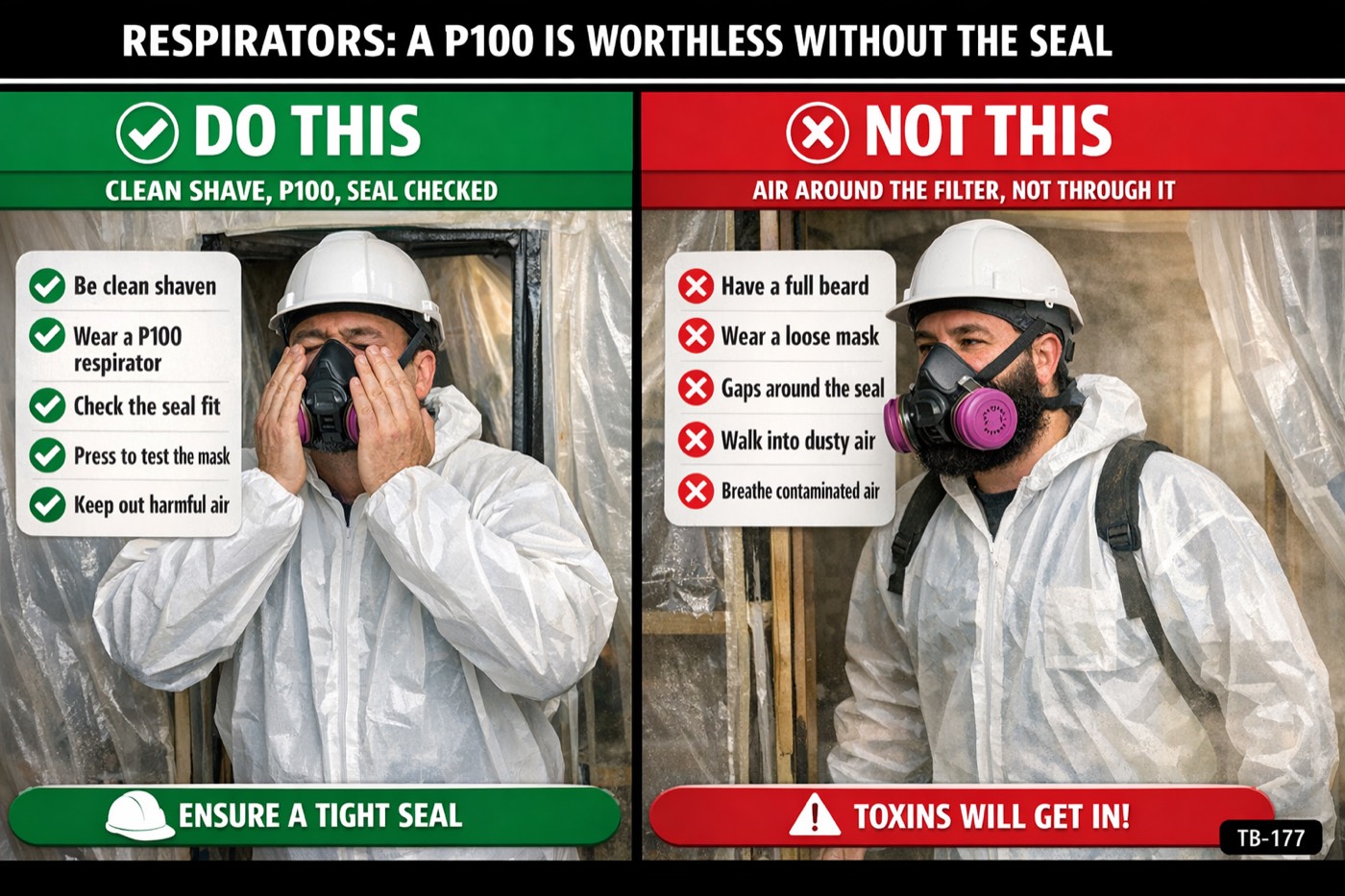
A half-face respirator with P100 filters stops 99.97 percent of what you breathe through the filter. A beard, a bad fit or a cracked valve sends the air around the filter, and then the number on the box means nothing.
The points
- Mold spores, asbestos fibers and lead dust do their damage years out: scarred lungs, cancer, a kid with a learning problem from what came home on your shirt. Nothing hurts today, so the respirator is the only feedback you get.
- For particles, the filter is a P100, the magenta cartridge, on a half-face or full-face respirator. An N95 is not a respirator for asbestos or lead work, and for mold it is the floor, not the ceiling.
- A half-face is rated for 10 times the exposure limit; a full-face for 50; a full-face PAPR for 1,000. Which one you wear depends on what the air sample says, and that is the competent person's call, not comfort.
- Fit test once a year, and before that a medical evaluation says you can breathe through it. Every time you put it on, cover the filters and inhale to check the seal; if it does not suck to your face, fix it before you go in.
- Facial hair between the seal and the skin is not allowed under the rule, and there is no exception for a trimmed beard. Change cartridges on the schedule, not when you smell something, because you cannot smell asbestos or lead.
Why it goes wrong
The assigned protection factors are in 29 CFR 1910.134, which applies to construction as well as general industry. A half mask with an APF of 10 means the air inside is expected to be one tenth of what is outside, if it fits. At 1 fiber per cc outside, that is 0.1 inside, which is exactly the asbestos PEL, so a half-face has no margin on a bad day.
Fit testing is once a year and again any time your face changes: weight up or down 20 pounds, dental work, a scar. The test is a pass or fail with a specific model and size; a Medium from one maker is not the same as a Medium from another. Wear the one you passed on.
A user seal check is every time, not once a shift. Positive pressure: cover the exhalation valve and breathe out; the mask should puff and not leak. Negative pressure: cover the cartridges, breathe in, the mask should pull to your face and stay. Ten seconds, and it catches the cracked valve and the lost gasket.
Cartridges for vapors, the black organic vapor ones you might use for solvents or some antimicrobials, wear out with time and humidity, not just with use. The rule requires a change schedule based on data or the maker's calculator, and the change-out is on the calendar, not on when you notice a smell. P100 particulate filters get changed when breathing gets hard or they are wet or contaminated.
The mask comes off last and gets cleaned. Taking it off inside the containment to talk, then putting it back on with whatever is on your gloves now on the inside of the facepiece, defeats the whole thing. Bag it, wipe it, store it in a clean box, not on the dash.
Anyone who cannot get a seal because of a beard or a face shape wears a loose-fitting PAPR hood, which has no seal to fail. That is the employer's problem to solve with equipment, not the worker's problem to solve with a razor at the truck.
Questions for the crew
- When was your last fit test, and is the mask on your face the model you passed on?
- Who on this crew has a beard today, and what are they wearing inside?
- What is the cartridge change schedule on this job, and where is it written?
To close
Everyone does a seal check at the containment door today, and anyone who cannot get a seal does not go in.
To hold this talk with your crew
1
Read it aloud. Five minutes, before the work starts.
2
Ask the questions. A crew that talks is a crew that remembers.
3
Have them sign on their own phones, and the record is sealed.