Lead abatement: the number in your blood
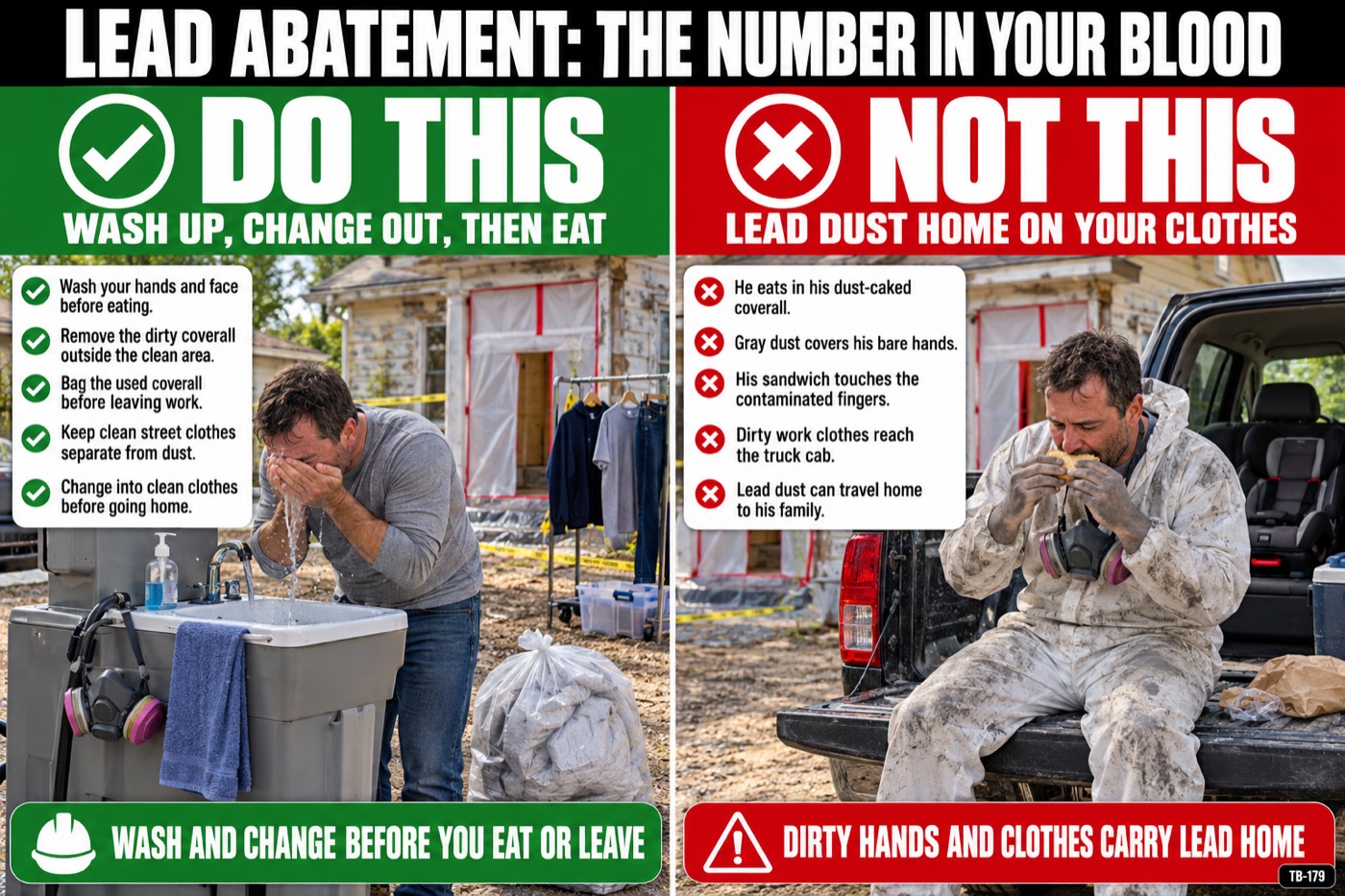
Lead does not leave. What you breathe and swallow on this job goes into your bones and stays for decades, and the only way to know how much is a blood test.
The points
- In an adult, lead means high blood pressure, kidney damage, nerve damage and trouble having children. In a kid under six, the same dust means a lower IQ for life, and the dust gets to the kid on your clothes, your boots and your hands.
- The rule's action level is 30 micrograms per cubic meter of air; the limit is 50. Scraping, sanding, torching or blasting lead paint blows past both, so the rule assumes you are over it until air sampling proves you are not.
- Blood lead gets tested when you start the work and every two months for the first six months, then every six. At 50 micrograms per deciliter, you are pulled off lead work with your pay protected until it comes down.
- No eating, drinking or smoking in the work area, and you wash your hands and face before you do any of those. The employer provides a change area, a shower where it is feasible, and coveralls that get laundered by them, not at your house.
- The dust you take home is the dose your kids get. Work clothes come off before you leave, in a bag, and street clothes go on in a separate place. The rule says separate storage for a reason.
Why it goes wrong
Lead in construction is 29 CFR 1926.62. The action level, 30 micrograms per cubic meter as an 8-hour average, triggers air monitoring, blood testing and training. The PEL, 50, triggers respirators, protective clothing, hygiene facilities and a written compliance program. Until you measure, the rule treats manual scraping and sanding as over 50, power tool cleaning with no dust collection as over 500, and abrasive blasting and torch cutting as over 2,500. The rule lists these assumed exposures for a reason: you are over the limit unless you measure otherwise.
Blood lead is in micrograms per deciliter. Medical removal is at 50, and you come back when two tests in a row are under 40. Under the rule you keep your pay and seniority for up to 18 months while you are off lead work. Public health bodies consider an adult over 5 elevated and over 20 a reason to look at the workplace, so 50 is a late number, not a safe one.
Lead comes in through the mouth as much as the lungs. Dust settles on your hands, you eat a sandwich or handle a cigarette, and the lead goes down with it. Hand and face washing before breaks is in the rule, and a hand wipe in the truck is not a substitute for a wash station on site.
Take-home lead is documented in families of abatement workers, battery workers and painters. Children of those workers have blood lead levels several times higher than their neighbors. Coveralls come off in the dirty area and go in a labeled bag for the laundry service; boots stay on the job; the truck cab is clean-side only.
The respirator for lead dust is a P100 on at least a half-face, and above 500 micrograms per cubic meter it is a full-face or a PAPR. See the respirator talk for fit and facial hair. HEPA vacuum only for cleanup; a shop vac without a HEPA filter is a lead dust blower.
On pre-1978 housing and child-occupied buildings, EPA's rule at 40 CFR 745 adds a certified firm and certified renovator, containment, prohibited practices like open-flame burning and heat guns above 1,100 °F, and a cleaning verification at the end. Abatement proper, meant to eliminate the hazard, needs a state or EPA abatement license on top of that.
Questions for the crew
- When was your last blood lead test, and do you know your number?
- Where is the wash station on this job, and where do the coveralls come off?
- What is the method today, scraping, chemical or blasting, and what respirator does that mean?
To close
Nobody eats, smokes or gets in the truck today without washing hands and face and changing out of the work clothes.
To hold this talk with your crew
1
Read it aloud. Five minutes, before the work starts.
2
Ask the questions. A crew that talks is a crew that remembers.
3
Have them sign on their own phones, and the record is sealed.