Assume every conductor is live
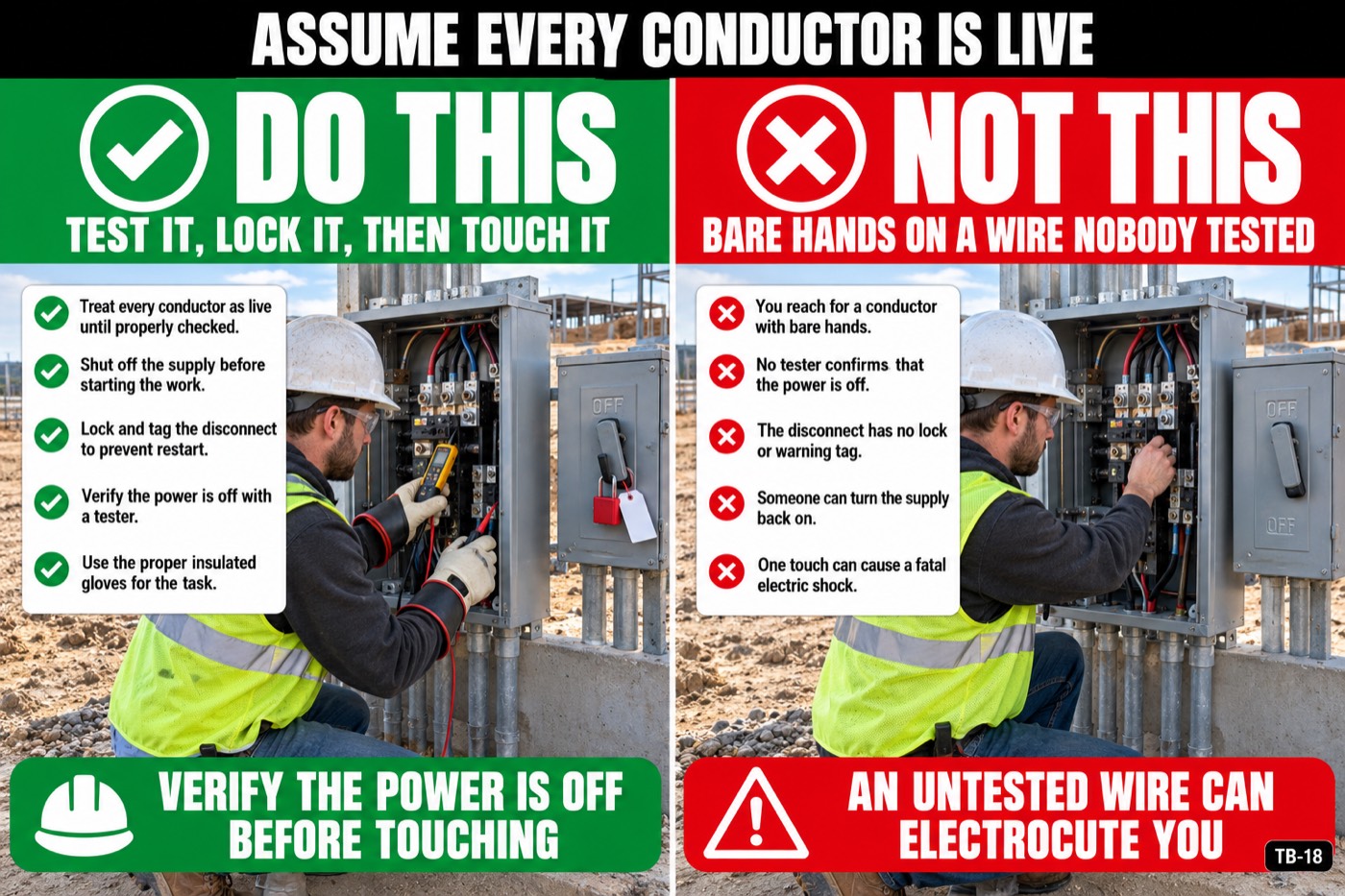
There is no way to look at a wire and know. Every conductor we touch today is live until a meter says otherwise.
The points
- Electricity kills faster than almost anything else on a job site, and it gives no warning.
- Test before you touch. Every time, with a meter you've verified on a known live source.
- De-energize and lock out before working on or near exposed conductors.
- Keep ten feet from overhead lines up to 50 kV, and more above that. That is the distance for people and what they carry; a crane has its own rule: twenty feet unless the utility confirms the voltage.
- Assume every downed line is energized, and keep everyone thirty-five feet back until the utility says otherwise.
Why it goes wrong
It doesn't take much current to kill. Well under an amp across the chest can stop a heart. The severity depends on the path through the body, and hand-to-hand or hand-to-foot both cross the heart.
Arc flash is the other hazard, and it's a different one. An arc flash can reach temperatures several times hotter than the surface of the sun, and the pressure wave can throw a worker across a room. Proper arc-rated PPE matters as much as insulation.
The live-dead-live check exists because meters fail silently. A meter with a dead battery, a broken lead or a wrong setting reads zero on an energized conductor, and zero is exactly the answer you were hoping for. Verifying on a known live source before and after the test is what separates a measurement from a guess.
Overhead lines are where the fatalities concentrate, and the reason is that everything about them is fine until something long moves. Ten feet minimum for lines up to 50 kV, more above that, and the clearance applies to material, ladders, scaffold and gutter as much as to people. The number changes with what is moving: ten feet covers people and what they are carrying, and a crane has to stay twenty feet back unless the utility confirms the voltage and a smaller Table A distance applies.
A downed line is a different situation again. Assume it is energized, keep everyone thirty-five feet back, and understand that the ground itself carries voltage outward from the contact point - which is why the danger extends well past the end of the wire, and why nobody approaches to move it.
Questions for the crew
- What's the voltage on the circuits we're working near today?
- Where's the nearest disconnect, and can you get to it in a hurry?
- When did you last verify your meter on a known live source?
To close
Test it, then test your meter on something you know is live. A dead meter reads dead on everything.
To hold this talk with your crew
1
Read it aloud. Five minutes, before the work starts.
2
Ask the questions. A crew that talks is a crew that remembers.
3
Have them sign on their own phones, and the record is sealed.