Fire damage: the char that holds nothing
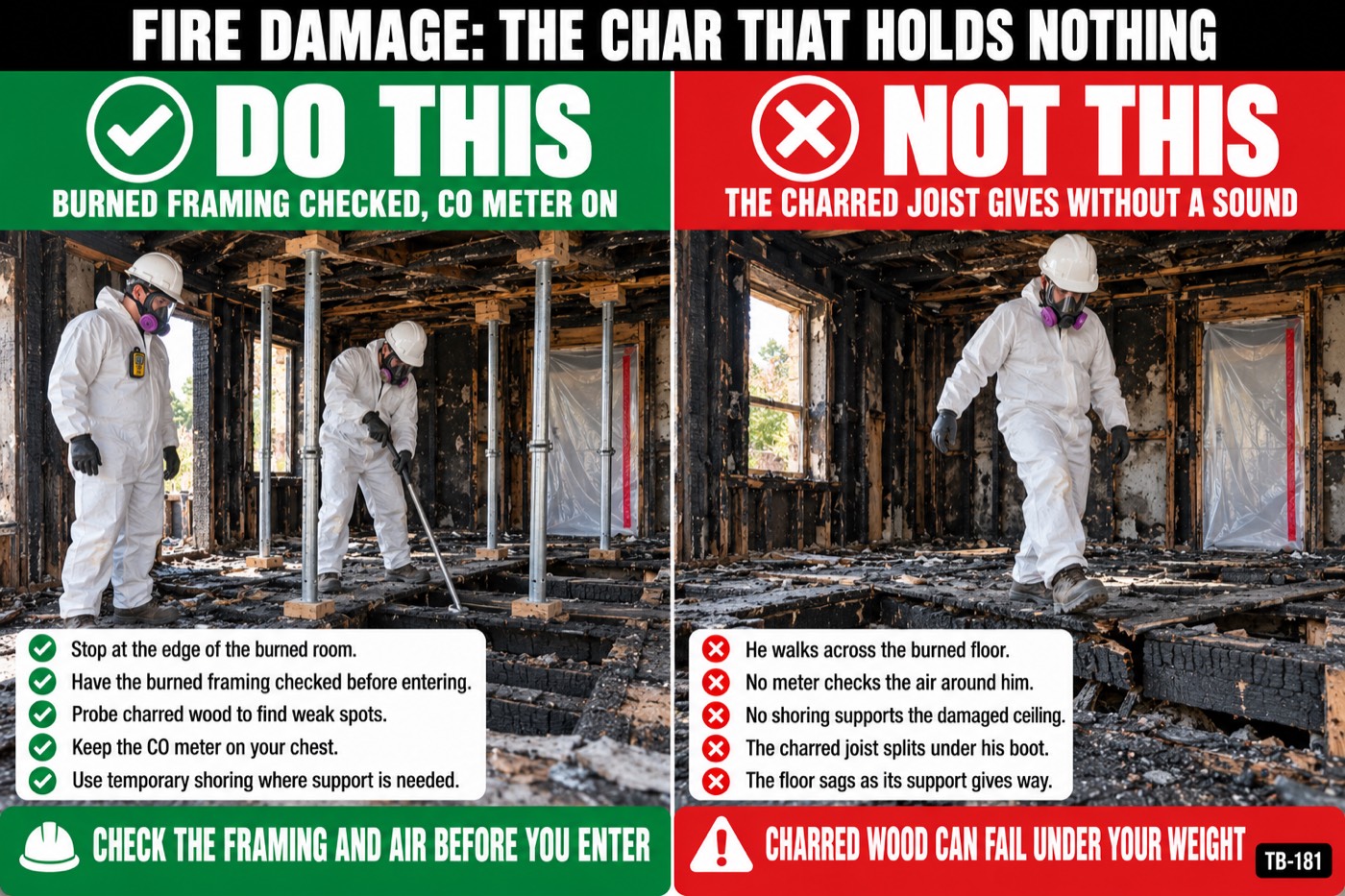
Soot is not dirt. It is the burned remains of plastic, foam, wiring and treated lumber, and the black on your gloves has the same chemicals in it that a pack-a-day smoker breathes.
The points
- A fire job can hurt you three ways: the soot and its cancer-causing PAHs you breathe and rub in, the charred structure that looks like it is holding and is not, and carbon monoxide from a generator running next door.
- Soot particles are under 1 micron and carry polycyclic aromatic hydrocarbons, formaldehyde, hydrogen cyanide residue and heavy metals. Air contaminants in construction are 29 CFR 1926.55: engineering controls first, then a P100, and an organic vapor cartridge if you smell it.
- Charred wood holds nothing. A 2x10 that has burned a half inch deep on three sides is a 1x9 doing the job of a 2x10, and it will fail without a sound. Nothing on a burned floor or under a burned ceiling gets trusted until a competent person has looked at it.
- The electrical was in the fire too. Panels, wiring and the ground can be damaged, the power might have been restored, and a breaker that survived a fire is not proof the wiring did. Nothing gets treated as dead until it is tested dead.
- Carbon monoxide has no smell. A generator in the garage or under a window, yours or the neighbor's, puts a limit of 50 parts per million into your work area in minutes. A CO meter on the crew, and every generator 20 feet from any opening.
Why it goes wrong
Polycyclic aromatic hydrocarbons, PAHs, are the product of incomplete combustion, and several are known carcinogens; benzo[a]pyrene is the one the studies name. Soot goes in through the lungs, but also through skin, and the sweat under a Tyvek suit in July moves it into the skin faster. Wash your hands and forearms before you eat, and do not eat inside the structure.
29 CFR 1926.55 sets exposure limits for gases, vapors, fumes, dusts and mists, and requires engineering or administrative controls before respirators. On a fire job, that is negative air and HEPA scrubbers in the space, then a P100 with an organic vapor combination cartridge. Coal tar pitch volatiles, which is how OSHA lists the soot fraction, have a limit of 0.2 milligrams per cubic meter.
Fire changes the structure in ways you cannot see. Char depth on a joist is easy to measure with a knife; what is harder is the top chord of a truss that got hot enough to lose its gusset plates, the glue in an engineered I-joist that cooked, or a masonry wall that spalled. The demolition rules require a survey by a competent person and shoring of anything damaged by fire before work starts under it.
The chemicals stored in the house are in the mix: the pool chlorine in the garage, the pesticide under the sink, the propane cylinder for the grill. A fire scene that had a chemical release is an unknown atmosphere until you have looked. Ask the customer and the fire department what was stored where.
Carbon monoxide binds to your blood about 200 times more readily than oxygen. At 200 ppm you get a headache in two hours; at 800 you are unconscious in two; at 1,600 you can die in under two hours, and higher kills faster. A portable generator puts out as much CO as several hundred idling cars, and one running on the neighbor's patio drifts through your open window. Carry a meter and clip it to somebody's chest at working height.
Wet fire debris is worse than dry. Firefighting water plus soot plus 48 hours makes mold and a slurry of everything above, and the drywall that held the ceiling now weighs three times what it did. Treat a fire loss that has been sitting wet as a mold job and a water job on top of a fire job.
Questions for the crew
- Has a competent person looked at the framing under where we are working today, and what did they say?
- Is the power to this structure off and tested, and who confirmed it?
- Where is the nearest generator running right now, ours or anyone else's?
To close
Nobody works under or on a burned member today until it has been looked at, and the CO meter is on before the first door opens.
To hold this talk with your crew
1
Read it aloud. Five minutes, before the work starts.
2
Ask the questions. A crew that talks is a crew that remembers.
3
Have them sign on their own phones, and the record is sealed.