Sewage and category 3 water: the cut that gets infected
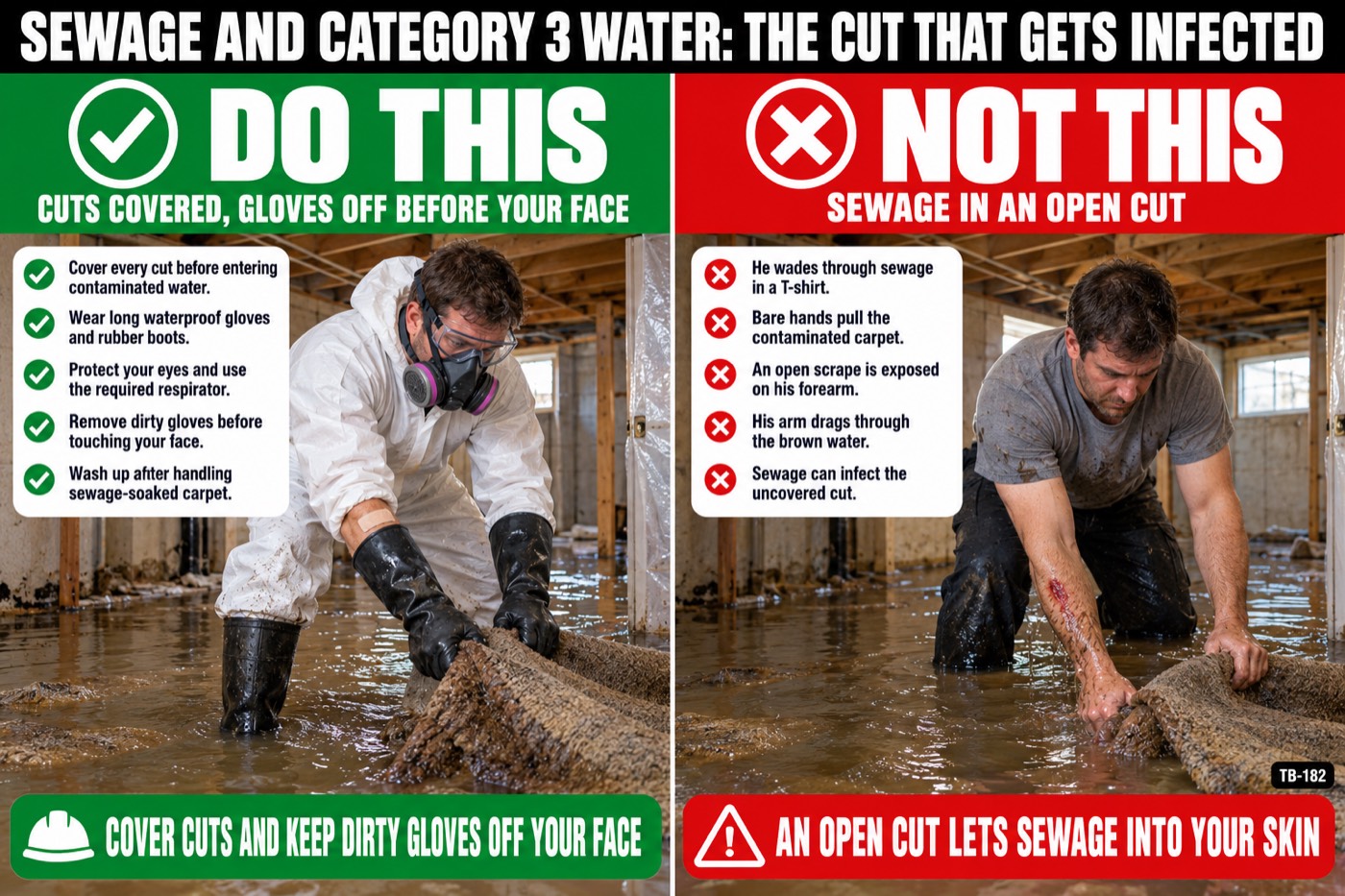
Category 3 water is the industry's name for sewage, floodwater and anything that has sat long enough to grow. It carries hepatitis A, E. coli, tetanus and whatever the household flushed, and it gets in through a cut you got last week.
The points
- Sewage infects through the mouth, the eyes and broken skin. Hepatitis A gives you weeks of liver disease; tetanus locks your jaw and can kill; a cut that went in dirty is swollen and red in a day and in a hospital in three.
- PPE for sewage is in 29 CFR 1926.95, the general PPE rule: waterproof gloves with a nitrile liner, rubber boots, eye protection, a fluid-resistant suit, and a P100 or better respirator when the material is being disturbed or dried.
- Vaccines are cheap and the disease is not. Tetanus is a booster every 10 years; hepatitis A and B are two or three shots and you are done. If you cannot remember your last tetanus, that is a yes to needing one.
- Sewage in the crawl space is a confined space with a bad atmosphere on top of the biology: hydrogen sulfide, methane and no oxygen where the sludge is. See the confined space talk; the entry rule is the same and the gas meter goes in before you do.
- Everything porous that touched category 3 water goes out: carpet, pad, drywall, insulation. What stays gets cleaned, then disinfected with the contact time on the label, then dried. Disinfecting first is spraying on top of the problem.
Why it goes wrong
The IICRC S500 standard puts water in three categories. Category 1 is clean supply water. Category 2 is gray, from a washing machine or a dishwasher. Category 3 is grossly contaminated: sewage backflow, toilet overflow from beyond the trap, and rising floodwater. Water also gets worse with time and heat, so clean water left sitting in a warm house can turn into category 3.
Hepatitis A spreads fecal-oral, so the route is sewage on a glove, glove on a face, and the incubation is two to seven weeks. Leptospirosis comes in rat urine in floodwater. Tetanus is in soil and the bacteria live in sewage-soaked dirt in a crawl space; it enters through a puncture, and the wound can look fine. None of these needs a large dose.
Hands are the exposure. Sewage gloves come off with the clean-glove technique and go in the waste; you wash your hands with soap and running water for 20 seconds before you touch food, a phone, a cigarette or your face. Hand sanitizer does not kill everything in sewage, and a hose out back is not a wash station unless you have soap there.
Cover every cut before the shift with a waterproof dressing and then a glove over that. A cut that got exposed anyway gets washed with soap and water right then, not at the end of the day, and gets reported so it is on the record if it turns. Red streaks up the arm, swelling or fever after sewage exposure is a same-day doctor visit.
The disinfectant is an EPA-registered product with sewage or a specific organism on the label, and the label gives the contact time, usually 10 minutes wet. Bleach at 1 part to 10 works on hard surfaces but is deactivated by dirt, so clean first. Do not mix bleach with anything, especially the ammonia cleaner under the customer's sink; the gas that makes has sent restoration crews to the hospital.
The crawl space with sewage in it is a confined space and probably a permit space: a gas meter for hydrogen sulfide, oxygen and methane before entry and continuously, ventilation, an attendant outside, and a way to get you out that is not a coworker crawling in after you. Pump it down from outside where you can, and let it vent before anybody goes in.
Questions for the crew
- Who on this crew has a tetanus shot inside 10 years, and who does not know?
- Where is the wash station with soap on this job, and where is the doff area?
- Is anyone going into the crawl space today, and what is the meter reading first?
To close
Every cut is covered, every glove comes off before hands touch a face, and nobody eats today without soap and water first.
To hold this talk with your crew
1
Read it aloud. Five minutes, before the work starts.
2
Ask the questions. A crew that talks is a crew that remembers.
3
Have them sign on their own phones, and the record is sealed.