Water extraction: the outlet under four inches of water
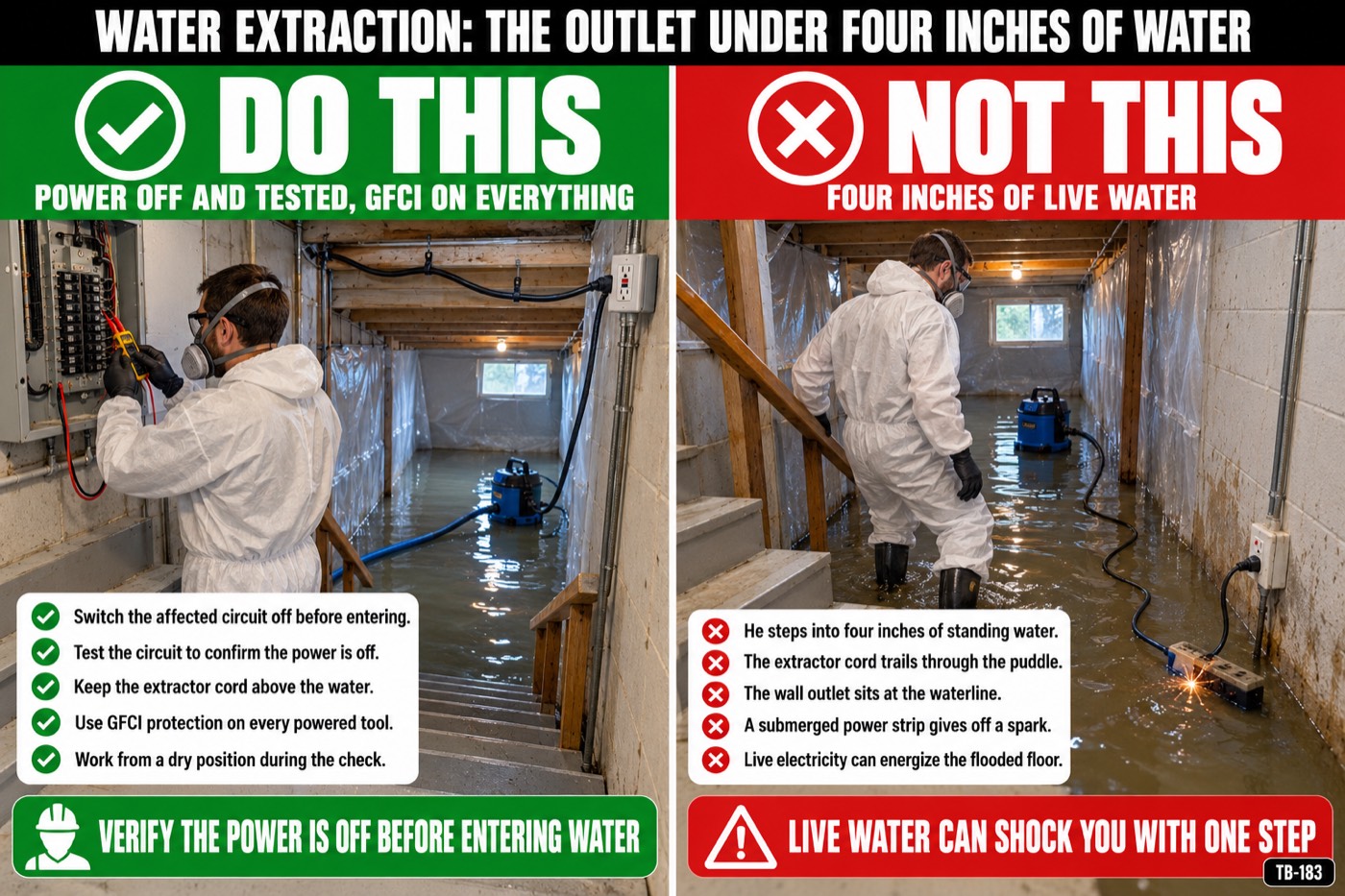
Four inches of water in a basement is deep enough to cover a fallen power strip, the cord to the freezer and the bottom of a low receptacle. Every gallon of it is a conductor.
The points
- Water and 120 volts: a GFCI trips at 5 milliamps, your hand locks on at about 10, and 50 to 100 across the chest stops your heart. Wet skin drops your body's resistance so far that a flooded floor can deliver that without any tool in your hand.
- Before anybody steps into standing water, the power to the flooded area is off at the panel and confirmed with a tester, or the utility has pulled the meter. If the panel is in the water, nobody goes near it; the utility does.
- Every extractor, wet vac, air mover and pump you plug in on that job runs through a GFCI. The construction rule, 29 CFR 1926.404, requires it on any temporary receptacle you use; the house's own outlets do not count as protected unless they say so and you tested them.
- Cords stay out of the water. A wet vac with the cord in the puddle and a damaged jacket makes the puddle live. Run cords overhead or along the dry side, use a cord rated for wet locations, and look at the jacket every time you pick it up.
- The sump and the extractor are electrical equipment sitting in water on purpose. Both are on a GFCI, both are grounded, and you do not reach into a sump pit or a full extractor tank with the plug in.
Why it goes wrong
Wet skin can bring your body's resistance down from 100,000 ohms to around 1,000. At 120 volts and 1,000 ohms, Ohm's law gives 120 milliamps, which is in the range that causes ventricular fibrillation. Nothing about that requires a bare wire; a receptacle under the waterline energizes the water around it and you become the path to the drain.
29 CFR 1926.404(b)(1) gives the employer two choices on construction sites: GFCIs on every 120-volt, 15 and 20 amp receptacle in use that is not part of the permanent wiring, or an assured equipment grounding conductor program with documented testing. For a restoration crew moving between houses every day, the GFCI is the only practical answer. Portable inline GFCIs cost less than a cord and go on every extension cord you own.
The extractor's own GFCI is a start, not the whole answer. A portable extractor drawing 12 amps on a 15 amp house circuit with two air movers already on it trips breakers, and a crew that resets a breaker four times will find an outlet that does not trip, which is often an outlet that is not protected. Map the circuits before you plug in, and run generator power or a separate feed if the house cannot carry the load.
A wet vac full of water is a shock hazard and a lifting injury. Water weighs 8.34 pounds a gallon, so a 16-gallon drum is 130 pounds, and the crew that tips it to carry it up the basement stairs is one slip from a broken wrist. Pump it out or empty it in place with a hose.
Test the GFCI with its own button at the start of every shift and after any trip. A GFCI that has been submerged is done; replace it. Same for any receptacle, switch or panel breaker that went underwater; it does not matter that it dried out and works.
Gas appliances are the other utility in the water. A water heater or furnace whose burner compartment was submerged has controls that may not shut off. Gas off at the appliance before the water goes down, and the customer's plumber or the utility relights it, not the crew.
Questions for the crew
- Is the power to the flooded area off and tested, and who did the test?
- Which outlet is each extractor plugged into, and is there a GFCI between it and the machine?
- Where is the panel in this house, and is it above the waterline?
To close
Nobody steps into the water today until the power is off and tested, and nothing gets plugged in without a GFCI ahead of it.
To hold this talk with your crew
1
Read it aloud. Five minutes, before the work starts.
2
Ask the questions. A crew that talks is a crew that remembers.
3
Have them sign on their own phones, and the record is sealed.