The drying chamber: 90 °F, 40 hoses and a roaring room
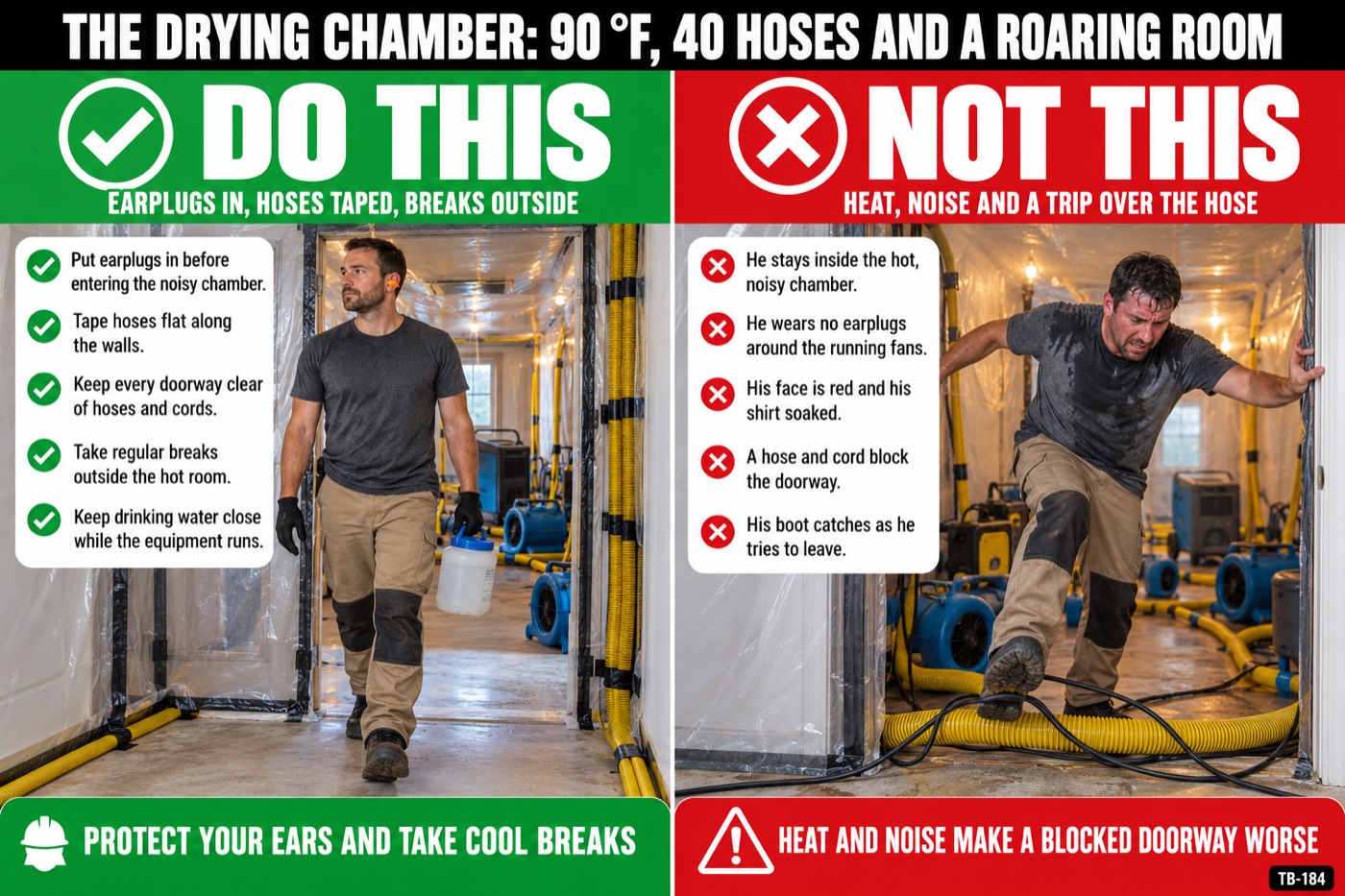
A room closed up with two dehumidifiers and 12 air movers runs at 90 °F and 85 to 90 decibels, and there are 40 hoses and cords on the floor. That is the room you are going to spend the day in.
The points
- The drying chamber is three hazards at once: heat stress, hearing loss and a trip. The heat is what puts you in a hospital, the noise is what you lose slowly, and the trip is the broken wrist on the hose you stepped over 50 times.
- An LGR dehumidifier heats the air it puts out by 15 to 20 °F, and a closed room with two of them running is 90 °F or better. OSHA has no heat number in construction, but your employer's duty to train you on hazards under 29 CFR 1926.21 covers it, and so do the symptoms.
- Heat exhaustion is heavy sweating, headache, nausea, weakness and dizziness. Heat stroke is confusion, no sweat or hot dry skin, and collapse; it kills. Anybody confused in a hot room gets out, gets cooled with water and ice, and gets an ambulance.
- Water before you are thirsty, a cup every 15 to 20 minutes in the chamber, and breaks outside it. Rotate the work in the hot rooms; nobody spends the whole shift in a 90 degree room because the schedule says the job is drying today.
- Air movers at 85 to 90 dBA put the room at the rule's 8-hour limit. Earplugs when you are in there for more than a walk-through. Hoses and cords run along walls, taped down at crossings, and never across a doorway or a stair.
Why it goes wrong
Air movers move air, dehumidifiers pull water out of it, and both put heat into the room from their motors and compressors. The drying goal is often to hold the chamber at 80 to 90 °F because warm air holds more water, so the heat is deliberate. The crew, however, is not part of the drying equation, and every hour in a 90 °F room with a P100 on is heat exposure by design.
Your body cools by sweating and evaporating. A closed chamber at 90 °F with a dehumidifier pulling the humidity down actually helps evaporation, but a suit, a respirator and a sealed room with no breeze push the other way. Heat exhaustion comes from losing fluid and salt; heat stroke is the body's cooling failing, core temperature above 104 °F, and it damages the brain within minutes.
The rule that governs is 29 CFR 1926.21, the training rule: you are told what the hazard is and how to recognize it, and 1926.20 requires the program that acts on it. The practical program is water, shade or a cool room, rest, and a buddy watching for the person who has gone quiet. Acclimatize new hires and anyone back from a week off; most heat deaths are in the first few days.
Air movers run 80 to 90 dBA each at a few feet, and adding units adds noise: two identical sources are 3 dB louder than one. Twelve of them in a hard-surfaced room puts you at or over 90. The rule, 29 CFR 1926.52, allows 8 hours at 90 dBA and 4 hours at 95; a plug or a muff gives you 20 to 30 dB back, so wear them going in, not after a headache.
The 40 hoses are the injury you will actually see. Discharge hoses, condensate lines, cords and ducting on a wet floor, in low light behind the poly. Run them along walls, bridge them at crossings, tape them at doorways, and keep one clear path from the entry to the far wall. The person who trips carrying a dehumidifier down the stairs lands under 100 pounds of machine.
Check on people in the chamber at intervals, not at the end of the day. A worker alone in a hot room with earplugs in cannot hear you and cannot call for help; the drying log check every hour is also the person check. If anyone looks off, out and cool first, questions after.
Questions for the crew
- What is the temperature in the chamber right now, and who is going in and for how long?
- Where is the water, and where does this crew take a break that is cooler than the room?
- Which doorway has hoses across it, and can we route them somewhere else?
To close
Nobody spends more than an hour at a stretch in the chamber today, and every hose across a walkway is taped or bridged before the machines start.
To hold this talk with your crew
1
Read it aloud. Five minutes, before the work starts.
2
Ask the questions. A crew that talks is a crew that remembers.
3
Have them sign on their own phones, and the record is sealed.