Demolition after water and fire: the ceiling that drops
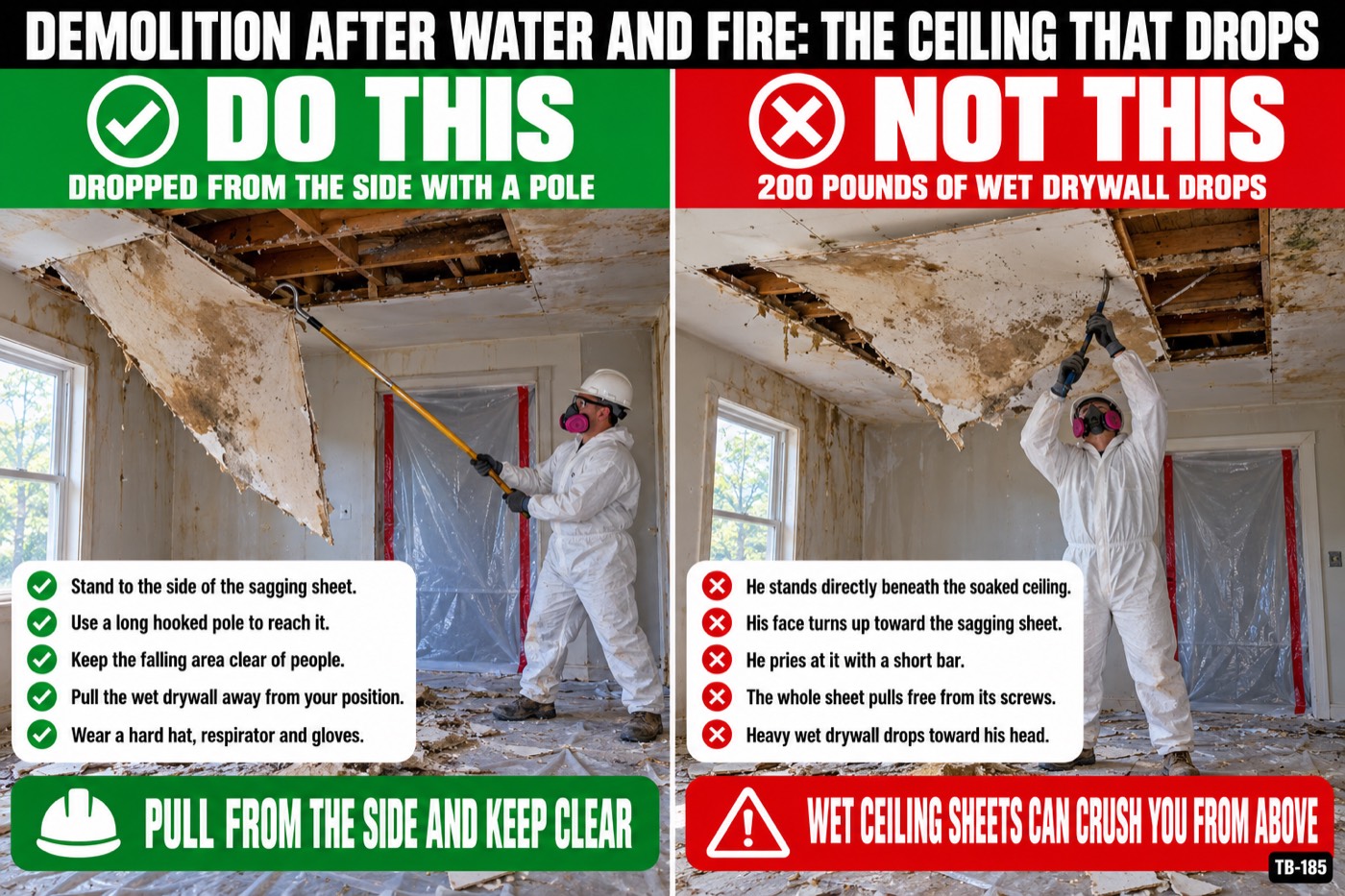
A 4-by-12 sheet of 5/8 drywall weighs about 100 pounds dry. After a week of holding a soaked ceiling and wet blown insulation, it can be twice that, and it lets go from the screws all at once.
The points
- Wet and burned structure fails without warning. The ceiling comes down as one piece on the person under it, the OSB subfloor gives way under a foot, the sagging joist is holding on the nail heads, and the nail through the sole of a boot is the everyday version.
- The demolition rule, 29 CFR 1926.850, requires a survey by a competent person of framing, floors and walls before demolition starts, and shoring or bracing of anything damaged by fire, flood or explosion before anybody works under or on it.
- Wet drywall ceilings get dropped from the side, with a pole, not from below with a pry bar and your face turned up. Pull the insulation from above through a hole if you can, and never stand where the sheet will land.
- Wet OSB subfloor swells, delaminates and loses most of its strength; particleboard underlayment turns to mush. Walk the joists, probe in front of you, and set plywood over anything soft before the crew works there.
- Nails in the debris get pulled or bent and the pile gets cleared as you go. Puncture-resistant insoles, and no carrying debris you cannot see over.
Why it goes wrong
Water adds weight and takes strength. A 5/8 drywall ceiling can absorb its own weight in water; blown cellulose insulation absorbs several times its weight and stays wet for weeks. The screws that held a 100 pound sheet are now holding 200 or 300 pounds in paper that has lost its strength, and gypsum gives no warning between holding and not.
Fire-damaged framing is measured by char depth and by what is left. Charred wood has essentially no strength, so a joist that has burned three-quarters of an inch on three sides is calculated on what is left inside. Truss gusset plates loosen as the wood shrinks; engineered lumber and I-joists with adhesive can lose the glue line at temperatures that leave the surface looking fine.
The rule at 29 CFR 1926.850 is for demolition, and a restoration tear-out is demolition. The competent person surveys the framing, floors and walls and writes it down, utilities are shut off, capped or controlled, and any part weakened by fire or flood is shored before work goes under it. Working from below a sagging ceiling to see whether it will hold is not a survey.
The ceiling drop technique: score the seams from the side, get everyone out of the drop zone, and bring it down with a pole or a hook from the edge, working toward the exit. Eye protection and a respirator are on because the sheet brings the insulation and whatever grew in it down with it. Face up under a pry bar is how people get a jaw broken and an eye full of wet cellulose.
Subfloor failure is the fall through. A foot goes through a soft spot, the leg goes to the hip, and the edge of the hole opens the thigh. If the joists are 16 on center you can walk them; if you cannot see them, lay a sheet of 3/4 plywood and work off it. Same rule in the attic, where the drywall between joists holds nothing.
Nails and screws in demo debris go through boot soles and through gloves. Pull or bend them as the material comes down, stack material with fasteners facing in, and keep the walking path clear; a nail puncture through a boot that touched category 3 water is a tetanus and infection case the same day.
Questions for the crew
- Who surveyed the framing on this job and where is it written down?
- Which ceiling is coming down today, and where does the crew stand when it drops?
- Where is the floor soft in this house, and what is covering it?
To close
Nobody stands under a wet ceiling or on an unseen subfloor today until the competent person has looked at it and said so.
To hold this talk with your crew
1
Read it aloud. Five minutes, before the work starts.
2
Ask the questions. A crew that talks is a crew that remembers.
3
Have them sign on their own phones, and the record is sealed.