Drilling mud: slick ground and the frac-out in the creek
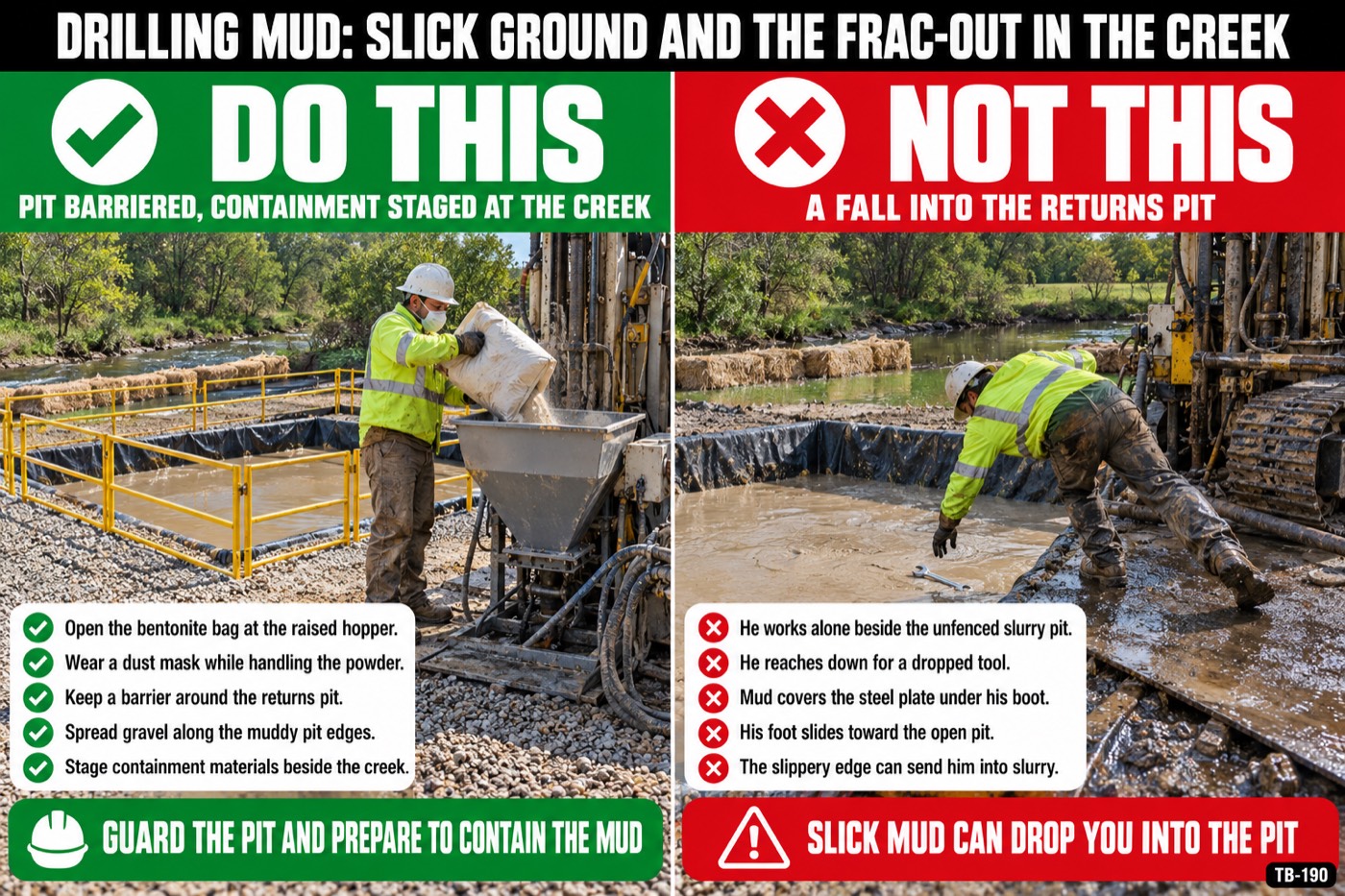
Bentonite is clay that swells to about ten times its size in water. On a steel plate, a rig deck or a slope it is slicker than ice, and a returns pit full of it holds your legs like wet concrete.
The points
- Drilling fluid is the slip hazard on this job. It coats the rig deck, the pit edges, the plates and your boots, and the fall that ends the day is onto a rod rack, into the returns pit or under the carriage.
- Mixing means 50-pound bags lifted to the hopper, dust you breathe, and a mud pump that pushes fluid down the stem at pressures that can top 1,000 PSI. Cut bags at the hopper with the pallet raised, wear the dust mask, and never open a mud line or a swivel under pressure.
- The returns pit at entry and exit is a hole full of slurry, often 3 to 4 feet deep. It gets a barrier, the edges get gravel or sand, and nobody reaches into it for a dropped tool or works at its edge alone.
- A frac-out is fluid finding a crack and coming up where you did not send it: a yard, a road, a creek. In water it smothers whatever lives on the bottom, and it is a reportable spill. The pump stops the moment anyone sees it.
- Contain it with what is already staged at the crossing: hay bales, silt fence, a vac truck on call. The bore does not restart until the fluid is contained and the foreman has made the call the permit requires.
Why it goes wrong
Bentonite hydrates into a gel with almost no friction, and the polymer additives make it worse. Hose the deck, the steps and the plates down through the day, put sand or gravel on the ground you walk on around the pits, and scrape your boots before you climb onto the rig. Housekeeping around a bore rig is fall prevention.
Bentonite dust carries some crystalline silica, and the mixing station is where you breathe it. Cut bags low in the hopper, not from shoulder height, and wear at least an N95. The lifting is the other half: 50 pounds, forty times a shift, from a pallet on the ground. Set the pallet at hopper height.
The mud pump on a mid-size rig can run 1,000 PSI or more and the line from the mixer to the rig, the swivel and the head are all under it. A coupling that lets go whips, and a hand on a fitting when the pump kicks in loses skin. The high-pressure hose talk covers couplings; the same rules hold here.
The returns pit is an entrapment. Slurry weighs about 9 pounds a gallon and gives no footing; a person who slides in cannot push off the bottom. Pump the pit down as it fills, keep a barrier around it, and never send anyone in to clear the suction hose. Off-loading the slurry from the truck has its own talk.
Frac-outs happen where the cover is shallow, the ground is fractured or the pump pressure is too high for the depth: under the road edge, at a creek crossing with 3 or 4 feet of cover. Do not push through it. Stop the pump, have the tracker walk the path looking for more, and get the containment down before the fluid reaches the water. A frac-out into a creek is reported to the state, and most permits require it in writing.
Returns never go into a storm drain or a ditch. They go to the mud tank or the vac truck and to the disposal site on the permit. The crew that dumps a tank behind the pit at the end of the day has turned a slip hazard into a spill that the neighbor photographs.
Questions for the crew
- Where does the bore cross water or a storm drain today, and what is staged there to contain a frac-out?
- Who is watching the ground over the bore path for fluid surfacing, and how do they stop the pump?
- Which surfaces around the rig and pits are already slick, and what do we put down before we start?
To close
Today the pits get a barrier, the containment is staged at the water crossing before the head goes under it, and the pump stops the second fluid shows where it should not.
To hold this talk with your crew
1
Read it aloud. Five minutes, before the work starts.
2
Ask the questions. A crew that talks is a crew that remembers.
3
Have them sign on their own phones, and the record is sealed.