Tracking the bore: eyes down, your back to traffic
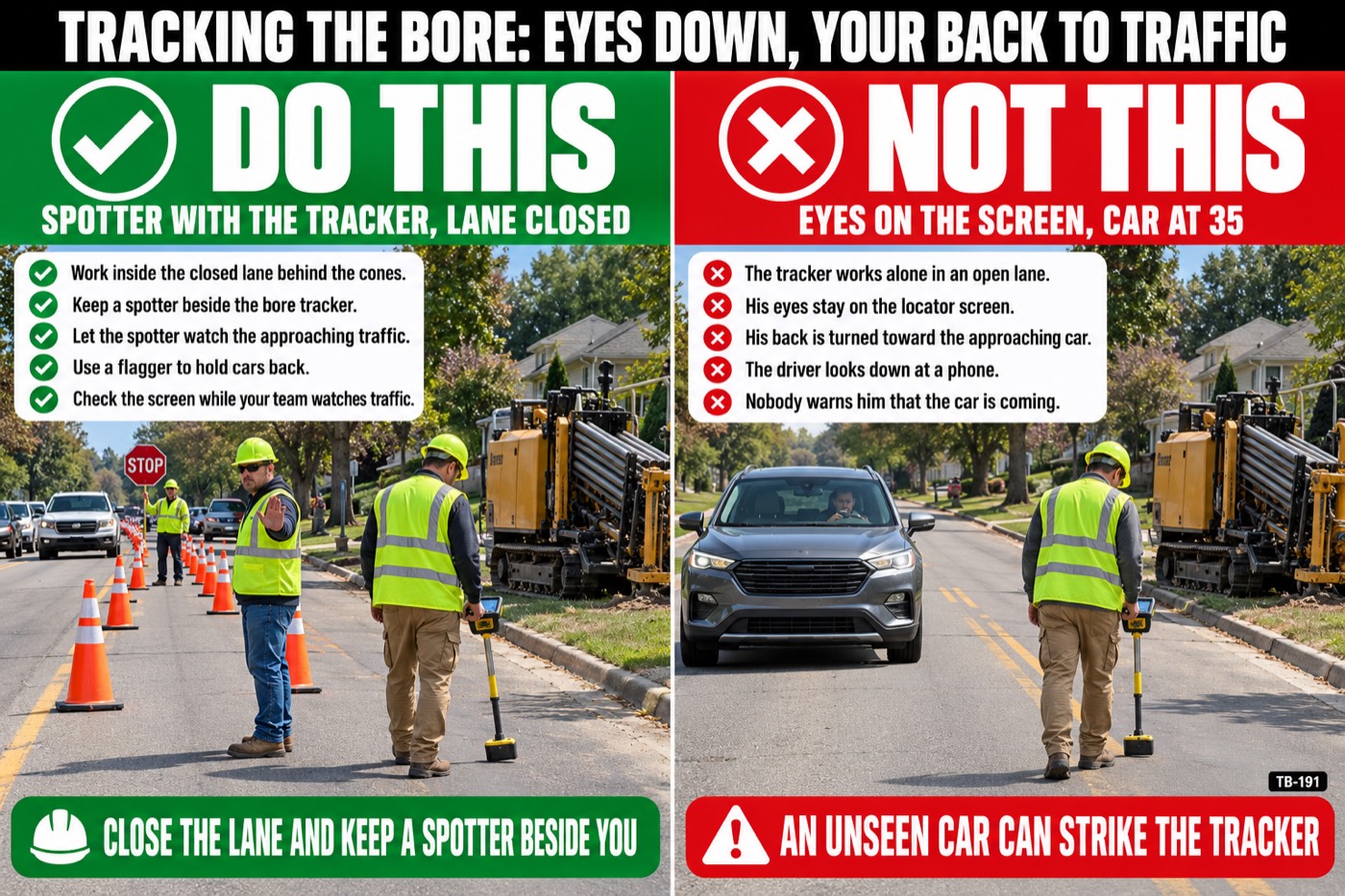
The tracker walks the bore path with the locator screen at knee height, reading depth and pitch. Half the time that path is a road, and a car at 35 mph covers about 50 feet every second.
The points
- The tracker is the most exposed person on a bore crew: in the road, eyes on a screen, ears full of the rig, walking backwards over a curb. Trackers get hit by cars and step into open pits because everything they are watching is underground.
- Anyone exposed to public traffic wears high-visibility clothing. That is a Class 2 vest at minimum, Class 3 at night, on the tracker and on the spotter, all day, not only when the flagger shows up.
- The tracker does not cross or stand in a live lane without traffic control: a closed lane, cones, or a flagger who is watching the traffic so the tracker does not have to. The tracker is never the flagger.
- A spotter walks with the tracker whenever the path crosses pavement. The spotter's job is the cars and the ground, not the locator screen, and the spotter has the right to pull the tracker back.
- The tracker calls the drill head as it approaches the exit pit and steps off the path. Nobody stands over the pit or over the head when it breaks out, and the tracker stays 10 feet off the entry pit while the stem turns.
Why it goes wrong
The walkover locator reads the sonde in the drill head, and the tracker's whole attention is on the display: depth, pitch, roll, and the head's position relative to the path. Hearing protection plus rig noise takes away the sound of a truck. Eyes down means the tracker does not see the pickup backing on the shoulder, the open manhole or the dog that just came off the porch.
29 CFR 1926.651(d) says employees exposed to public vehicular traffic wear warning vests or other garments made of reflectorized or high-visibility material. On a road that means ANSI 107 Class 2 in daylight and Class 3 after dark, with the retroreflective stripes on the arms and legs where headlights hit first. A vest under a jacket is no vest.
Traffic control follows Part 6 of the MUTCD. Crossing a two-lane road with the tracker needs at least a flagger and advance signs; a longer run down the shoulder needs a taper and cones. The lane closure talk covers the setup. The point here is that the tracker does not step into the lane until it is set.
The ground on the bore path is its own hazard: the entry pit with the stem turning in it, the exit pit, curbs, culverts, yards with sprinklers and dogs. The tracker plans the walk before the head is moving, and does not walk backwards across anything they have not walked forwards first.
When the locator loses the signal, the tracker wanders to reacquire it, and the wandering goes toward the road. Stop the drill. The head is not going anywhere while the crew sorts out interference, and chasing a signal into traffic has killed trackers.
Questions for the crew
- Where does today's bore path cross pavement, and who is watching traffic for the tracker at each crossing?
- Who is spotting for the tracker today, and do they understand that they are not reading the locator?
- What is on the ground along this path that the tracker cannot see while looking at the screen?
To close
Today the tracker does not step into a lane without a spotter and traffic control, and calls the head before it reaches the exit pit.
To hold this talk with your crew
1
Read it aloud. Five minutes, before the work starts.
2
Ask the questions. A crew that talks is a crew that remembers.
3
Have them sign on their own phones, and the record is sealed.