Live gas main: the smell, the meter and the block
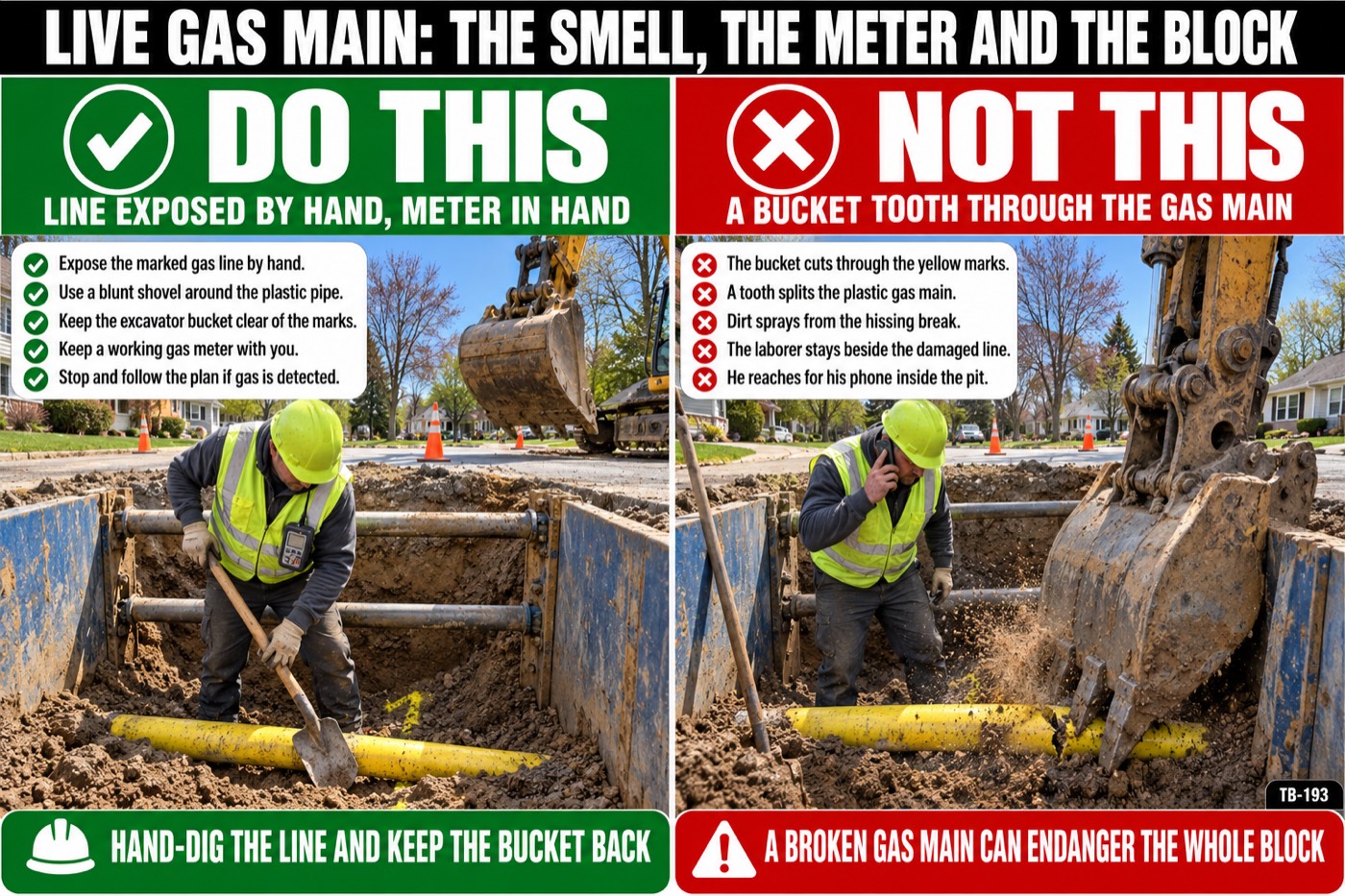
Natural gas burns at anywhere from 5 to 15 percent in air. Below that it is a leak; above that it is waiting for air. A basement, a sewer or a trench gets to the right mix without anyone deciding to make it dangerous.
The points
- A struck gas main does not usually kill at the trench. It kills when the gas follows a sewer, a duct or the backfill into a house and finds a pilot light, or when someone in the trench starts a saw, a truck or a phone.
- Before any bucket goes near a marked gas line, the exact location is exposed by hand or vac and seen. The rule says the estimated location is found before digging and the exact location before the bucket gets there. The marks are not the pipe.
- If you smell it, hear it or the meter reads, everything stops. No engines started or shut off, no phones, no lights, nothing that sparks. Move upwind, and take the meter reading from a distance.
- Call 911 and the gas company from clear ground. If the leak is not yours, you still call. Nobody squeezes off, plugs, kinks or covers a live leak; the gas company does that with their tools and their people.
- A leaking main gets the block evacuated, not just the trench. Gas migrates 100 feet or more underground, and the house next door has a water heater in the basement.
Why it goes wrong
Mercaptan is added so leaks smell, and a small leak in open air disperses. The danger is gas that is confined: in the trench itself, in a sewer lateral, in a conduit, in the gravel under a slab. 29 CFR 1926.651(g) says the air gets tested in an excavation over 4 feet deep where a hazardous atmosphere could reasonably be expected, and near gas that is always. A four-gas meter reads percent of the lower explosive limit; 10 percent LEL is the stop.
Plastic gas pipe cuts with a shovel, and a nicked PE service can leak weeks after backfill. Every contact gets reported to the gas company, even a scratch in the coating on steel, even one that is not leaking. 49 CFR 196.107 says the excavator who damages a pipeline reports it to the operator right away, and 196.109 says that if gas is escaping, you call 911 too. 811 and the gas company's number are how you tell them.
Squeeze-off on PE pipe is done by the gas company or a crew qualified to do it, with a tool made for it, and even then it can build static. Never try to bend the pipe closed, crimp it with a bucket, clamp it with locking pliers or stuff a rag in it. A static discharge off PE pipe in a gas cloud is the ignition.
Ignition sources on a utility job are everywhere: the rig, trucks idling, the saw, the generator, the compressor, a steel tool on a rock, a phone, a flashlight switched on. Inside the cloud you touch none of it, on or off. You walk out upwind and deal with equipment from outside.
A broken main sounds like a jet and can be heard a block away. That is at least a 330-foot evacuation, and the fire department sets the zone. Count the crew at the meeting point, nobody goes back for tools, and the neighbors are knocked out of their houses, not told from the sidewalk.
Sometimes you smell gas before you have touched anything: an old leak you happened to dig next to. Report it anyway, the same call. And once a gas line is exposed in your trench, 29 CFR 1926.651(b) says it is protected and supported while the trench is open. A service hung off a 2x4 sags, and it fails after backfill, at night, with people asleep above it.
Questions for the crew
- Where are the gas lines on this job today, which of them have been exposed by hand, and which are still only paint?
- If the meter reads at the trench right now, what stays exactly as it is, who calls, and where do we meet?
- What on this site could light gas: engines, phones, the generator, the saw, the rig?
To close
Today no bucket goes inside the tolerance zone of a gas mark until the line is exposed by hand and seen, and any smell or reading stops the job and gets the call made from clear ground.
To hold this talk with your crew
1
Read it aloud. Five minutes, before the work starts.
2
Ask the questions. A crew that talks is a crew that remembers.
3
Have them sign on their own phones, and the record is sealed.