Gutter machine: the rollers do not stop for a finger
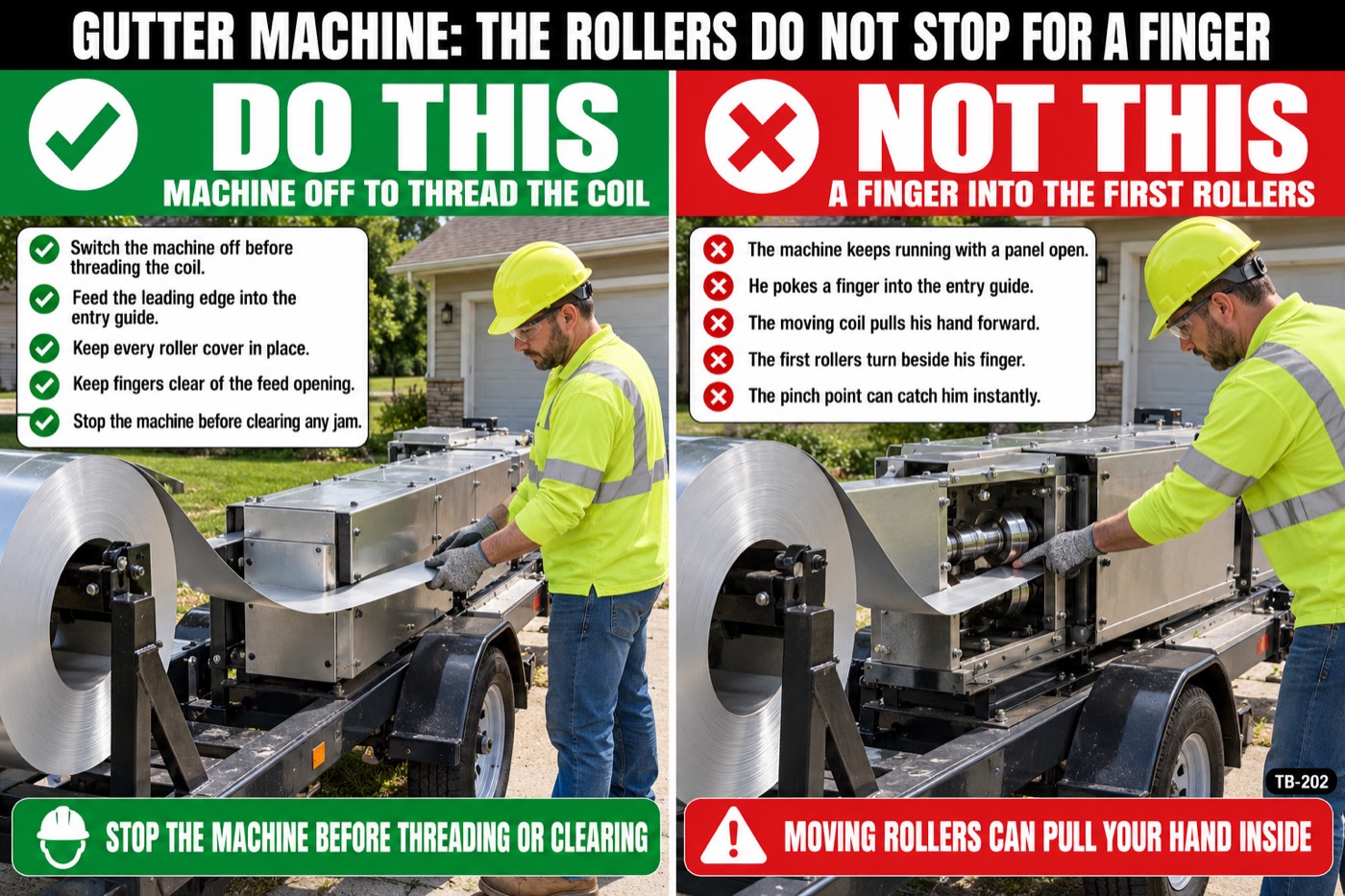
The forming rollers in a gutter machine are steel, they run in pairs, and they pull the metal through at about 40 feet a minute. They cannot tell a finger from a coil edge.
The points
- A hand in the entry guide of a running machine goes into the first pair of rollers before you can pull it back. A finger comes out flat, and that is the good outcome.
- The rule says moving and rotating parts that can be reached get guarded. The covers on the roller sections stay on, and nobody runs the machine with a panel open to watch it.
- Thread the coil with the machine off. Feed the leading edge to the first roller by hand, then step back and jog it. Nothing gets pushed, poked or cleared with a finger while the motor is live.
- The coil edge is a blade the whole length of the coil, and a coil weighs 100 pounds or more. Two people load it onto the spool, cut gloves on, and the spool gets pinned before anyone lets go.
- A 60-foot run coming off the machine takes a person at the exit and a person at the far end, and a third in the middle when it is windy. Nobody stands past the far end where it will fold and come down.
Why it goes wrong
A gutter machine is a rolling mill on a trailer. Ten or more pairs of hardened rollers fold flat coil into a K profile, and each pair is a nip point: the rollers turn toward each other, and anything that touches the gap gets drawn in. There is no clutch that senses skin. The rule calls these ingoing nip points and they are exactly what the machine guarding requirement is written for.
The entry guide is where hands go. Coil that walks sideways, a burr on the leading edge, a jam at the first roller, and the reflex is to reach in and straighten it. The reverse and jog controls exist so that never happens. Machine off, clear the jam, hands out, then jog.
The cutoff shear at the exit is a guillotine. It cuts 0.032 aluminum with a lever or a hydraulic ram, and it will cut a hand the same way. Nobody puts a hand in the shear throat, and the run is held below the shear, never at it.
The trailer itself hurts people. It gets chocked, the tongue jack goes on a pad not on the lawn, and the machine is leveled before the coil is loaded. A coil spool that is not pinned lets 100 pounds of aluminum unroll, and the edge goes across whatever is in the way.
Long runs move. Sixty feet of gutter has almost no stiffness across the profile, so it whips in a gust and it kinks if it folds. In wind the run comes off in two shorter pieces or waits. The person at the far end walks it back, they do not stand under it, and nobody carries a live run across a road or under the service drop.
Eye protection and cut gloves at the machine, every time. Aluminum shavings come off the shear and the rollers, and the trimmed end of every gutter is sharp enough to open a forearm. Long sleeves are cheap.
Questions for the crew
- Who is running the machine today, and who is on the far end of the long runs?
- Where is the trailer sitting, is it chocked, and is the tongue jack on something solid?
- What do you do if the coil jams at the first roller?
To close
Nobody puts a hand past the entry guide today unless the machine is off and the jog button is under their own thumb.
To hold this talk with your crew
1
Read it aloud. Five minutes, before the work starts.
2
Ask the questions. A crew that talks is a crew that remembers.
3
Have them sign on their own phones, and the record is sealed.